
As 2026 gains momentum, Dusk Foundation has clearly moved beyond the experimental phase that once defined many privacy focused blockchain projects. What was previously viewed as academic cryptography and theoretical research has now transformed into a functioning Layer 1 ecosystem tailored for regulated institutions that require confidentiality without breaking compliance rules. The shift feels measured rather than promotional. Instead of chasing headlines, Dusk has focused on delivering working systems that financial entities can actually deploy. The launch of DuskEVM on mainnet and the structured collaboration with NPEX highlight a transition from conceptual frameworks to real operational finance built around privacy-first design.
One of the most notable aspects of Dusk’s evolution is the deliberate pacing behind its development. Rather than pushing unfinished tools into the market, the project spent years refining zero-knowledge infrastructure before introducing production-ready solutions for tokenized assets, confidential settlements, and private trading environments. The broader ecosystem now reflects that patience. With core components like DuskEVM, DuskTrade, institutional privacy modules, expanding developer participation, and alignment with European regulatory frameworks, Dusk is shaping a platform that merges technical depth with practical usability.
DuskEVM Introduces Confidentiality to Established Solidity Development
The activation of DuskEVM in early 2026 marked a defining milestone for the network. Solidity developers can now deploy contracts on Dusk while benefiting from built-in zero-knowledge privacy, eliminating one of the largest barriers to confidential application development. Ethereum-based codebases do not require full rewrites or migration to unfamiliar programming models. Sensitive data such as balances, internal states, and transactional logic remain shielded through PLONK-based proofs, while developers continue working in an environment that closely mirrors traditional EVM workflows.
This compatibility changes how privacy chains are perceived. Historically, developers faced steep learning curves or performance tradeoffs when building confidential applications. With DuskEVM, validators execute both transparent and shielded logic within the same framework, supported by attestation improvements that enable rapid finality and efficient throughput. Early deployments, including private payment tools and confidential lending solutions, demonstrate the network’s practical use cases. Traders gain protection against strategy exposure and MEV exploitation while maintaining regulatory compliance through Citadel-based attestations. The accessibility of this approach invites a broader developer audience into privacy-preserving finance without sacrificing familiar tooling.
DuskTrade Moves Tokenized Securities Into Active Markets
Another central development is DuskTrade, expected to expand through 2026 in collaboration with NPEX, a regulated Dutch multilateral trading facility. This partnership is focused on bringing hundreds of millions of euros worth of SME securities onto blockchain infrastructure, covering equity shares, bonds, and venture investment instruments. Instead of existing as static token representations, these assets are designed to function within live trading environments governed by embedded compliance logic.
Smart contracts enforce investor eligibility, transfer conditions, and lockup rules automatically, allowing market participation without public exposure of personal identity. Selective disclosure ensures that only required regulatory information is shared, preserving privacy while maintaining oversight. Settlement flows utilize EURQ, a euro-denominated stablecoin aligned with MiCA standards, enabling continuous clearing without reliance on legacy central securities infrastructures. With shielded oracle feeds preserving confidentiality even at the market data level, DuskTrade presents a framework where regulated DeFi operates with both transparency and discretion. If projected trading volumes are achieved, it could represent one of the clearest demonstrations of tokenized finance functioning at meaningful scale.
Institutional Privacy Tools Expand Beyond Trading Platforms
Dusk’s roadmap extends further through specialized institutional solutions designed for advanced financial workflows. Hedger introduces an auditable mixing mechanism that encrypts transaction patterns while maintaining regulatory verifiability through temporary viewing permissions. This helps protect large trading strategies from front-running and order leakage while preserving auditability for compliance purposes. Additional tools such as Hyperstaking offer optimized staking structures for custodial entities, while Dusk Vault leverages multiparty computation to secure tokenized asset portfolios.
Shelter’s updated infrastructure handles off-chain processing and scalable data availability, enabling enterprise-level throughput without burdening the base layer. Together, these features address a key challenge within traditional finance: maintaining confidentiality without abandoning oversight. By combining encryption with verifiable proofs, Dusk is attempting to bridge a long-standing gap between institutional expectations and blockchain transparency models.
Developer Momentum Accelerates as Infrastructure Matures
With a stable privacy enabled EVM environment now live, developer activity on Dusk has begun expanding more rapidly. Teams are building privacy-enhanced decentralized exchanges, confidential derivatives platforms, and real-world asset yield systems that rely on shielded liquidity and hidden position structures. Grant programs, SDK resources, and hackathon initiatives have encouraged experimentation across identity verification tools and confidential data aggregation solutions.
On-chain activity suggests growing adoption. Value locked within the network continues to climb, daily active users show steady increases, and the volume of shielded transactions is expanding as institutional onboarding progresses. Validator participation remains accessible, promoting decentralization while maintaining strong staking engagement. With token emissions gradually decreasing, ecosystem growth appears increasingly driven by practical utility rather than inflationary incentives.
Economic Signals Reflect Infrastructure Driven Growth
Market reactions often trail technological progress, but in Dusk’s case, economic indicators are beginning to align with real network usage. The DUSK token has shown renewed strength tied more closely to its role in tokenized asset issuance, settlement processes, and privacy services rather than speculative cycles alone. Derivatives activity suggests rising confidence, while fee-based token burns introduce elements of deflationary pressure as network utilization grows.
The Dusk Network Development Fund continues supporting bridges, proving infrastructure, and ecosystem expansion, reinforcing a cycle where increased adoption fuels further innovation. Exchange-level staking initiatives indicate broader industry recognition that Dusk is transitioning from a niche privacy experiment into a foundational component of regulated decentralized finance.
Europe Provides Structure While Global Expansion Continues
Regulatory clarity within Europe has acted as an accelerator rather than a limitation for Dusk’s strategy. By aligning early with MiCA guidelines, the network has positioned itself as an attractive environment for compliant tokenized assets and institutional deployments. Cross-chain bridges and collaborations with European financial institutions for settlement pilots extend this reach further. Meanwhile, exploratory initiatives in Asia and preparatory groundwork for eventual U.S. expansion highlight a broader global ambition even as Europe remains the initial operational anchor.
Challenges and Competitive Landscape
Despite strong progress, Dusk faces the same uncertainties that confront any emerging infrastructure project. Sustained developer adoption remains critical, and regulatory conditions can evolve unpredictably. However, its competitive position has become more defined. Compared with general-purpose chains hosting tokenized assets, Dusk integrates native privacy at the protocol level. Compared with privacy-only networks, it provides full smart-contract programmability and compliance focused tooling. A track record of consistent uptime and the absence of major exploits further reinforce perceptions of maturity.
Closing Perspective
As the blockchain industry advances into 2026, Dusk Foundation appears to be transitioning from theoretical promise into functional infrastructure. Confidential contracts are operating, tokenized securities are approaching real market liquidity, and institutions are experimenting with privacy-preserving workflows that maintain regulatory transparency. In an ecosystem often dominated by hype cycles, this steady execution stands out. If Europe continues its trajectory toward large scale asset tokenization, platforms capable of balancing confidentiality with compliance will play a defining role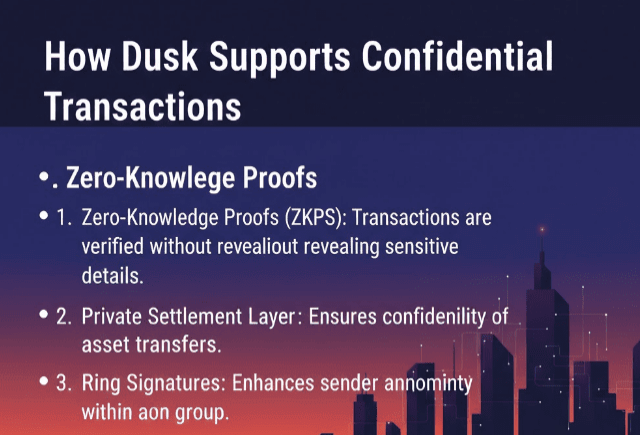 . Dusk’s progress suggests it may not only participate in that transformation but actively help shape how regulated decentralized finance evolves in the years ahead.