
I usually assess blockchain technology based on how effectively it captures the regulatory and operational reality of capital markets. In my opinion, Dusk is one of the few networks that was purposefully created with tokenized security as the main use case rather than as an add-on to a general-purpose system.
According to my understanding, the network's architecture recognizes a fundamental limitation: securities markets function inside precisely defined regulatory parameters. Although tokenization may increase efficiency, it does not eliminate the responsibilities for compliance, reporting, and investor protection. Infrastructure that plans to host tokenized instruments must therefore be able to meet these specifications without sacrificing the integrity of the market.
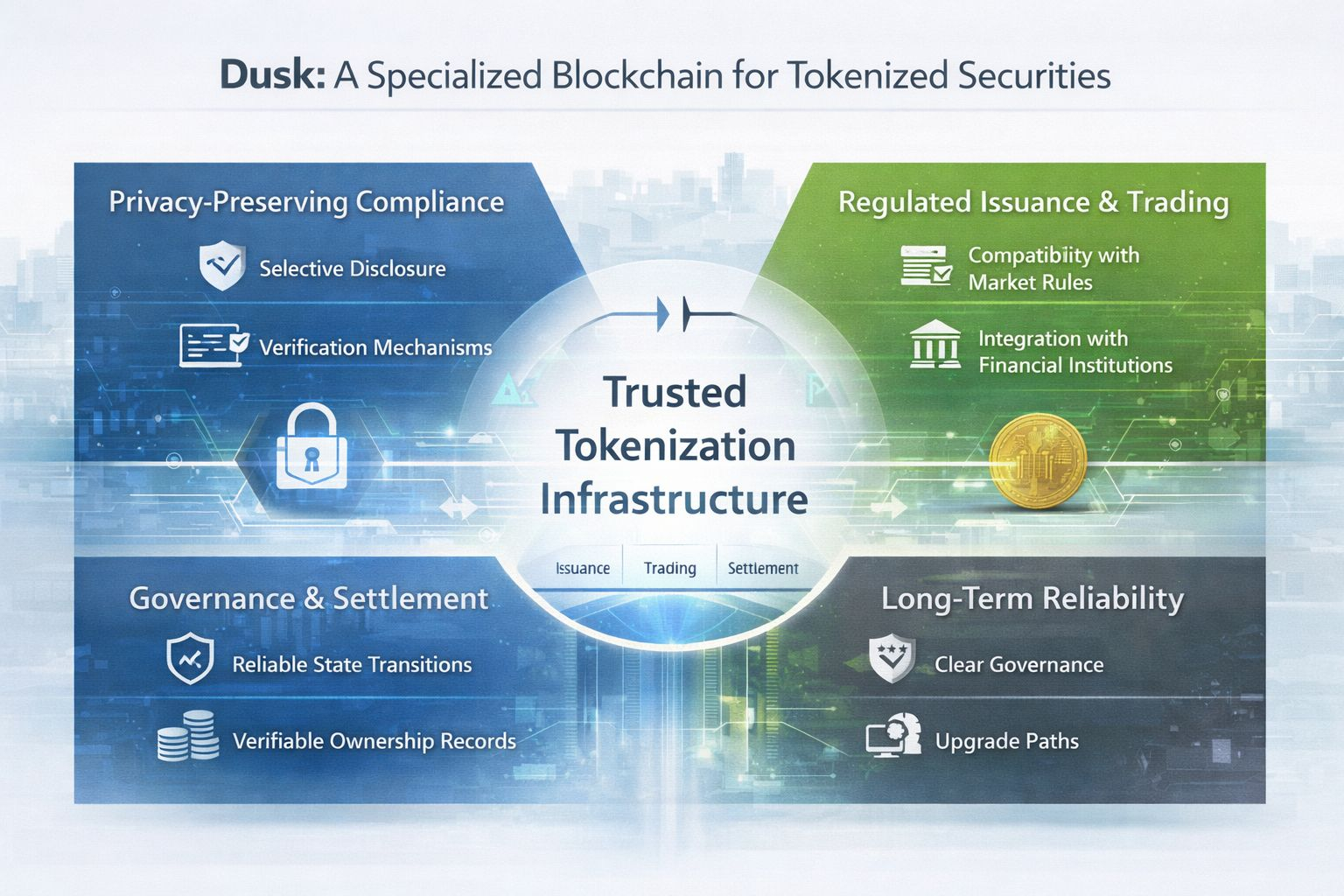
Dusk seems to be designed with this equilibrium in mind. The focus on privacy-preserving compliance is one feature that particularly interests me. In conventional markets, issuers and investors rely on confidentiality to safeguard commercially sensitive information, while regulators need openness to keep an eye on risk and implement regulations. An effort to balance these requirements through systems that allow verification without indiscriminate exposure is suggested by Dusk's design.
For regulated digital securities, where discretion and control are essential operational requirements, I see this as a workable basis. When evaluating whether a platform can serve as reliable financial infrastructure, I also take governance and settlement mechanics into account. Issues with finality, ownership records, and auditability are raised by tokenized securities. For players used to traditional clearing and settlement procedures, a network that is purposefully designed to preserve trustworthy state transitions and verifiable transaction histories can lessen uncertainty.
According to what I've read, Dusk's design strategy shows an understanding that operational predictability is just as important to institutional adoption as technological capabilities. Alignment with current market workflows is another element that influences my evaluation. It is uncommon for financial organizations to replace their infrastructure all at once. Rather, they incorporate new technology into procedures that are already overseen by reporting systems, compliance teams, and custodians. By concentrating on interoperability with regulated issuance and trading settings, Dusk seems to be in a position to support that incremental approach.
This implies that the network is meant to survive with existing structures rather than try to get around them, but it does not remove integration issues. Additionally, I appreciate that the network seems to prioritize long-term viability over quick growth. It is unlikely that tokenized securities will become widely accepted if the underlying infrastructure is primarily designed for short-term experimentation. Assets that reflect legally enforceable rights are typically better suited for systems that place a higher priority on stability, transparent governance, and upgrade paths.
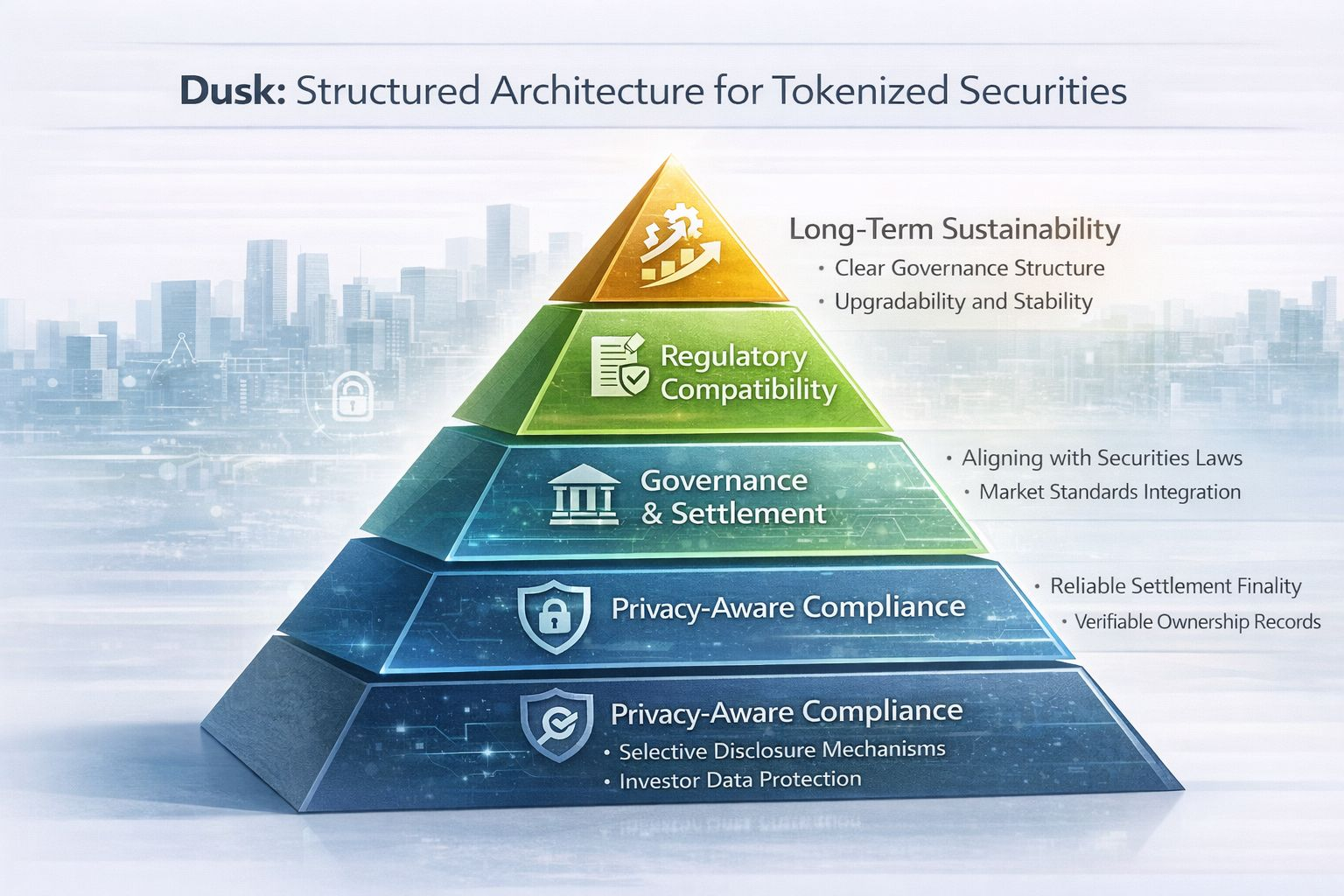
Dusk appears to indicate that it is made for tenacity rather than novelty by highlighting these qualities. From the standpoint of the market, credibility frequently grows with time. Investors need certainty that ownership records and settlement procedures will be accepted by counterparties and regulators, while issuers need assurance that their instruments will continue to be compliant over time. Even if it doesn't guarantee instant scale, infrastructure that is purposefully in line with supervisory standards might lower perceived risk.
I see Dusk as a "natural home" for tokenized securities because its design decisions seem to align with the limitations of regulated markets, not because it asserts exclusivity. By fusing operational dependability, privacy-conscious compliance, and a readiness to cooperate within pre-existing frameworks, the network promotes itself as infrastructure capable of supporting digital securities in a way that is both institutionally and technically acceptable.