
When I first started assessing blockchain ecosystems, I had a tendency to characterize "utility" in terms of token incentives, transaction speed, or the quantity of apps developed on top of a network. My evaluation of Vanar eventually led me to reevaluate that concept and examine whether infrastructure is truly built to enable long-term, practical use.
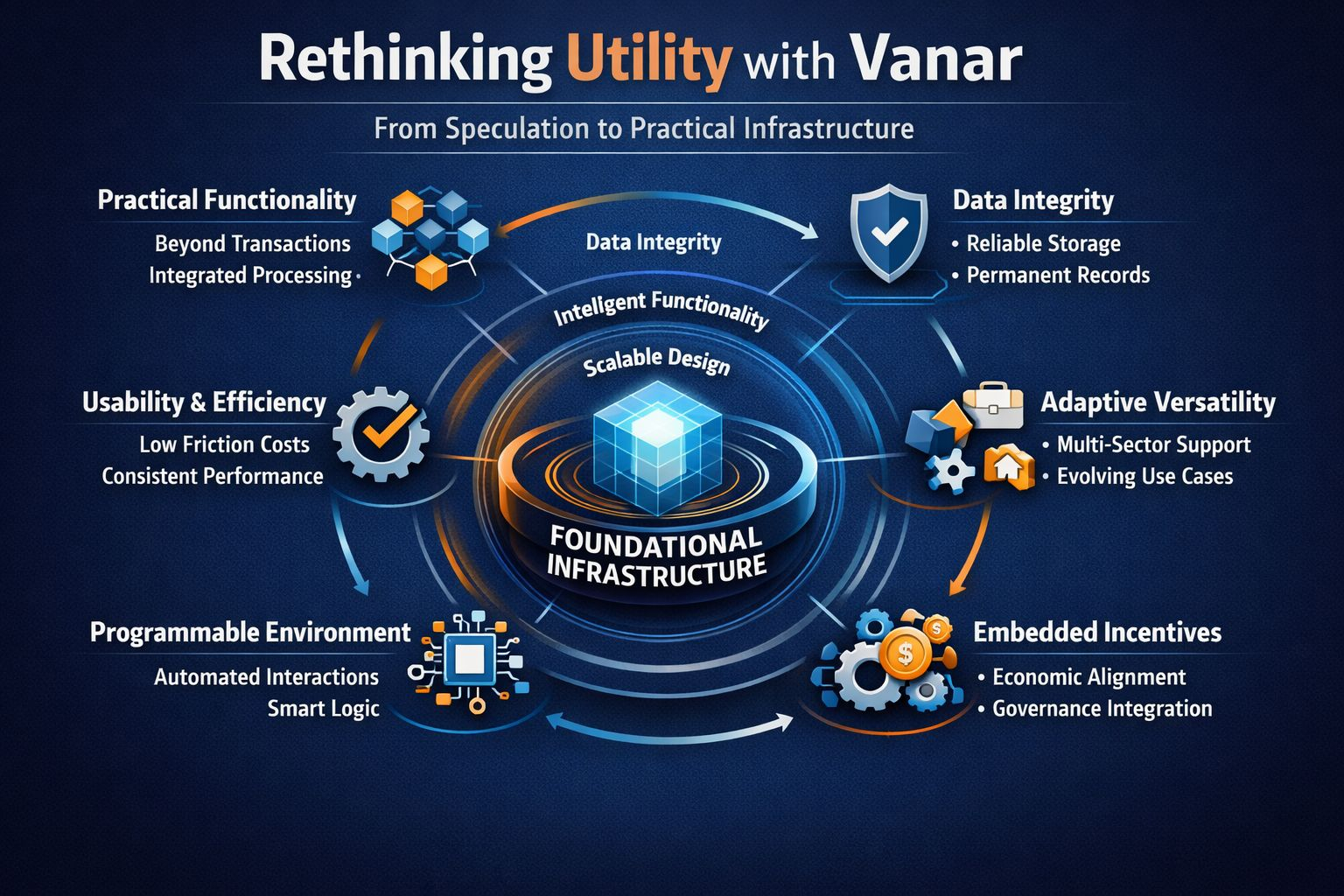
Vanar's focus on useful functioning rather than just speculative activity was what most affected my viewpoint. The network presents itself as infrastructure that can manage data processing and application logic within its design in addition to transactions. This, in my opinion, moves the conversation about utility away from performance measures and toward the capacity to sustain long-term, significant digital activities.
The focus on data permanence and integrity was another element that changed the way I thought. A blockchain's utility goes beyond asset transactions to become a trustworthy record-keeping environment if it can consistently store and validate important data. Utility starts to resemble operational reliability in this situation instead of just transactional throughput. The network's emphasis on intelligent functionality caught my attention as well.
A more expansive understanding of what blockchain systems can actually support is suggested when infrastructure is built to facilitate automated interactions and decision-based procedures. These platforms start to resemble programmable ecosystems that can support more complicated activity rather than only serving as settlement layers. I think systems that try to make daily interactions less complicated are valuable from a usability perspective.
Users and developers are more inclined to interact regularly if transaction costs are predictable and execution is effective. In my experience, frequent, everyday use is where actual benefit is revealed, not sporadic high-volume occasions. I also thought about the ecosystem's integration of incentives. The underlying token starts to serve as infrastructure rather than just a traded asset when network participation such as validation, governance, and transaction processing is closely linked to operating mechanics.
Longer-term stability is typically supported by this connection between technological function and economic design. My reevaluation was also impacted by the platform's seeming adaptability to many industries. Utility and adaptability are intimately related, as evidenced by the infrastructure that can support entertainment, digital ownership, enterprise workflows, and developing asset models. It seems to be set up to meet changing needs rather than being tailored for a single story.
Vanar made me consider utility more as the result of intentional design and less as a list of features. A blockchain starts to resemble core infrastructure when it can store significant data, facilitate intelligent interactions, and encourage ongoing engagement. Although I do not see this as a final answer to adoption issues, it does support my opinion that true usefulness arises when technology is designed to facilitate ongoing, useful behavior rather than discrete transactions.