
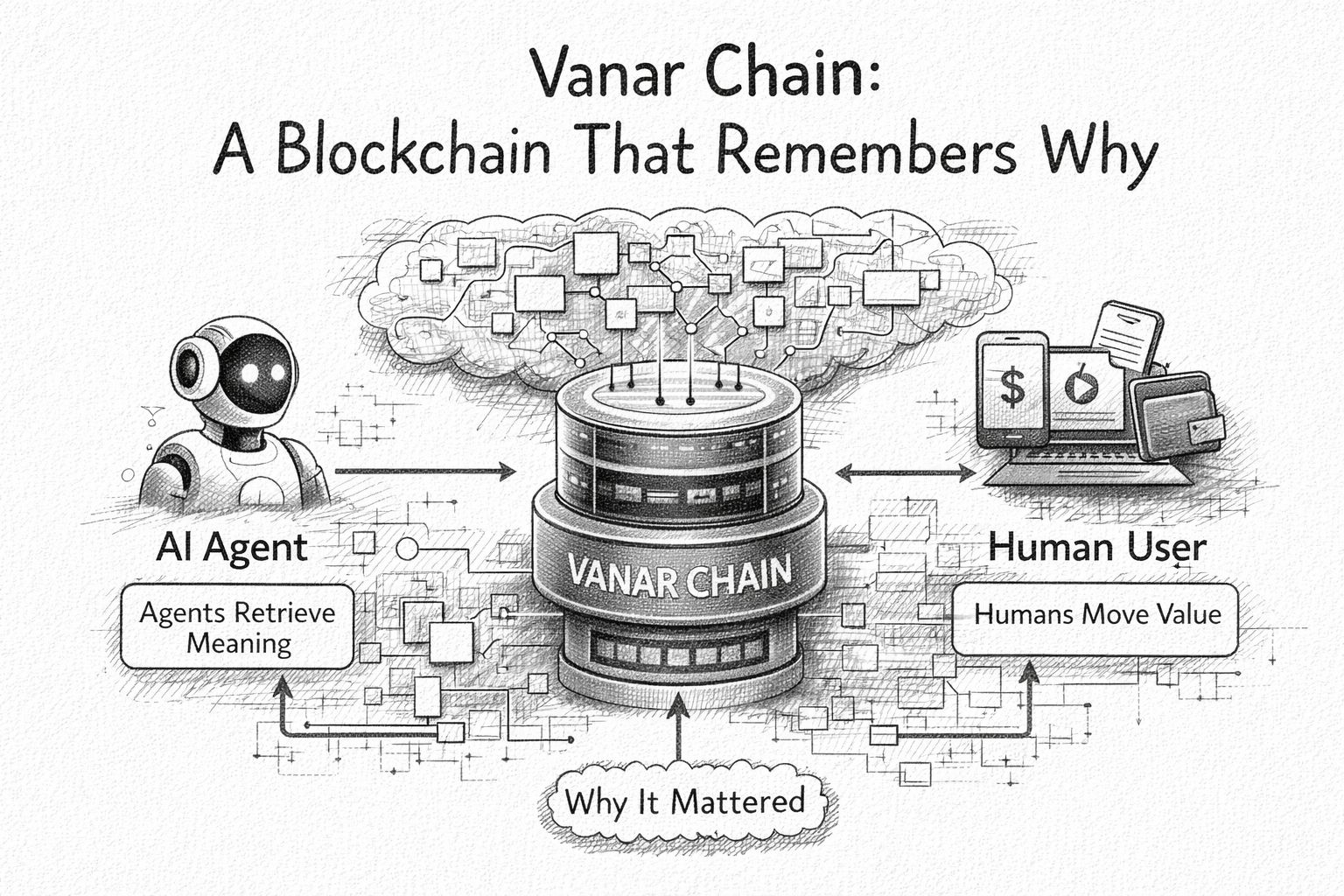
When I first looked at vanar chain, Vanar didn’t impress me with its interface. What stood out was that the interface hardly seemed to matter. Most chains feel like they’re built for humans—buttons, wallets, confirmations. Vanar, by contrast, felt like it was speaking a different language.
What stood out was quieter, almost subtle. Vanar feels less like a network moving transactions and more like a system built to remember. It behaves less like a traditional blockchain and more like a brain that keeps a ledger.
Most Layer 1s still optimize for motion: fast transfers, cheap settlement, high throughput. That made sense when crypto’s primary focus was payments or speculation. But AI agents aren’t struggling to move data—they struggle to hold context. Reconstructing prior state is expensive. Large language models spend over 70% of their inference budgets reprocessing information they’ve already seen. On chains, this translates to repeated reads, external indexing, and wasted compute.
Vanar Chain tackles this problem head-on. Its architecture organizes data for persistent, retrievable context, treating memory as a foundational layer. Blocks, validators, and transactions remain, but semantic structure is built-in. Agents can resume where they left off, reducing repeated computation and cost. Humans interact normally, but the chain is optimized for AI continuity first.
The brain analogy is practical: brains are fast because memory retrieval is cheaper than recomputation. Vanar applies this on-chain, enabling applications like long-lived AI services, adaptive governance, and persistent on-chain identities—things traditional chains struggle to support.
Early development signals emphasize memory layers and reasoning engines over raw throughput. Market trends reinforce this approach. Projects tackling memory bottlenecks attract sustained attention, unlike those chasing short-lived compute spikes.
The risks are clear: persistent context can ossify, and thinking in memory layers increases cognitive load for developers. Yet the payoff is a subtle shift: chains now compete on usefulness over time, not just speed. Vanar Chain is quietly building infrastructure that remembers why things mattered, preparing for a future where AI agents dominate on-chain interactions.$VANRY @Vanarchain #vanar