


There’s a tendency in system design to obsess over special cases. High load. Unusual behavior. Stress scenarios that make good test stories. Those cases matter, but they’re not where systems actually live. They’re where systems prove themselves.
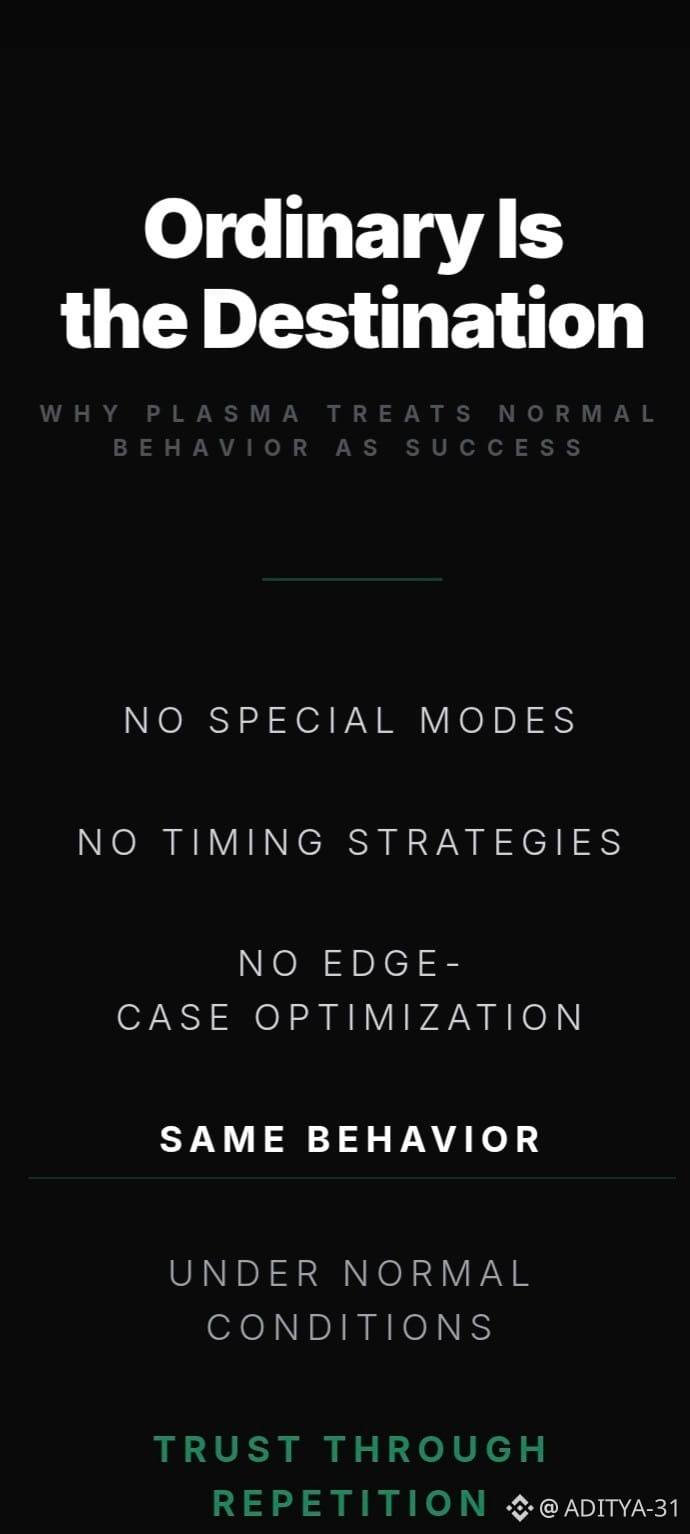
What keeps standing out about Plasma is how little it seems to treat those moments as the center of its identity.
Instead, it feels designed around the assumption that most usage will be ordinary — unremarkable, repetitive, and undeserving of special handling. And rather than treating that ordinariness as a baseline to escape from, Plasma seems to treat it as the destination.
Most payments are boring.
That’s the point.
They happen when people are focused on something else. They’re not events. They’re prerequisites. And systems that demand special attention during ordinary use quietly disqualify themselves from becoming routine.
Plasma feels like it’s trying to prevent that disqualification.
Instead of building a payment experience that shines during edge cases, it appears to build one that never behaves differently during normal conditions. No special modes. No “ideal timing.” No moments where the user is expected to adjust behavior because the system might be sensitive right now.
That consistency is what allows trust to settle without effort.
When users sense that normal behavior is sufficient, they stop adapting. They don’t learn tricks. They don’t develop timing instincts. They don’t warn others about quirks. The system becomes something you can recommend without caveats.
That’s rare in crypto.
Many platforms work well, but only if you know how to use them. That knowledge becomes tribal. It spreads informally. And it creates a quiet barrier to entry. Payments don’t tolerate that kind of gatekeeping. They need to work for people who aren’t paying attention.
Plasma seems designed with that audience in mind.
What’s interesting is how this philosophy changes the role of the user. Instead of being an operator who needs to manage conditions, the user becomes a source of intent. You decide what to do. The system decides how to make it safe and predictable.
That division of responsibility is crucial.
When systems push too much responsibility onto users, mistakes feel personal. When systems absorb responsibility themselves, mistakes become rare and bounded. Users don’t feel like they need to be experts to participate.
Plasma feels comfortable taking on that burden.
There’s also a long-term stability angle here. Systems built around exceptional performance often drift as those exceptions evolve. New conditions emerge. Old assumptions break. The system becomes harder to reason about over time.
Systems built around normality age better. Their core behavior doesn’t change because their core use doesn’t change. Ordinary payments remain ordinary, year after year.
That kind of stability doesn’t generate headlines. It generates reliance.
I also find it telling how little Plasma seems to ask users to believe anything. There’s no promise that things will usually work. Just an expectation that they will. That expectation isn’t reinforced with messaging. It’s reinforced with repetition.
Repetition is how habits form.
Once a system has been used enough times without requiring adaptation, it stops feeling like a choice. It becomes part of the environment. At that point, even alternatives feel strange, because they ask for more attention than you’re used to giving.
Plasma feels like it’s aiming for that environmental status.
Of course, designing for normal use doesn’t mean ignoring failure. It means containing it. When something unusual happens, it should be clearly unusual — not something users have been trained to anticipate constantly. The exception should feel like an exception, not like confirmation of a lingering fear.
That’s a hard balance to strike.
Plasma’s restraint suggests an understanding that fear is taught. Systems teach users what to expect through behavior, not documentation. If normal behavior works smoothly enough, users stop expecting friction.
And once that expectation resets, the system stops being evaluated transaction by transaction. It starts being assumed.
Assumption is the quiet victory of infrastructure.
Plasma doesn’t feel like it’s trying to win by being exceptional.
It feels like it’s trying to win by making exceptionality irrelevant — by ensuring that ordinary use is so reliable, so unremarkable, that nothing else needs to be optimized around it.
In payments, that’s often the only optimization that truly matters.