

Hello Family, Today i will discuss about a revolution that is not just changing the ledger, but changing the very way a blockchain "thinks." We often hear the names of the giants - Solana, Cardano, and Polkadot. They are the architects of the past decade, each solving a piece of the puzzle. Solana gave us the adrenaline of pure speed; Cardano gave us the academic rigor of scientific security; and Polkadot gave us the vision of a connected multi-chain universe. But as we step into 2026, the question isn’t just how fast a chain can move or how many chains it can connect. The question is: How smart is the chain itself? This is where Vanar Chain enters the arena, not as another competitor, but as a completely new species of Layer 1.
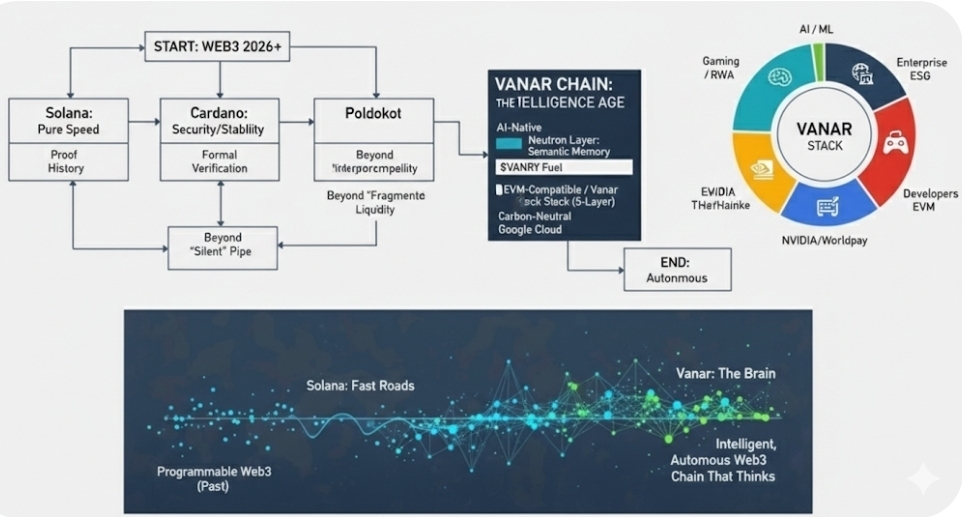
While Solana focuses on Proof of History to squeeze out every millisecond of throughput, it remains a "silent" pipe - it moves data but doesn't understand it. Vanar, however, is AI-native from the ground up. Imagine a world where the blockchain doesn't just record a transaction but possesses a "Semantic Memory" through its Neutron layer. This is a massive leap from the high-speed but "logic-blind" execution we see in Solana. In Vanar, data is compressed by AI into "Seeds," allowing the chain to store and recall information with a level of efficiency that traditional architectures simply cannot match. We are moving from the era of high-speed calculators to the era of on-chain intelligence.
When we look at Cardano, we see a masterpiece of formal verification and peer-reviewed stability. It is the "professor" of blockchains—meticulous and slow. But in the fast-paced world of gaming, AI, and real-world assets (RWA), "meticulous" can sometimes mean "stationary." Vanar takes the security of a Layer 1 and fuses it with the Kayon AI reasoning engine. Unlike Cardano, which requires years for a new upgrade to breathe, Vanar’s Kayon allows smart contracts to evaluate text, verify invoices, and analyze structured data in real-time. It transforms a "contract" from a static set of "if-then" rules into an intelligent agent capable of autonomous decision-making.
Polkadot, on the other hand, is the king of interoperability, connecting various parachains like a massive internet of blockchains. But that complexity often comes with a steep learning curve and fragmented liquidity. Vanar simplifies the entire stack. By being fully EVM-compatible, it welcomes the millions of Ethereum developers with open arms, but then hands them a superpower: the Vanar Stack. It’s a 5-layer vertical integration that handles everything from raw infrastructure to industry-specific "Flows." You don't have to win a parachain auction to build here; you just need a vision and the desire to use the world's first carbon-neutral, Google Cloud-powered AI infrastructure.
Let's talk about the "Green" factor. While Solana and Polkadot have made strides in efficiency, Vanar has integrated sustainability into its very DNA. By leveraging Google Cloud’s carbon-neutral infrastructure and providing real-time energy tracking, Vanar is the only choice for ESG-conscious brands like Disney and Hasbro who are already entering its ecosystem via Viva Games. This isn't just a technical flex; it’s a market necessity. We are seeing $VANRY become more than just a gas token; it is the fuel for a "Green Intelligence Economy" where transactions cost a fixed, ultra-low $0.0005, making it more affordable than almost any competitor in the top 20.
Ultimately, the comparison isn't about who has the most validators or the highest TPS on a testnet. It’s about who is ready for the "Intelligence Age." Solana is a Ferrari on a straight track; Cardano is a fortress on a hill; Polkadot is a map of a thousand cities. But Vanar? Vanar is the brain that operates the car, defends the fortress, and navigates the cities. It is the first "Chain That Thinks," bridging the gap between the programmable Web3 of yesterday and the intelligent, autonomous Web3 of tomorrow. With partnerships ranging from NVIDIA to Worldpay, the infrastructure is no longer a promise - it is a reality.