

@Fogo Official I’ve noticed something changing in the way people talk about “ecosystems” lately. It used to mean a long list of apps that might exist someday. With Fogo, the conversation is trending for a more practical reason: you can feel the chain’s priorities showing up in the kinds of products that are choosing to build here, and in the supporting infrastructure that makes those products usable under real pressure. When a network openly frames itself around speed, low friction, and trading-grade reliability, it attracts builders who obsess over the same things—and it discourages the rest. That filtering effect is already visible in Fogo’s ecosystem lineup, which is heavily skewed toward trading, lending, data, wallets, and the plumbing that keeps everything responsive.
The simplest way I explain Fogo’s ecosystem to myself is that it’s being built around the moments when users are most impatient and most emotional: when markets move fast, when a position is close to liquidation, when a token is ripping and everyone is trying to enter at once, when congestion usually turns into a quiet tax. Fogo’s own positioning highlights sub-40ms block times and ~1.3s confirmation as part of the baseline experience, and it pairs that with a “colocation” story—validators operating close to markets, with backups elsewhere for continuity. Whether someone loves the vibe or not, the intent is clear: shorten the distance between a user’s decision and the chain’s final answer. 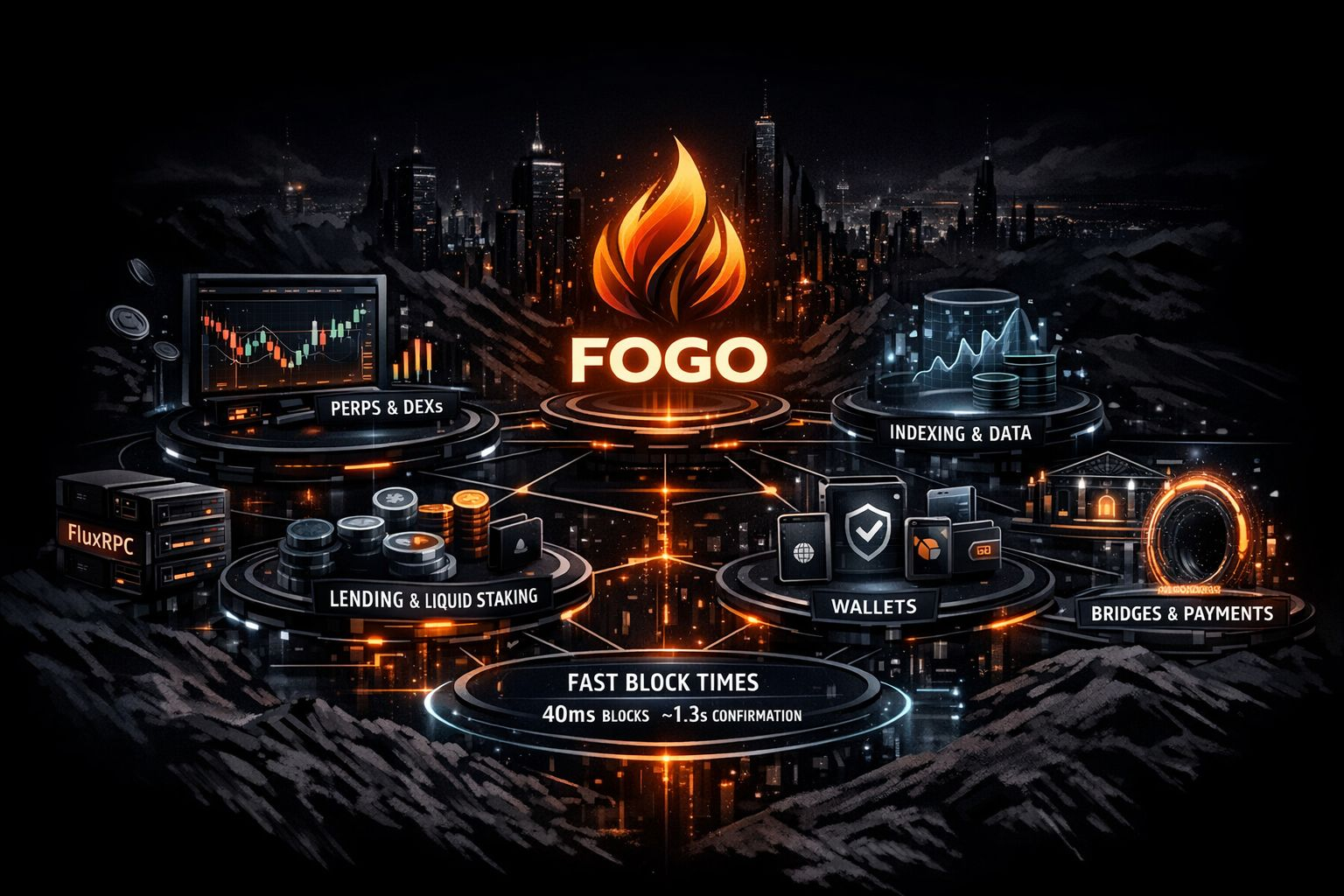
That intent becomes more than marketing once you look at what’s actually being built. Start with the trading venues, because they’re the heartbeat of the current ecosystem. Ambient is presented as Fogo’s native perps venue, and what stood out to me is not the “perps” label—it’s the design choice they highlight: moving away from a traditional order book model toward Dual Flow Batch Auctions (DFBA), explicitly framed as a way to reduce MEV and toxic order flow, create price improvement and fairness, and even shift fees in a direction where end users pay reduced or potentially zero fees while market makers pay to access retail flow. That’s a very specific philosophy about who should win in a market and why. It’s also the kind of philosophy that only matters if the chain can execute quickly enough that the “batch” doesn’t feel like a delay.
Valiant sits nearby in the ecosystem, and it’s described in a way that signals ambition: a hybrid design with an onchain order book, concentrated liquidity AMMs, and a launchpad component, again using DFBA to target tighter spreads, fairer execution, and deeper liquidity across an asset’s lifecycle from launch to spot markets. I don’t read that as “features.” I read it as a claim about market structure: that you can merge the parts of trading that users like—speed, depth, clean fills—without inheriting the worst parts of onchain execution that show up when latency and adversarial behavior combine. 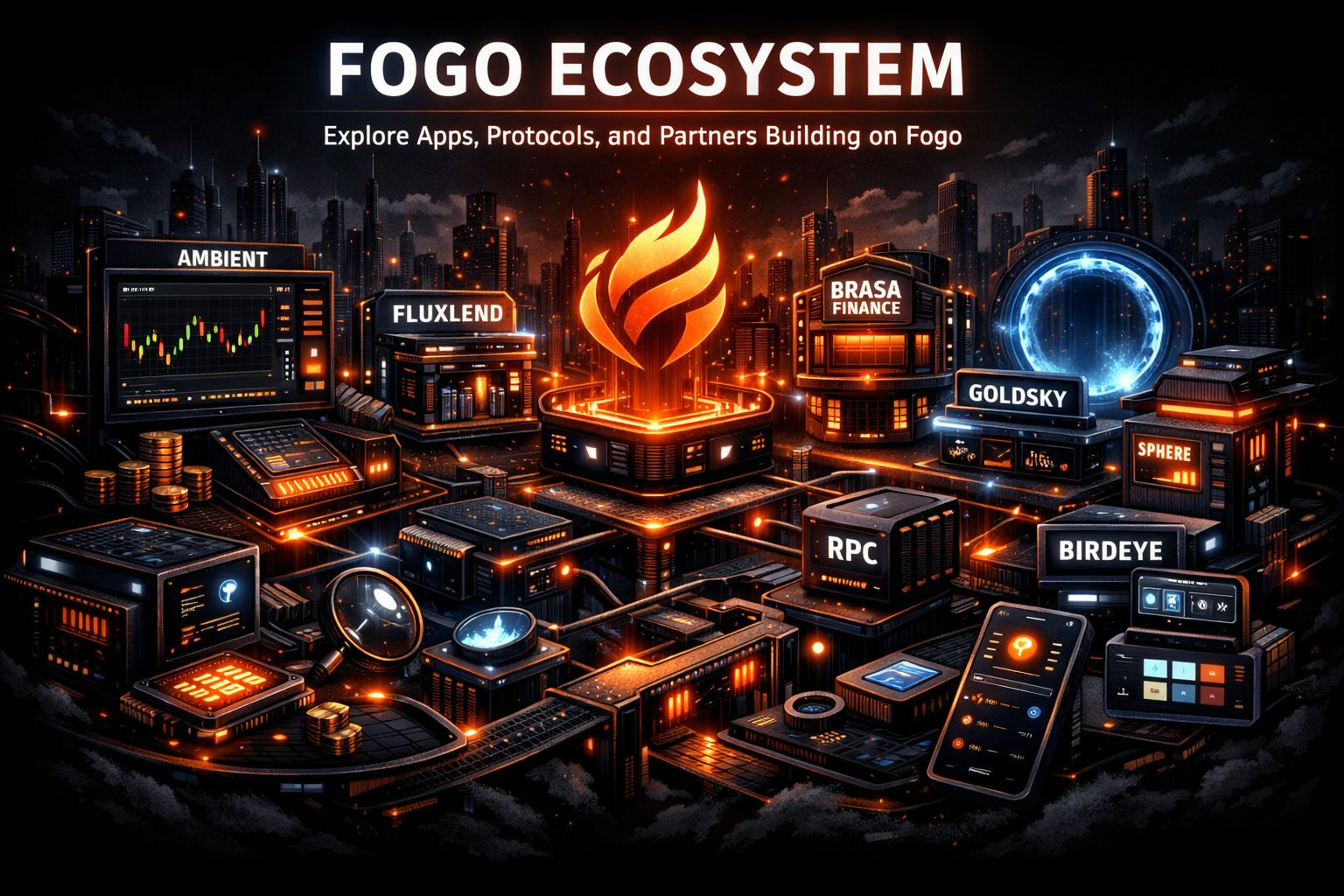
Then you have FluxBeam, which is positioned less as one single app and more as a suite: a spot DEX, a Rugcheck-style inspection tool for token and contract red flags, and even a Telegram trading bot. That mix matters. It suggests the ecosystem is trying to meet users where they already trade, while also acknowledging the safety problem that appears the moment a chain gets attention. The faster a market moves, the easier it is to get tricked quickly. Having “speed” and “inspection” show up side-by-side is a subtle sign of maturity: somebody is thinking about what happens when retail arrives at scale and things get messy
Lending is the other pillar t tells you whether an ecosystem is serious, because it’s where risk concentrates. On Fogo’s ecosystem page, Fogolend is framed as “lend, borrow, leverage,” and PYRON is framed with a simplicity-first message—lend what you want, borrow what you need, keep it clean and fast. I’m not treating those lines as proof of outcomes, but they do reflect the ecosystem’s consistent obsession: reduce waiting, reduce friction, reduce the feeling that you’re wrestling the chain while the market moves. If you’ve ever tried to manage collateral during a volatile hour, you know exactly why this category is attracting attention right now.
Liquid staking shows up as a third pillar, and here the ecosystem looks like it’s trying to turn “holding” into something usable without forcing a personality change. Brasa Finance is listed as liquid staking—earn rewards while staying liquid—and Ignition appears as another liquid staking option “for Fogo.” In practice, this category often becomes the base layer for everything else: liquid staked assets get used as collateral, liquidity, and a kind of portable yield. The interesting part, to me, is not that liquid staking exists. It’s that it’s being treated as an expected component of the trading stack rather than a side quest. That’s how you know the ecosystem is building for continuous activity, not occasional participation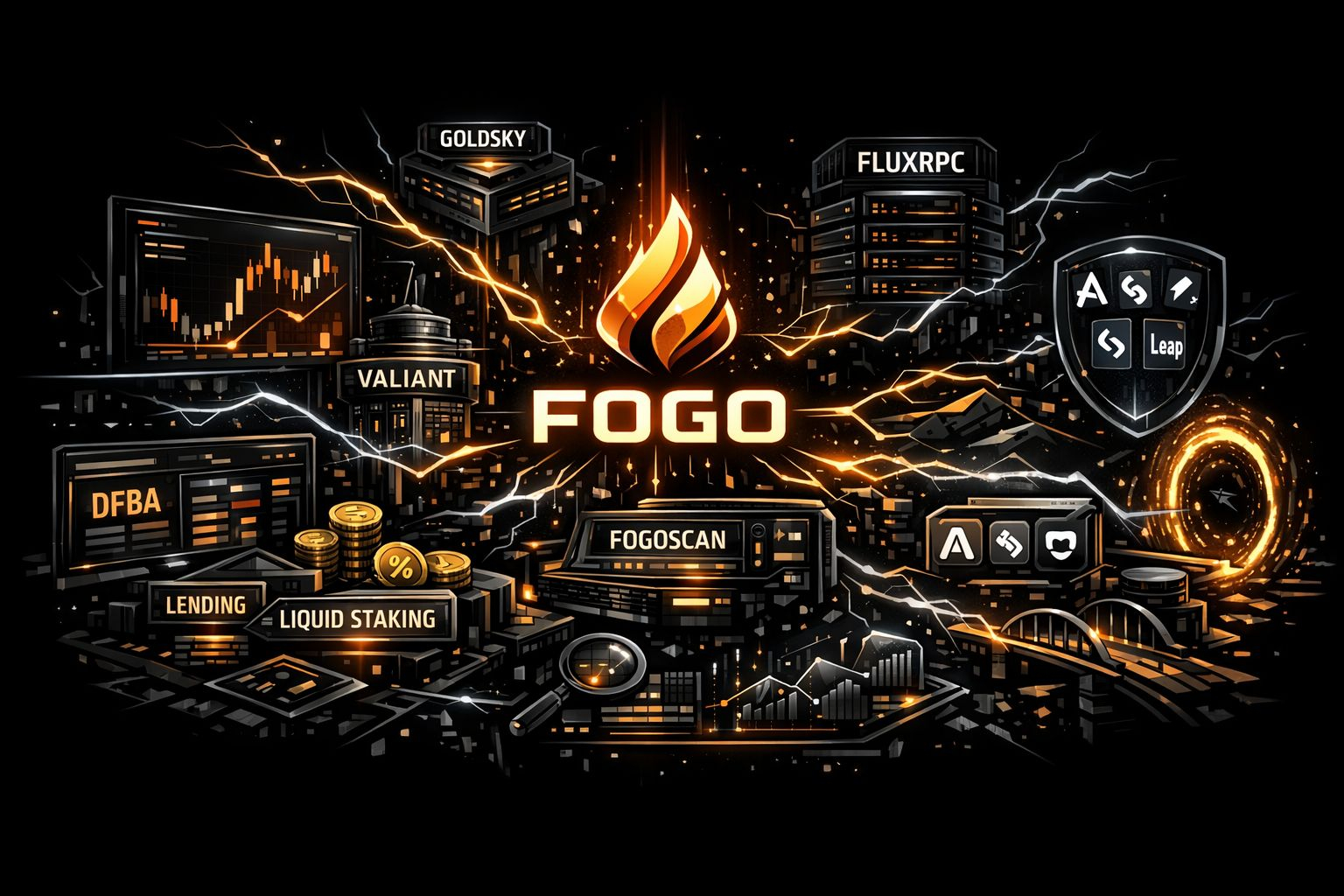
All of this only works if the “invisible” layer is strong, and Fogo’s ecosystem list spends real space on that invisible layer. FluxRPC is positioned as infrastructure “built from scratch to crush load, not collapse under it,” and Goldsky is listed for indexing, with a concrete throughput claim (processing 100M+ events per minute). Those aren’t the kinds of partners you highlight if you’re building a chain for slow, occasional interactions. They’re the kinds of partners you highlight when you expect constant reads, constant writes, constant users refreshing screens, and builders who need data fast enough to feel real-time.
The tooling and access layer fills in the rest of the picture. Fogoscan is presented as a real-time, user-friendly explorer. Wallet support includes names that suggest the ecosystem is optimizing for distribution, not just ideology: Atomic Wallet is described as supporting 1000+ coins and serving 15M+ users, Bitget Wallet is framed as serving 80M users, and Leap Wallet is described as trusted by 1M+ users. Add OKX Wallet and Nightly, and you get a sense that Fogo wants to be reachable through familiar doors rather than forcing everyone into a niche setup. Data partners like Birdeye, Codex, and Chainspect reinforce the same theme: users and traders don’t just need execution, they need visibility—price, flows, wallets, fundamentals, and the confidence that they’re not blind.
Bridges and payments are where ecosystems either become real or stay isolated. Wormhole is listed as the interoperability platform connecting traditional finance and the internet economy, and Sphere shows up under “fiat ramps” as payments infrastructure for the next generation of the internet. I’m careful not to overread what any single integration means, but as a pattern, it’s meaningful: Fogo’s ecosystem isn’t pretending that everything begins and ends on one chain. It’s acknowledging that capital moves across venues and that user experience includes getting in and out without drama. In markets, smooth entry and exit is emotional safety. If you can’t move when you need to, nothing else matters.
So why is this trending now? Because the “latency tax” is finally being treated as a first-class problem instead of a meme. In faster markets, seconds feel like minutes. People are tired of clicking “confirm” and hoping the chain agrees in time. They’re tired of systems where adversarial flow extracts value simply because it reacts faster than a normal user can. Fogo’s ecosystem, as it stands on its official pages, looks like an attempt to build a coherent answer: a chain designed for minimal latency, paired with trading venues explicitly discussing fairness and MEV reduction, backed by indexing and RPC built for load, and wrapped in wallets and data partners that make the whole thing usable for normal humans.
My conclusion is simple, and I’m saying it cautiously: Fogo’s ecosystem reads less like a random assortment of apps and more like a deliberately assembled trading stack. The data points that matter aren’t just names; they’re the way categories cluster—perps, spot, lending, liquid staking, RPC, indexing, explorers, bridges, wallets, analytics—around a single thesis: real-time finance requires real-time infrastructure. Fogo is betting that if it can keep execution tight (40ms blocks, ~1.3s confirmation) and keep the plumbing resilient, builders will compete on product quality instead of fighting the chain.
