
The adoption of Web3 remains technical in most discussions. Faster chains. Lower fees. New narratives.
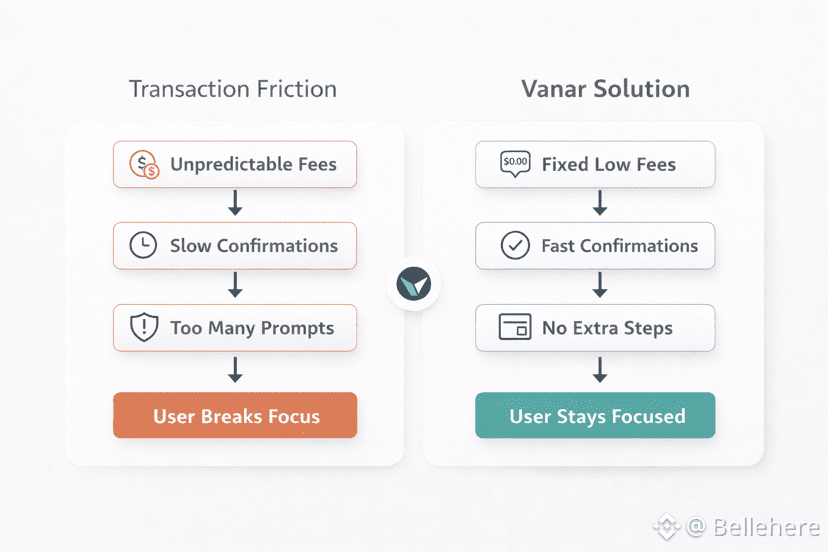
However, once you get out of crypto and observe the real behavior of people, you begin to realize what the issue is. The reason why adoption fails is not because users do not know about blockchain. It does not work since blockchain continues to disrupt them. Each additional step, every unknown expense, every interruption to make sure everything is fine makes users understand they are working with something unstable rather than something stable.
That is the place Vanar is attempting to work in
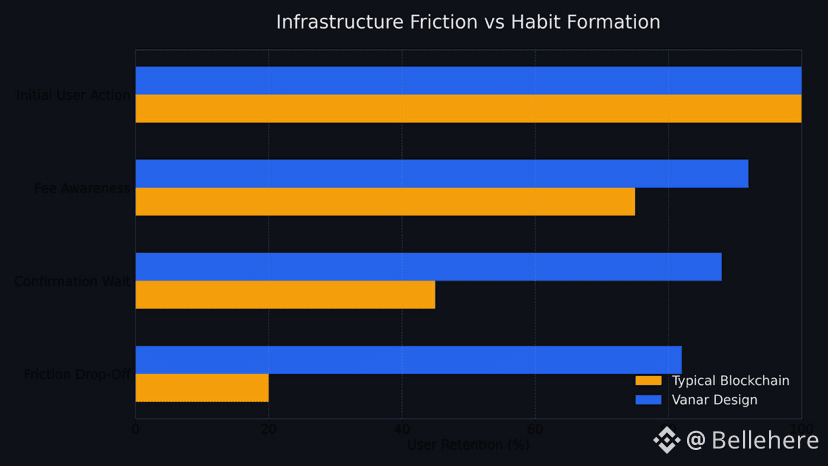
Vanar is not constructed based on the concept of being impressive. It is constructed based on the concept of making memories, but in a forgettable way. The fundamental ideology of the team appears to be that blockchain must not look like a financial experiment but rather background infrastructure. Something that operates silently as the users concentrate on what they really intend to do.
The emphasis on predictability that Vanar has is one of the most obvious indications of such an attitude. Majority of the blockchains are technically functioning, yet they act in different ways under market situations. Fees rise when tokens pump. When the activity peaks, it slows down transactions. This is random and stressful to a user. The design of Vanar is in the opposite way. It tries to maintain low and stable fees in dollar amounts, a fraction of a cent, irrespective of the token price action. The concept is rather straightforward in that, when customers are always aware of the price of something, they will never think about price anymore.
It is not an isolated pricing choice. It's a psychological one. Users are reluctant when costs are unpredictable. Users take action when the costs can be predicted. Such a difference will make an app used once or once in a lifetime.
Speed plays a similar role. Vanar is so focused on short block times that actions are immediate. Neither fast because crypto nor fast enough that one does not leave the app in mind as they wait. This is not as insignificant as some believe. Delays do not only slow systems, but they disrupt attention. Or when the sense is ruined never habits are made.
The other silent but significant option is the compatibility of Vanar to the already existing tools in Ethereum. Vanar does not require the developers to be introduced to an entirely new environment. This lowers resistance. To release a product, builders do not have to turn into researchers of blockchain. They are able to concentrate on design, gameplay, content, or user flows, whereas the chain remains in the background to do its job.
However, Vanar is not merely transactions. In the way it attempts to do more is the handling of data. Old-fashioned blockchains are useful when it comes to documenting the events but not when it comes to flexibly operating with the information. Vanar adds more layers that are designed to render the data more usable. Rather than files or records becoming dead weight after being stored, the concept suggests that data must persist to be accessible, searchable as well as be applicable and useful by applications and automated systems.
This is where such concepts as structured data units and reasoning layers are introduced. In simple words, Vanar is researching on how blockchain can exit the store and verify stage into the store and understand and use stage. Such a change is important in those applications that require more than mere transfers. Imagine digital rights management systems, compliance logs, in-game resources, or automated processes. These are not a single transaction but are processes.
Vanar is also practical in his governance and security choices. Instead of the openness at all costs, the network is biased towards reputation-based validator model. It is expected that validators are reputable persons. This may make the network seem safer to both the business and mainstream application even though it may also raise concerns about the degree to which the system is decentralized. Again, it's a tradeoff. Vanar does not appear to be an ideological fanatic; rather, he values reliability and trust.
As an investment, or research, this places Vanar in a curious situation. It is not attempting to make a victory based on being the loudest and most radical. It is attempting to be more usable to win. That complicates short term measurement of progress. Unobtrusive infrastructure does not make the headline news. However, when it is adopted, it is more likely to be sticky since it is an adoption that is founded on behavior, rather than enthusiasm.
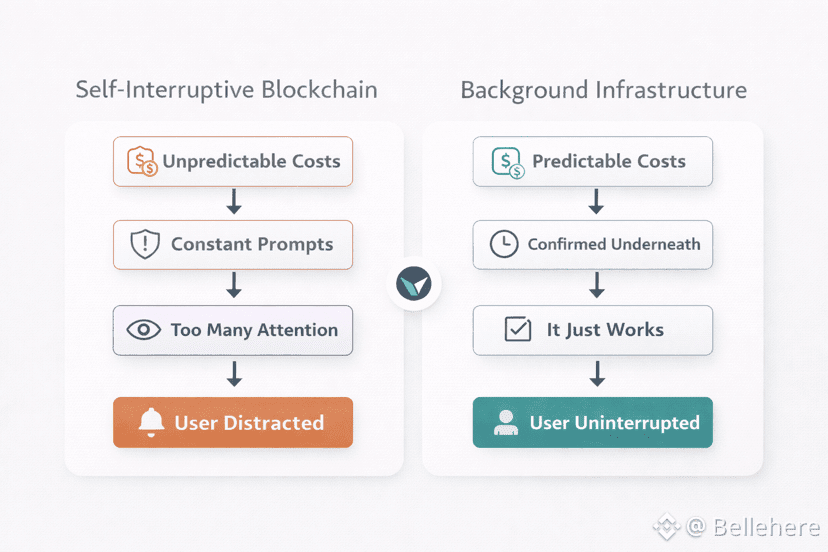
Announcements and narratives are the least important to watch. It's usage patterns. Are applications making decisions to construct in an environment where costs are predictable? Do users interrelate without being reminded that they are using a blockchain? Is it for the reason people want to do something that transactions are taking place, rather than that incentives are forcing people to click?
When these signs are evident in the course of time, the approach of Vanar begins to be sensible. Not as an ostentatious innovation, but a sluggish normalization. And in technology, it is all about being normal. As soon as something becomes normal, it ceases to be debated and begins to be used.
Finally, @Vanarchain does not bet that people will fall in love with blockchain. That is that people will not even need to consider it.
