There is a quiet hum beneath our digital lives, a sound most of us never hear but intuitively feel is there. It’s the energy consumed by a thousand invisible processes: verifying a transaction, minting a digital collectible, securing a network that spans the globe. For years, as we marveled at the possibilities of blockchain technology—decentralized finance, true digital ownership, communities built on transparent code—a nagging question began to form in the collective conscience, often pushed aside but never fully silenced. What is the cost? Not in dollars, but in tangible, environmental terms. The excitement of innovation started to carry a subtle, bitter aftertaste of guilt. We found ourselves caught in a painful paradox, championing a future that felt, in a very real way, like a betrayal of the planet we hoped to improve. The very tools for building a new world seemed to be mortgaging the future of the old one.
This environmental anxiety isn't abstract. It manifests in the hesitation of an artist who wants to tokenize their work but recoils at the energy footprint of certain networks. It lives in the doubt of a community that wants to organize via a DAO but worries about the carbon legacy of their governance votes. It’s the shadow over every conversation about adoption, a silent partner asking whether technological progress must inherently mean ecological regress. This conflict creates a form of spiritual friction, where the desire to build is stifled by the fear of what that building destroys. We have been asked to make an impossible choice: participate in the next evolution of the internet, or be a responsible steward of our physical world.
What if this is a false choice? What if the next great leap in blockchain isn't just about doing more transactions, but about transforming the relationship between technological growth and resource consumption? The conversation is shifting from pure performance to conscientious performance. It’s not enough to be fast and secure; a chain must also be sustainable, not as an afterthought or a marketing point, but as a foundational, architectural imperative. This is about aligning the ethics of a technology with its capabilities, ensuring that building a digital future doesn’t come at the expense of our environmental one.
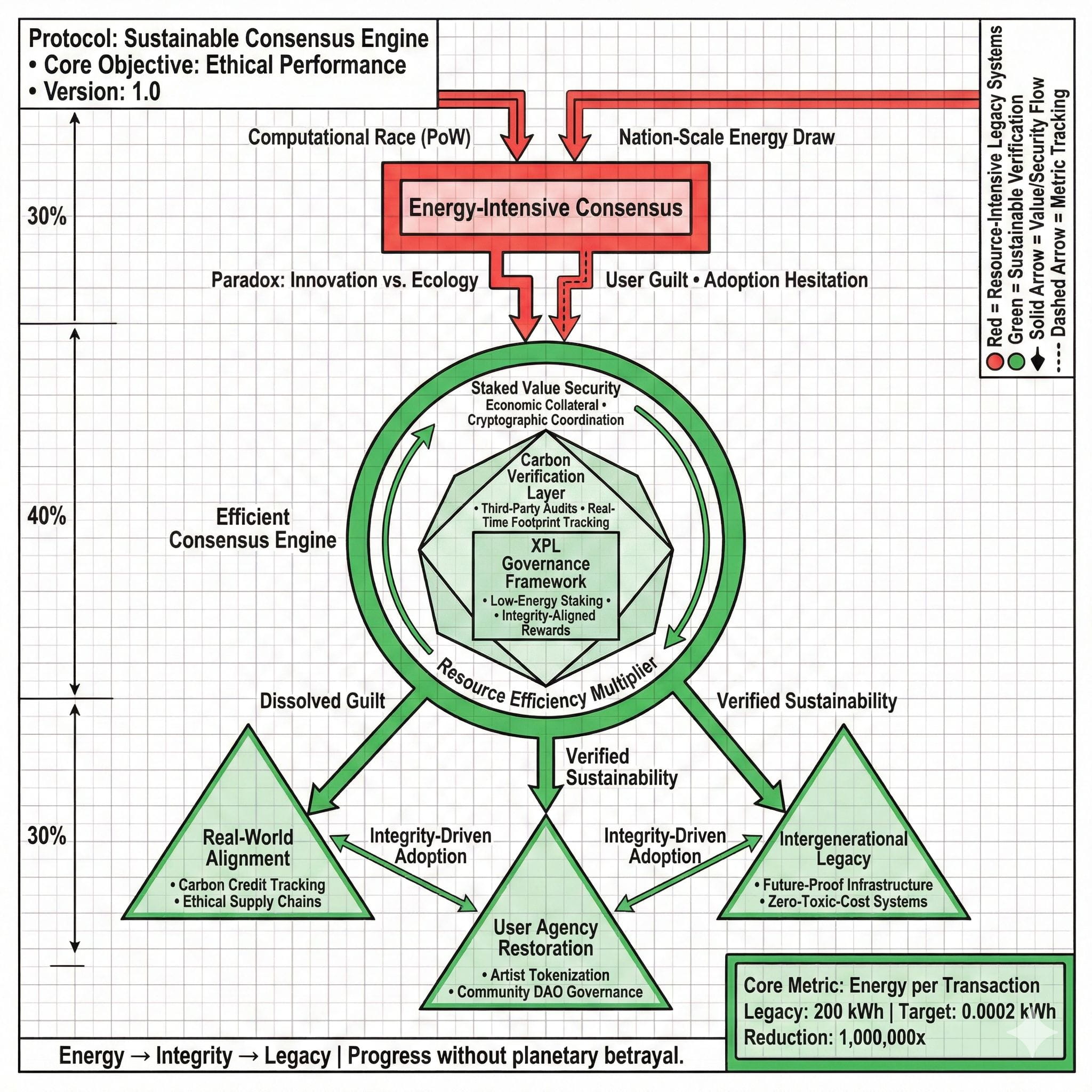
The core of this transformation lies in the consensus mechanism—the beating heart of any blockchain, which determines how agreement is reached and how the ledger is secured. The traditional, energy-intensive model relies on vast networks of computers competing in a computational race, consuming electricity on a scale comparable to small nations. The alternative, and the path forward, embraces mechanisms like Proof-of-Stake and its more advanced, efficient derivatives. Here, security is derived not from burning energy, but from staked economic value and clever cryptographic coordination. The energy requirement plummets from that of a nationwide grid to that of a modest office building, while security and decentralization remain robust, or even improve.
Choosing a network built on such efficient consensus is more than a technical decision; it is an ethical and emotional reclamation. It allows the developer, the artist, the community organizer, and the everyday user to step out of the shadow of that paradox. It dissolves the guilt and replaces it with agency. You can deploy a smart contract, launch a collection of digital art, or govern your community treasury with the knowledge that your digital actions are not contributing to a hidden environmental crisis. This is how technology earns not just our adoption, but our trust and our peace of mind.
The impact of this efficiency ripples far beyond personal conscience. It radically alters the practicality of blockchain for real-world use cases. Consider a project aiming to track carbon credits or manage a regenerative agriculture fund on-chain. Using a high-energy network would be laughably self-defeating, undermining its very mission. A sustainable chain, however, becomes the perfect, integrity-aligned tool for the job. Imagine supply chains for ethical goods, where every step from origin to consumer is immutably logged without creating a contradictory environmental burden. This is where the technology truly finds its purpose—not in speculation, but in building verifiable, transparent systems for good, without a hidden toxic cost.
The native token in such an ecosystem, XPL, embodies this principle of efficient value. Its role in staking and securing the network is inherently low-energy, making the entire economic model sustainable from the ground up. Its value is tied to the utility and security of a network that is designed for a future where resources are respected. It represents a proof-of-stake in every sense: a stake in a secure digital future and a stake in a viable physical one.
We are at an inflection point where we must build not just for capability, but for legacy. The next generation of users will not ask, "How fast is it?" as their first question. They will ask, "What does it cost the Earth?" Building on a foundation that has a clear, compelling answer is no longer a niche advantage; it is a fundamental necessity for lasting relevance. It’s about constructing a digital infrastructure that our descendants will thank us for, rather than one they must dismantle to survive.
This is the quiet, profound work of true innovation: to remove the obstacles not just in front of us, but within us. It’s about offering a path where our ambition to create and connect is no longer held hostage by the dread of what we might destroy in the process. We can have both—a vibrant, sovereign digital life and a healthy, thriving planet. The future belongs to those who understand that the most resilient network isn't just the one that can withstand an attack, but the one that can harmoniously coexist with the world it inhabits. The choice is no longer between progress and preservation. The most advanced protocol is the one that finally, elegantly, allows them to be the same thing.