


Most people who use blockchains don’t wake up thinking about swaps, routes, or settlement logic. They think about outcomes. They want capital to move. They want exposure to change. They want trades to clear without surprises. For a long time, crypto made users carry the burden of execution. Every action required attention. Every step needed manual confirmation. Every large move came with anxiety around slippage, delays, or missed pricing.
That tension shaped the way DeFi evolved.
Early systems assumed that users were willing to manage complexity in exchange for sovereignty. And for a while, that was true. But as usage grew and capital sizes increased, that assumption began to break down. When execution becomes the thing you have to constantly think about, it stops being empowering and starts becoming a tax.
This is the environment Plasma is operating in today.
The integration of NEAR Intents is not just a technical update. It reflects a deeper recognition that execution is no longer the differentiator. Coordination is. The real question now is not whether something can be done onchain, but whether it can be done cleanly, predictably, and at scale without forcing the user to supervise every detail.
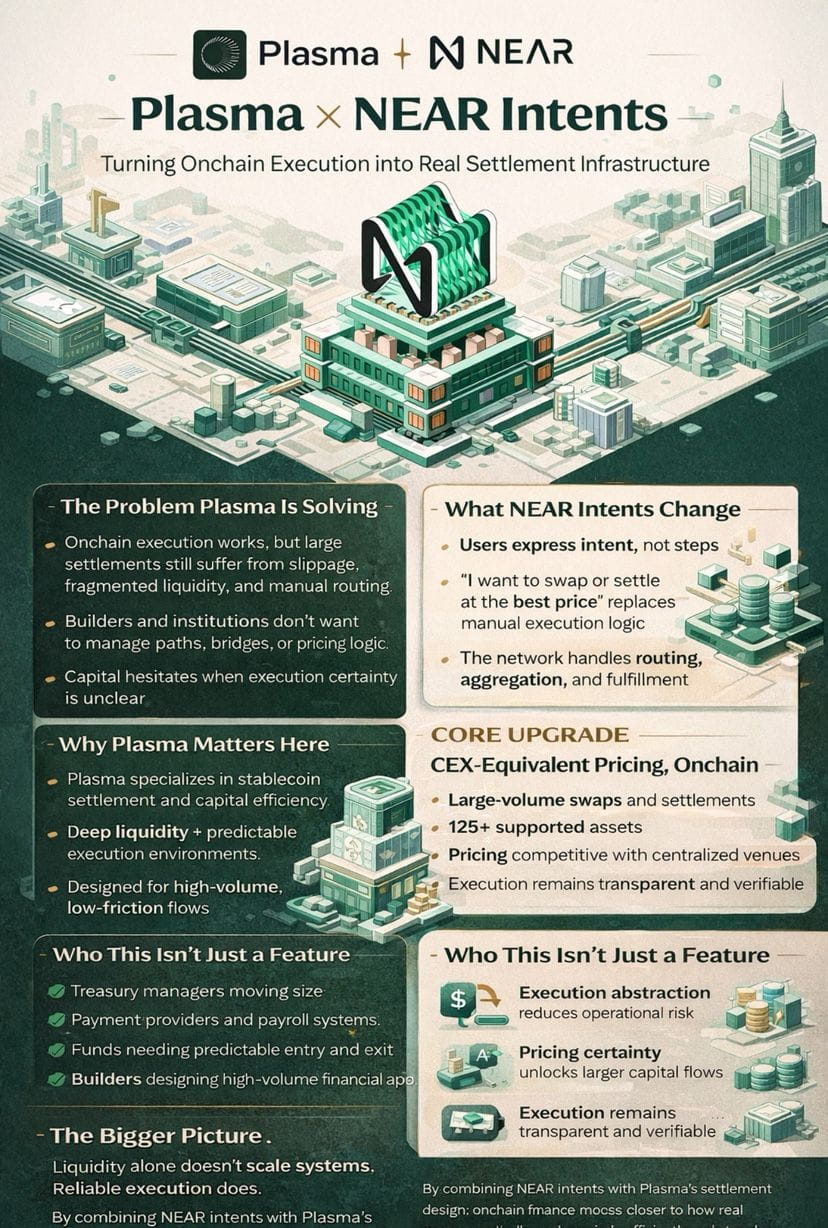
Intents flip the relationship between users and infrastructure. Instead of telling the system exactly how to act, users describe what they want to happen. The system takes responsibility for finding the best way to make that happen. That sounds simple, but it changes everything about how onchain activity feels.
Plasma integrating NEAR Intents means that large settlements and swaps can now happen with pricing comparable to centralized exchanges, across more than 125 assets. But the more important shift is psychological. Builders and users no longer have to treat execution as a fragile process that needs constant babysitting. They can treat it as a service.
That matters most when size enters the picture.
Small trades hide inefficiencies. Large trades expose them. Anyone who has tried to move real size onchain knows this feeling. You split orders. You wait. You check liquidity. You accept that price impact is part of the deal. Centralized exchanges dominated this space not because they were ideologically superior, but because they offered reliability. You knew what price you would get and when the trade would settle.
Plasma is closing that gap without asking users to give up custody.
By enabling intent-based execution with deep liquidity and competitive pricing, Plasma removes one of the last practical reasons large actors stayed away from onchain settlement. This is not about chasing volume for its own sake. It is about making the system usable for people who cannot afford uncertainty.
And once uncertainty drops, behavior changes.
Treasuries rebalance more often. Funds deploy capital more efficiently. Applications stop building defensive logic around execution failure and start focusing on user experience. Payment flows become smoother. Settlement becomes background noise rather than a focal point.
@Plasma benefits from this because it has never tried to be everything at once. It has consistently leaned into being a place where money moves seriously. Stablecoins, lending, settlement, and now intent-based execution all reinforce that identity. Each layer supports the next instead of competing for attention.
There is also something important about what Plasma did not do here. It did not try to reinvent intents itself. It chose to integrate with a system that already understands coordination well. That choice signals maturity. Strong infrastructure does not need to own every abstraction. It needs to compose cleanly with the right ones.
For builders, this changes how applications are designed. Instead of hardcoding execution paths and worrying about edge cases, they can define desired outcomes and trust the underlying system to deliver them. That reduces complexity and lowers the mental load of development. Over time, that attracts better builders, not louder ones.
For users, the change is quieter but more powerful. Things simply work more often. Prices feel fair. Large actions do not feel risky just because they are onchain. The system fades into the background, which is exactly what good infrastructure should do.
This is how Plasma is positioning itself. Not as a place where users need to understand every mechanism, but as a place where outcomes are dependable. Intents are a natural extension of that philosophy because they align infrastructure with human intent instead of forcing humans to adapt to infrastructure.
What makes this integration meaningful is not the headline. It is the direction it points to. Plasma is building toward a world where onchain finance feels less like an experiment and more like a utility. Where coordination happens automatically. Where scale does not introduce fear.
My take is that updates like this rarely get the attention they deserve in the moment. They do not create instant hype cycles. But they change who trusts the system and why. Over time, that trust compounds into usage, liquidity, and relevance.
Plasma is not trying to be loud. It is trying to be dependable. And when execution stops being something users worry about, that dependability becomes obvious without needing to be explained.