
Have you ever worried about what happens to your photos or files if a big tech company suddenly has a server crash? It is a scary thought for all of us. I want to talk to you about a really cool way we are solving this problem using something called Walrus. This system uses a special design called Red Stuff to make sure your data stays safe even when computers break or people turn them off. Let me break down how this works in a way that makes sense for all of us.
When we store things on the internet we usually rely on one big central group. But Walrus is different because it is decentralized. This means we are spreading data across many different computers all over the world. The big challenge we face is that these computers are not always reliable. Some might lose power or just stop working. If we just made simple copies of your files it would take up way too much space and cost a lot of money.
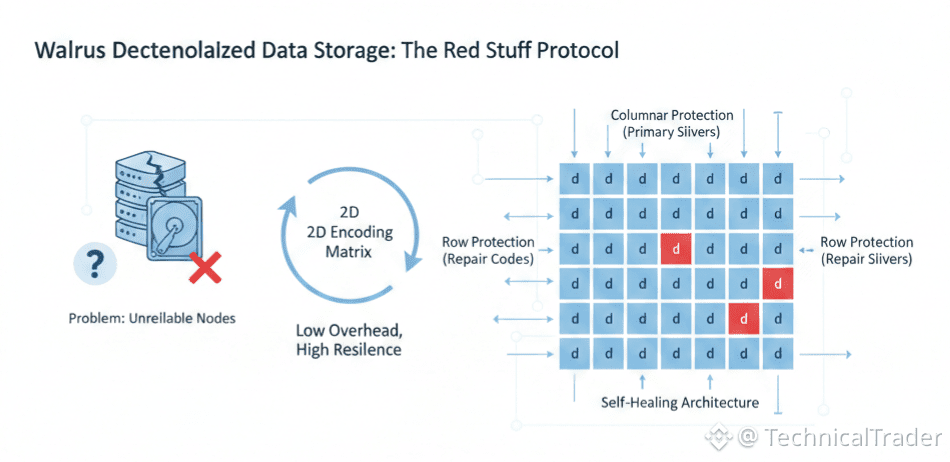
The Problem of Fixing Broken Parts
Imagine you have a giant puzzle spread out across twenty different houses. If one house loses its piece of the puzzle how do we get it back? In the old days we would have to copy the entire puzzle all over again just to fix that one missing spot. As you can imagine that is a huge waste of time and energy. We call this a high overhead cost and it is exactly what we want to avoid with Walrus.
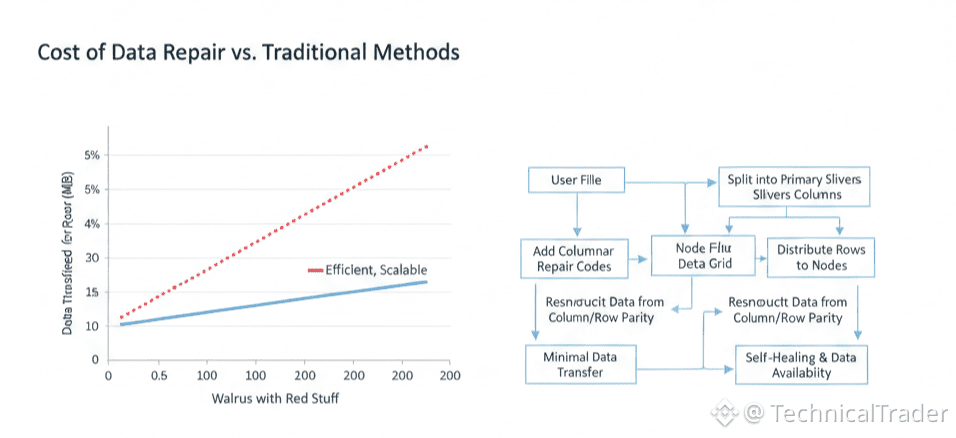
We need a system that can heal itself without being a burden on the network. We want the cost of fixing a mistake to be small. If only a tiny bit of data is lost we should only have to move a tiny bit of data to repair it. This is why the Red Stuff design is so important. It gives Walrus a way to be self healing so it can last for a long long time without constant manual repairs.
Introducing the Two Dimensional Grid
To solve this problem we use a clever trick called 2D encoding. Think of it like a game of Sudoku or a crossword puzzle. Instead of just writing your data in a long straight line we arrange it into a grid with rows and columns. This is the heart of the Red Stuff protocol. By putting data into a matrix we give ourselves two different ways to find and fix any missing pieces.
When we use this grid for Walrus we are making the data much stronger. If we lose a piece in one direction we can still find it by looking in the other direction. It is a very human way of thinking about organization. If you cannot find your keys by looking on the floor you look on the table. Red Stuff does this automatically for digital information making it nearly impossible to lose the original file.
Protecting the Columns
The first step in this Red Stuff process is protecting the vertical columns of our grid. We take the original file and split it into primary slivers. Each column gets extra information added to it so that if a few rows go missing we can still understand what the column was supposed to say. This is the first layer of defense for everything we store in Walrus.
Each computer in the network is given one of these rows to look after. This part of the design is great for security but it still does not solve the problem of making repairs easy and cheap. If we only had this vertical protection we would still be stuck downloading too much data whenever a single node goes offline. That is why we have to add the second dimension to the mix.
Protecting the Rows for Easy Repairs
This is where the magic happens for Walrus. We take those same rows and we extend them horizontally with even more repair codes. Now every single node in the system is holding two different types of slivers at once. By adding this horizontal layer we make it so we can fix a broken node by only talking to a few other nodes nearby.
Because of this horizontal protection the network does not have to struggle to stay alive. It is efficient and fast. We are basically giving every piece of data a backup that is also connected to every other backup. This double layer of protection is what makes Red Stuff so much better than the older ways of storing things online. It ensures that Walrus stays running smoothly for all of us.
Why Decentralized Storage Needs Red Stuff
You might wonder why we go through all this trouble. The truth is that a system like Walrus is open to everyone. Since anyone can join the network as a storage provider we have to assume that some people will leave or their hardware will fail. We need a system that does not rely on everyone being perfect all the time.
Red Stuff allows Walrus to be resilient in a world where things are always changing. It handles the natural movement of nodes coming and going without losing a single byte of your information. It is like a safety net that is constantly weaving itself back together. This gives us the freedom to store our most important memories without fear.
Building a Better Future for Our Data
At the end, we all want an internet that is reliable and fair.
By using Walrus and the Red Stuff design we are building a foundation that does not depend on any single person or company.
We are creating a way for data to live on its own protected by math and smart design.
This makes the storage cheaper for the providers and safer for us as users.
It is exciting to see how these complex ideas can be used to make our digital lives better.
Whether you are storing a simple document or a high resolution video this technology is working behind the scenes to keep it safe.
Walrus is a huge step forward in how we handle information and I hope this look at Red Stuff helps you see how powerful it really is.
what you think about this? don't forget to comment 💭
Follow for more content 🙂

