
Walrus is often described as a decentralized storage and data availability network.
That description is accurate but incomplete.
The more important question isn’t how Walrus stores data.
It’s what happens when many users and node operators interact with the network at the same time, and not all of them make the right decisions.
That’s where Walrus behaves very differently from most Web3 infrastructure.
Why Coordination, Not Code, Breaks Systems
Most decentralized systems don’t fail because the technology breaks.
They fail because coordination breaks.
Data remains online because everyone assumes someone else still needs it.
Nodes stay active because operators assume incentives will always justify the effort.
Responsibility spreads so widely that it slowly disappears.
Nothing crashes.
Nothing triggers an alert.
The system just accumulates quiet neglect.
Walrus treats this as a core design problem.
How Walrus Makes Collective Behavior Visible
Instead of assuming coordination will “just work,” Walrus designs it directly into the protocol.
Availability is continuously verified.
Obligations persist across time.
Costs remain visible, even when attention fades.
This means collective behavior never disappears into abstraction.
Mistakes don’t explode into crises but they also don’t vanish quietly.
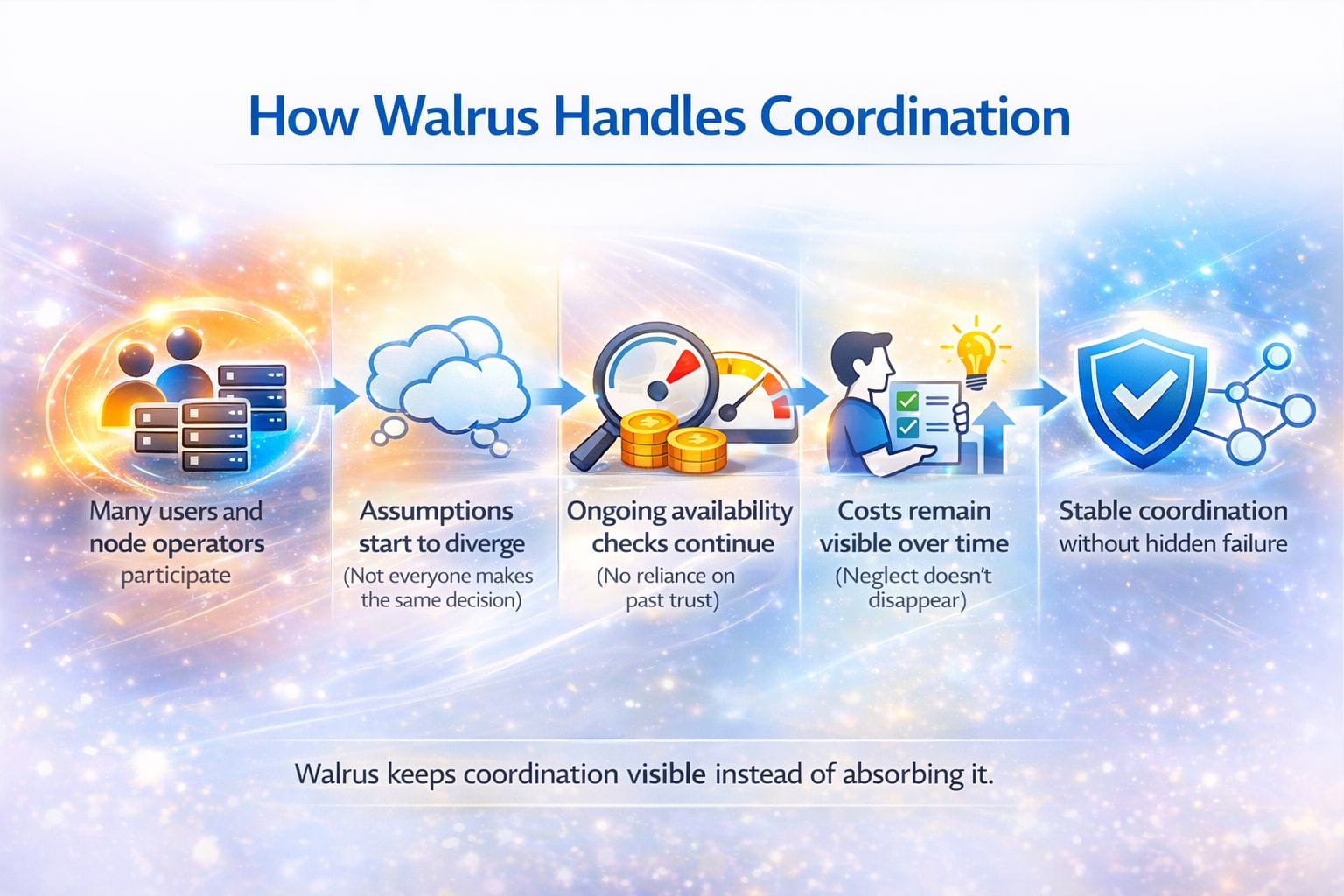
“Walrus keeps coordination visible instead of absorbing it.”
When Being Wrong Together Stops Being Cheap
In many networks, being wrong together is easy.
If enough participants make the same incorrect assumption, redundancy absorbs it. Replication smooths it out. Costs dissolve into the system, and no single action feels responsible for the outcome.
Walrus doesn’t allow this dynamic.
Keeping data available is not a one-time event.
Operating a node is not a fire-and-forget action.
Responsibility does not dissolve just because many participants are involved.
This turns coordination on Walrus into a visible economic signal, not a background assumption.
Participants adjust behavior not because they’re punished, but because being wrong continues to matter over time.
Walrus doesn’t label bad actors.
It simply doesn’t subsidize collective neglect.
Incentives Designed for Long-Term Alignment
Many Web3 systems reward short-term optimization.
Minimize effort. Maximize yield. Exit early.
Walrus incentives are built for a different outcome.
Node operators are rewarded for sustained availability, not momentary participation.
Users are exposed to the real cost of keeping data alive, rather than an abstract promise that it will “stay there forever.”
This pushes the network toward stable coordination rather than fragile efficiency.
Growth may be slower but alignment is stronger.
The User Experience of Explicit Responsibility
From the outside, Walrus feels calm.
There are no constant prompts asking users to reaffirm trust.
No aggressive alerts demanding attention.
No interface pretending responsibility has vanished.
But this calm UX is built on clarity, not invisibility.
Users understand that persistence requires care.
Operators know availability is continuously measured.
Responsibility is never hidden behind automation.
Walrus doesn’t try to remove responsibility from the experience.
It makes responsibility understandable.
Why This Matters for Web3 Infrastructure
As Web3 infrastructure matures, most systems will outlive their early users, incentives, and assumptions.
The hardest challenge won’t be scaling storage capacity.
It will be scaling coordination across time.
Walrus assumes drift will happen that attention will fade, that participants will move on and designs around that reality.
Instead of pretending coordination is free, Walrus makes it explicit.
Instead of hiding shared costs, it keeps them visible.
Instead of optimizing for speed, it optimizes for staying power.
That choice isn’t flashy.
But it’s durable.
And it’s what makes Walrus more than a storage layer it’s a coordination-aware data availability network built for long-term use.

