
Have you ever stopped to think about where your photos and files actually go when you save them to the cloud? Most of us just trust a few big companies to keep our memories safe. But today I want to introduce you to a really cool project called Walrus. It is a decentralized storage network that changes how we keep our data safe by using blockchain technology.
Walrus is not just another storage app. It is a system that splits your files into many tiny pieces and spreads them across a whole team of different computers. This means no single person or company owns your data. Instead a community of storage nodes works together to make sure your files are always there when you need them.
I think the most interesting part is how it uses a blockchain to manage everything. The blockchain acts like a digital manager that keeps track of the rules while the nodes handle the heavy lifting of storing the actual files. We are going to explore how this simple but powerful idea is making the internet a more secure place for everyone.
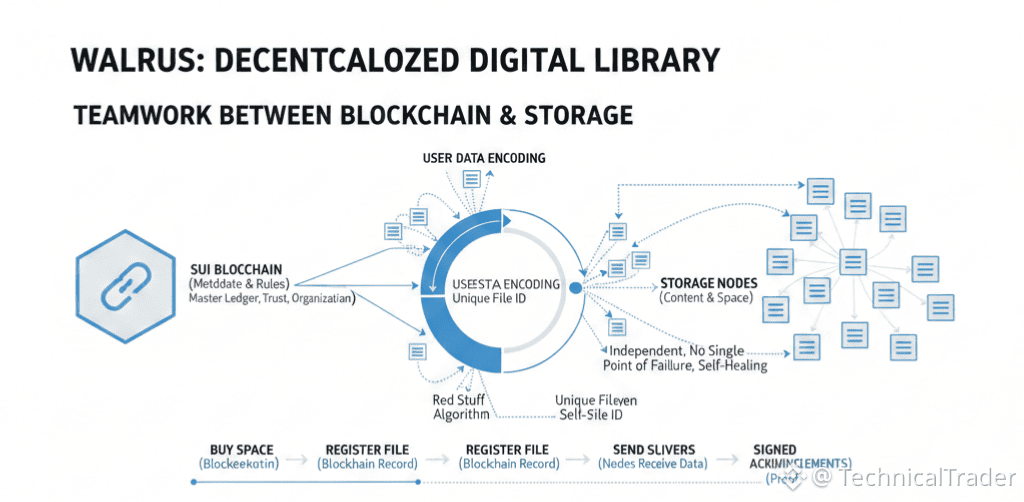
The Teamwork Between Blockchain and Storage
When we talk about Walrus we have to look at how it uses the Sui blockchain as its brain. The blockchain handles the metadata and the rules about who gets to store what. It is like a master ledger that ensures every node in the system is doing exactly what it promised to do for you.
While the blockchain manages the rules a separate group of storage nodes handles the actual content. These nodes are independent which is great because it means the system does not have a single point of failure. If one node goes offline the rest of the team is still there to protect your information.
We can see this as a perfect partnership. The blockchain provides the trust and the organization while the storage nodes provide the space. It is a very clever way to build a library that never closes and can never be burned down.
How Your Data Gets Ready for the Network
Before you send a file to Walrus it goes through a special process called encoding. I like to think of this as turning your file into a puzzle. Walrus uses something called the Red Stuff algorithm to break your data into pieces called slivers. This makes the data much harder to lose.
When this encoding happens the system also creates a unique ID for your file. This ID is based on things like how big the file is and what type of data it contains. It acts like a fingerprint so the network always knows exactly which file is yours and can verify it is correct.
The best part about this is that you do not need all the pieces to get your file back. Because of the way the slivers are created we can lose a few pieces and still reconstruct the entire file. It gives us a level of safety that a regular USB drive or a single server could never offer.
Buying Space and Registering Your Files
When you are ready to store something the first step we take is going to the blockchain to buy some space. You basically tell the network how much data you have and how long you want to keep it there. This is a very transparent process where you pay for exactly what you use.
Once you have your storage space the blockchain records your file and its unique ID. This is like signing a contract that says the network is now ready to take care of your data. It ensures that the storage nodes are prepared to receive the pieces of your file.
I really like this approach because it puts you in control of the cost and the duration. You are not stuck in a confusing monthly subscription with hidden fees. You simply buy the space you need on the blockchain and the network takes care of the rest for you.
How the Nodes Confirm They Have Your Data
After you register your file on the blockchain you send the little slivers of data to the storage nodes. Each node gets its own assigned pieces and a proof that shows the pieces are real. When a node receives its part it checks everything to make sure it matches your file ID.
If everything looks good the node sends back a signed acknowledgment. This is basically the node saying I have your data and it is safe with me. You collect these signatures until you have enough to prove that the network has successfully stored your file.
This part of the process is all about building confidence. You do not have to just hope that the nodes have your data. You get actual proof from the nodes themselves. It is a very interactive way to ensure that your digital items are tucked away safely.
Reaching the Point of Availability
The final big step is called reaching the Point of Availability or PoA. Once you have enough signatures from the nodes you post them back to the blockchain. This tells the whole world and the entire network that your file is now officially available and fully protected.
Once your file reaches this point you can actually delete it from your own phone or computer. The Walrus network is now the official guardian of that data. You can go offline and rest easy knowing that your information is being held by dozens of nodes across the world.
This PoA is also a great tool if you want to show someone else that a file exists. You can just point them to the blockchain record. It is a fast and reliable way to prove that information is available without having to send a giant file over email or chat.
Staying Safe and Recovering Data
The nodes in the Walrus network are very smart and they are always watching the blockchain.
If a node sees that a new file has reached the Point of Availability but it does not have the pieces yet it will automatically start a recovery process.
It talks to other nodes to get the missing parts.
This self healing feature is one of the things I love most about decentralized systems.
We do not have to worry if one computer crashes or if a storage provider disappears.
The rest of the network recognizes the gap and works together to fix it immediately.
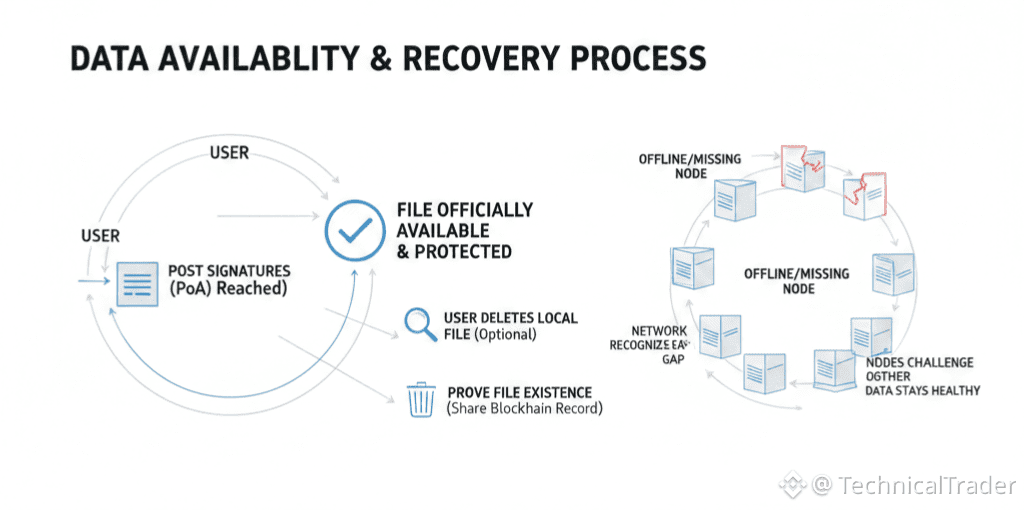
By constantly checking and challenging each other the nodes make sure the data stays healthy forever.
It is a living system that is always working in the background to protect our digital lives.
It makes the internet feel a lot more like a community and a lot less like a big corporate machine.
what you think about this? don't forget to comment 💭
Follow for more content 🙂


