
After years in crypto, one pattern becomes impossible to ignore: most so-called “blue chip” altcoins don’t age well. Narratives change, ecosystems fade, and liquidity moves on. Bitcoin is different. It’s the only asset in this space where long-term survival isn’t a constant question mark.
That difference matters — because Bitcoin shouldn’t be treated like a short-term trade.
Where Most People Mess Up
Many investors try to trade Bitcoin the same way they trade altcoins:
buy the dip, sell the pump, repeat endlessly. In reality, this approach often leads to overtrading, emotional decisions, and missed upside.
Bitcoin works best when it’s treated as a long-term accumulation asset, not a vehicle for constant in-and-out trades. The real objective isn’t to time every move — it’s to steadily increase your Bitcoin holdings over years, not weeks.
This Is Not a Trading Strategy
Let’s be clear:
This approach isn’t about catching every spike or predicting every top. It’s about building a position patiently and letting time do the heavy lifting.
The question then becomes simple:
How do you accumulate Bitcoin in a way that actually builds wealth?
Dollar-Cost Averaging (DCA): The Foundation
The most reliable strategy for most people is dollar-cost averaging.
That means buying Bitcoin on a fixed schedule — weekly, bi-weekly, or monthly — regardless of price. No prediction. No stress. No chasing candles.
Why this works:
You remove emotions from decision-making
You avoid the trap of “waiting for the perfect entry”
Over time, your average entry price smooths out market volatility
For the majority of investors, this alone will outperform active trading.
Understanding Bitcoin’s Cycles
If you want to add a bit more precision, Bitcoin’s historical behavior offers useful clues.
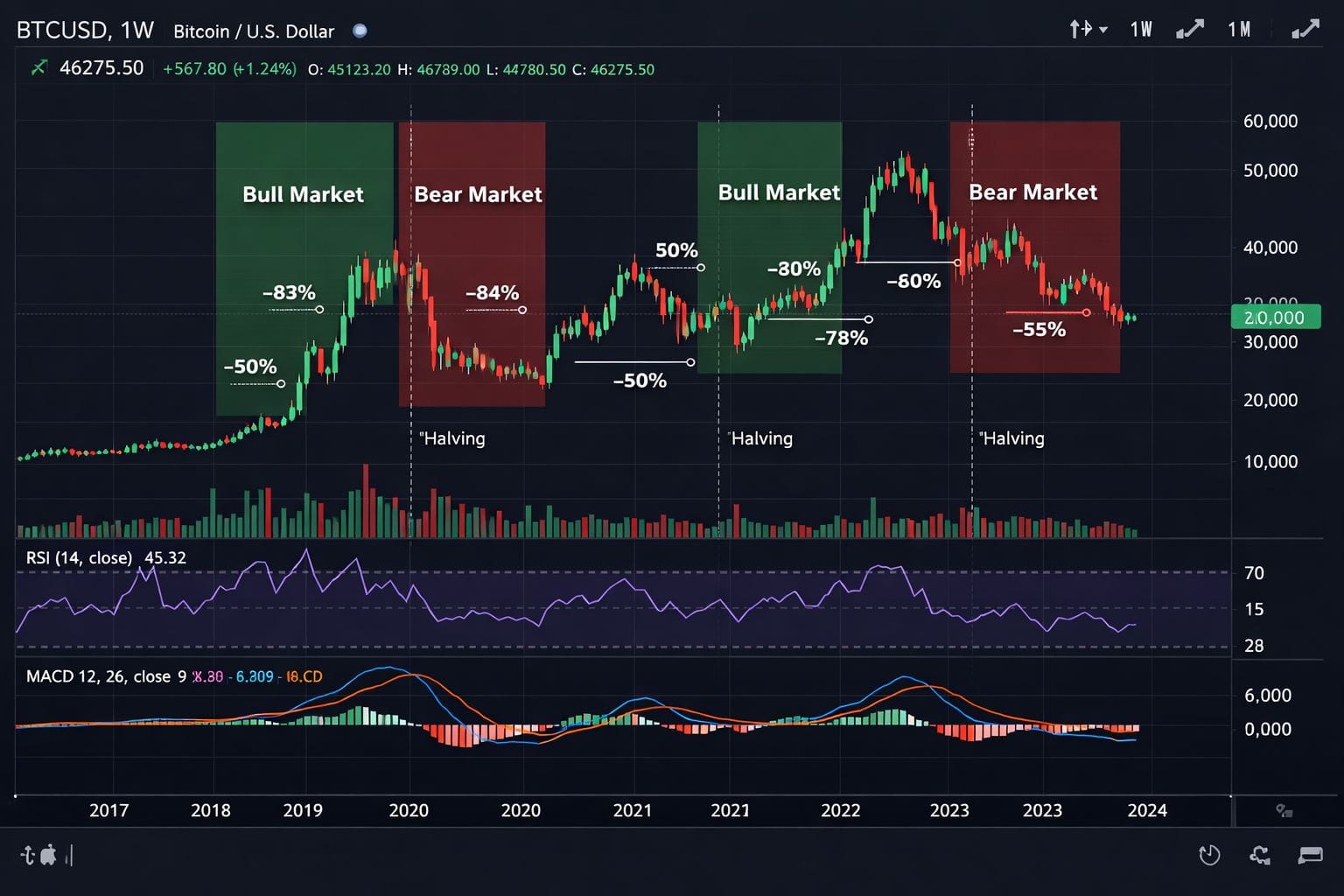
Bitcoin tends to move in four-year cycles, driven largely by supply dynamics and market psychology:
Explosive bull markets
Followed by deep bear markets
Often involving 70%–90% drawdowns from all-time highs
That doesn’t mean you should sit on the sidelines waiting for a crash. But historically:
30%–40% pullbacks often happen even in strong bull markets
40%–60% drops have consistently offered strong long-term value
Deeper drops usually signal bear-market conditions
You don’t need to time the exact bottom. You just want to buy when Bitcoin is clearly trading at a discount.
Two Practical Ways to DCA
There are two effective ways to approach accumulation:
1) Fixed-Interval Buying
Buy at regular time intervals, completely ignoring price.
This is simple, boring, and extremely effective over the long run.
2) Opportunistic Accumulation During Fear
Increase buying during major market pullbacks — 40%, 50%, or deeper corrections.
These moments feel uncomfortable, but historically they’ve offered some of the best long-term entries.
A balanced approach works well:
Keep consistent buys running in the background
Add heavier purchases during high-timeframe pullbacks
Focus on weekly and monthly charts, not short-term noise.
The Hardest Part: Execution
None of this is complex — but it is emotionally difficult.
Buying when the market is red, sentiment is negative, and headlines are screaming doom goes against human instinct. That’s exactly why it works.
When fear is highest, value is usually being created.
The real goal isn’t price targets or short-term profits.
It’s increasing your Bitcoin stack over time — because in the long run, Bitcoin is the asset, not the price.
#Write2Earn #MarketRebound #Binance #Bitcoin❗
