I remember opening my terminal in late 2021, ready to deploy a contract, and realizing nothing I knew applied anymore.
New syntax. New wallet quirks. New bugs. I watched good ideas stall, not because they were bad, but because the ecosystem around them was too thin. That memory comes back every time I look at EVM compatibility, especially in projects like Plasma.
EVM compatibility isn’t exciting. I watch people scroll past it like it’s a footnote. But if you’ve traded, built, or even just moved size on-chain long enough, you know this is where real trust begins. The Ethereum Virtual Machine is not perfect, but it is familiar. It has scars. It has history. And history matters in markets.
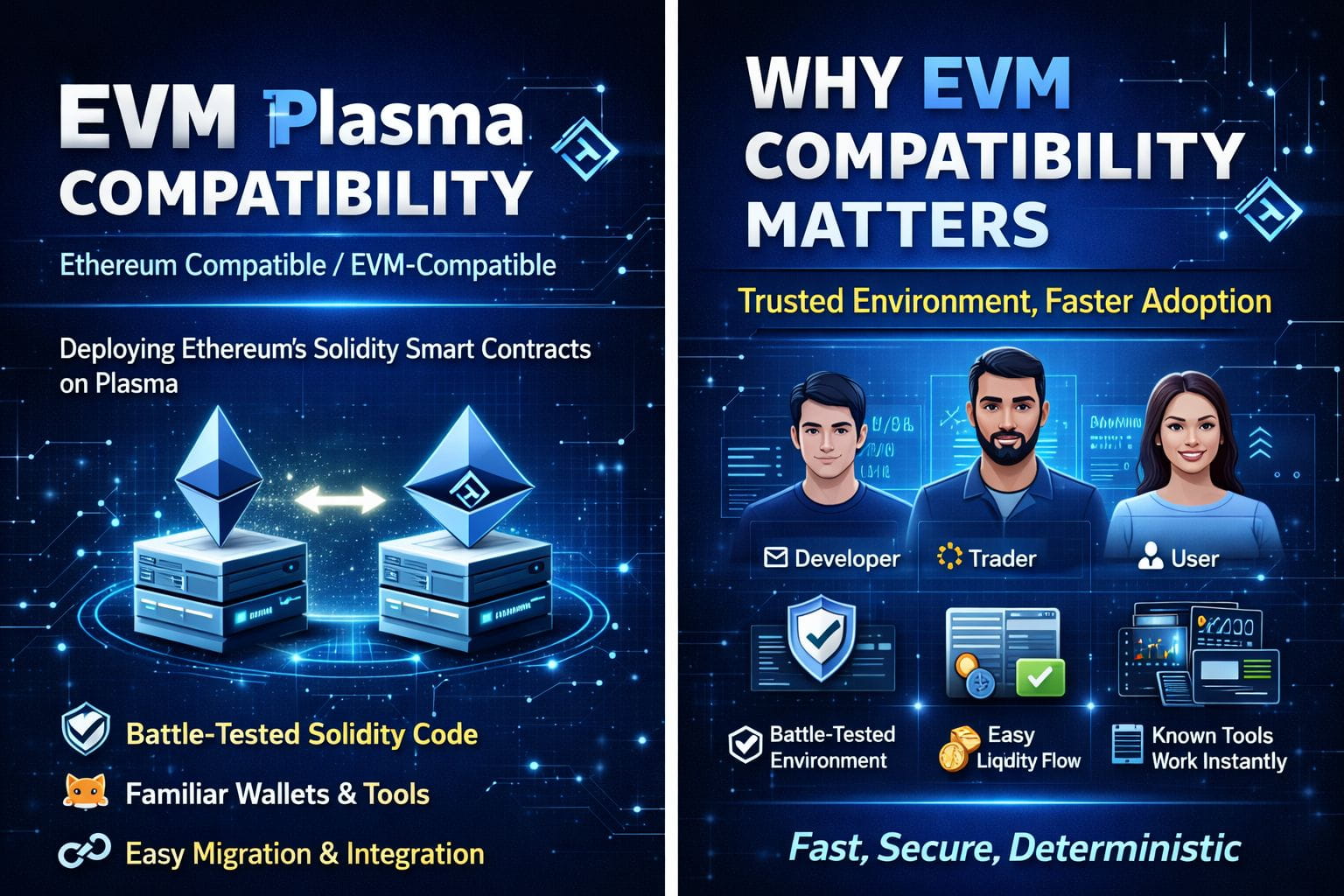
In simple terms, being EVM-compatible means Plasma can run the same smart contracts Ethereum does. Solidity code works. Wallets like MetaMask connect. Tools for analytics, monitoring, and security audits don’t need reinvention. That saves time, and in crypto, time equals survival.
Why is this conversation trending again in 2024 and early 2025? Because the market matured. According to developer activity reports published throughout 2024, Ethereum-compatible environments still host the majority of active smart contracts. Despite dozens of alternative virtual machines launched over the years, most serious builders stayed close to EVM. Not out of loyalty, but out of practicality.
Plasma’s whitepaper reflects this shift. Instead of creating a new execution environment and asking developers to adapt, it adapts to developers. That’s a subtle but powerful inversion. It lowers the barrier to entry and speeds up deployment. When projects launch faster, liquidity follows faster. Traders notice that immediately.
From a trading perspective, EVM compatibility reduces uncertainty. Familiar tooling means better data. Better data means better decisions. When explorers, indexers, and dashboards work from day one, price discovery becomes cleaner. I’ve traded assets where basic contract data was unreliable for weeks. That uncertainty isn’t priced into charts, but it’s very real.
There’s also a security angle that often gets overlooked. New virtual machines bring new attack vectors. New languages introduce mistakes simply because fewer eyes have reviewed them. The EVM has been stress-tested through exploits, audits, and failures over nearly a decade. That doesn’t make it safe by default, but it makes it predictable. And predictable risk is easier to manage than unknown risk.
Progress on Plasma’s side has been steady rather than loud. Throughout 2024, development updates focused on aligning with existing Ethereum tooling instead of reinventing it. That allowed early integrations without rewriting entire codebases. Developers didn’t have to gamble on learning something new just to experiment. That’s how ecosystems grow quietly.
As someone who trades and builds, I’ve learned that friction kills momentum. Every extra step loses users. Every unfamiliar tool delays adoption. Plasma’s EVM compatibility removes friction before it appears. It doesn’t promise perfection. It promises continuity.
Some critics argue that EVM compatibility limits innovation. I understand that argument. But innovation that isolates itself often ends up talking only to itself. Markets reward systems that integrate, not systems that isolate. Plasma seems aware of that trade-off and accepts it intentionally.
Philosophically, this feels like crypto moving from rebellion to responsibility. Early chains wanted to prove they were different. New chains now need to prove they are dependable. Plasma’s approach suggests that maturity isn’t about rejecting the past, but building on it thoughtfully.
I trust systems that respect accumulated knowledge. I trust chains that don’t ask users to reset their experience to zero. Compatibility is not laziness. It’s empathy. It acknowledges that people have already invested years learning tools, patterns, and risks.
In the end, EVM compatibility doesn’t guarantee success. Nothing does. But it increases the odds that good ideas actually reach the market. And after watching too many promising projects fail due to avoidable friction, I’ve come to value boring decisions that quietly work.
Sometimes, the most forward-looking move is choosing not to break what already functions.