

When a Node Disappears, the Protocol Doesn't Panic
Most decentralized systems handle failure through explicit coordination: detect the outage, vote on recovery, execute repairs. This requires time, consensus rounds, and opportunities for adversaries to exploit asynchrony. Walrus takes a radically different approach. Failure detection and recovery happen through natural protocol operations, surfaced and recorded on-chain as events. There is no separate "recovery process"—instead, the system heals as a side effect of how it functions.
Detection Through Absence, Not Announcement
When a storage node holding fragments of a blob falls offline, the protocol doesn't wait for someone to declare it dead. Readers trying to reconstruct data simply encounter silence. They request fragments from the offline node, receive no response, and automatically expand their requests to peer nodes. These peers, detecting that fragments they need are missing from expected sources, begin the healing process. The trigger is implicit: if enough readers hit the same gap, the network responds by regenerating what was lost.
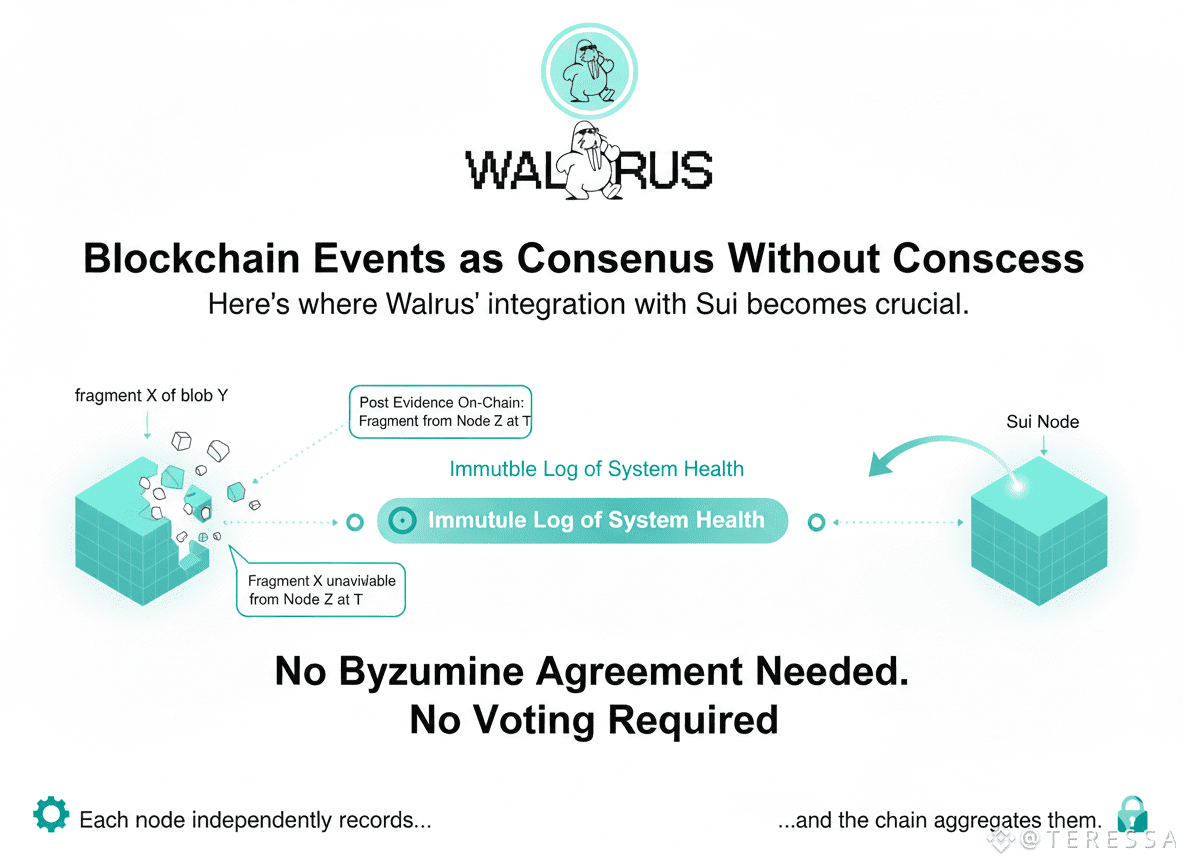
Blockchain Events as Consensus Without Consensus
Here's where Walrus' integration with Sui becomes crucial. When nodes detect missing fragments, they don't negotiate with each other directly. Instead, they post evidence on-chain: a record that "fragment X of blob Y was unavailable from node Z at timestamp T." These events accumulate on the blockchain, creating an immutable log of system health. No Byzantine agreement needed. No voting required. Each node independently records its observations, and the chain aggregates them.
Secondary Slivers as Pre-Computed Solutions
The magic happens through what Walrus calls secondary slivers—erasure-coded redundancy that nodes maintain alongside primary fragments. When missing fragments are detected on-chain, peer nodes don't reconstruct from first principles. They already hold encoded derivatives. A node in possession of secondary slivers for blob Y can transmit these pieces to reconstruct the missing primary fragments. Think of them as pre-computed backup blueprints. They exist because the system anticipated this moment.
The Recovery Flow: Silent, Incentivized, Verifiable
The mechanics unfold cleanly. Reader encounters missing fragment → broadcasts request to network → nodes with secondary slivers receive and respond → fragments are reconstructed → healed data is redistributed → blockchain event records the successful recovery. Throughout this process, no centralized coordinator exists. No halting of the system. Readers experience temporary latency while recovery completes, but the data remains available. The network heals around the failure continuously.
On-Chain Recording Prevents Gaming
Because every successful recovery is logged as a blockchain event, nodes cannot fake participation. A node claiming to have recovered missing slivers must produce cryptographic proof. Walrus uses Merkle commitments to fragments—attempting to lie about reconstruction fails verification. The blockchain becomes a truth ledger not of storage itself, but of whether the network successfully healed. This prevents nodes from claiming recovery rewards without actually contributing.
Incentives Flow From Chain Events
Here's the efficiency layer: nodes are compensated for participating in recovery based on on-chain records. A node that contributes secondary slivers to reconstruct missing fragments receives payment automatically through a smart contract triggered by the recovery event. This creates a self-reinforcing system. Missing fragments create opportunities for peers to earn. Peers respond by participating. The protocol achieves resilience through direct economic incentive rather than altruism or obligation.
Asynchronous Resilience as a Feature, Not a Bug
Traditional systems require synchronous network assumptions to coordinate recovery. Walrus embraces asynchrony. Nodes participate in recovery whenever they become aware of missing fragments. Messages can be delayed, reordered, or lost entirely—the blockchain-event-triggered recovery still completes. A node in Europe can recover slivers from nodes in Asia without needing to synchronize clocks or wait for rounds of consensus. The chain acts as a global, persistent message board.
Operator Experience: Healing Happens Unseen
From an operator's perspective, a node failure triggers nothing dramatic. The network continues serving readers. Behind the scenes, peers exchange secondary slivers, reconstruct missing data, and redistribute it. By the time an operator notices a node is offline and replaces it, the system has already healed the damage. New nodes joining the network receive not just current state but also redundancy sufficient to continue healing future failures independently. Operational overhead collapses.
Why This Architecture Scales Where Others Stall
Systems that require explicit recovery orchestration hit scaling walls. Every failure requires coordination, which means bandwidth for messages, latency for rounds, and complexity in fault-tolerance proofs. Walrus inverts this: failures trigger local responses that are passively recorded on-chain. Recovery is distributed, asynchronous, and incentivized. At thousand-node scale, the cost remains constant. The system handles correlated failures, Byzantine adversaries, and massive data volumes because it never required centralized orchestration in the first place.
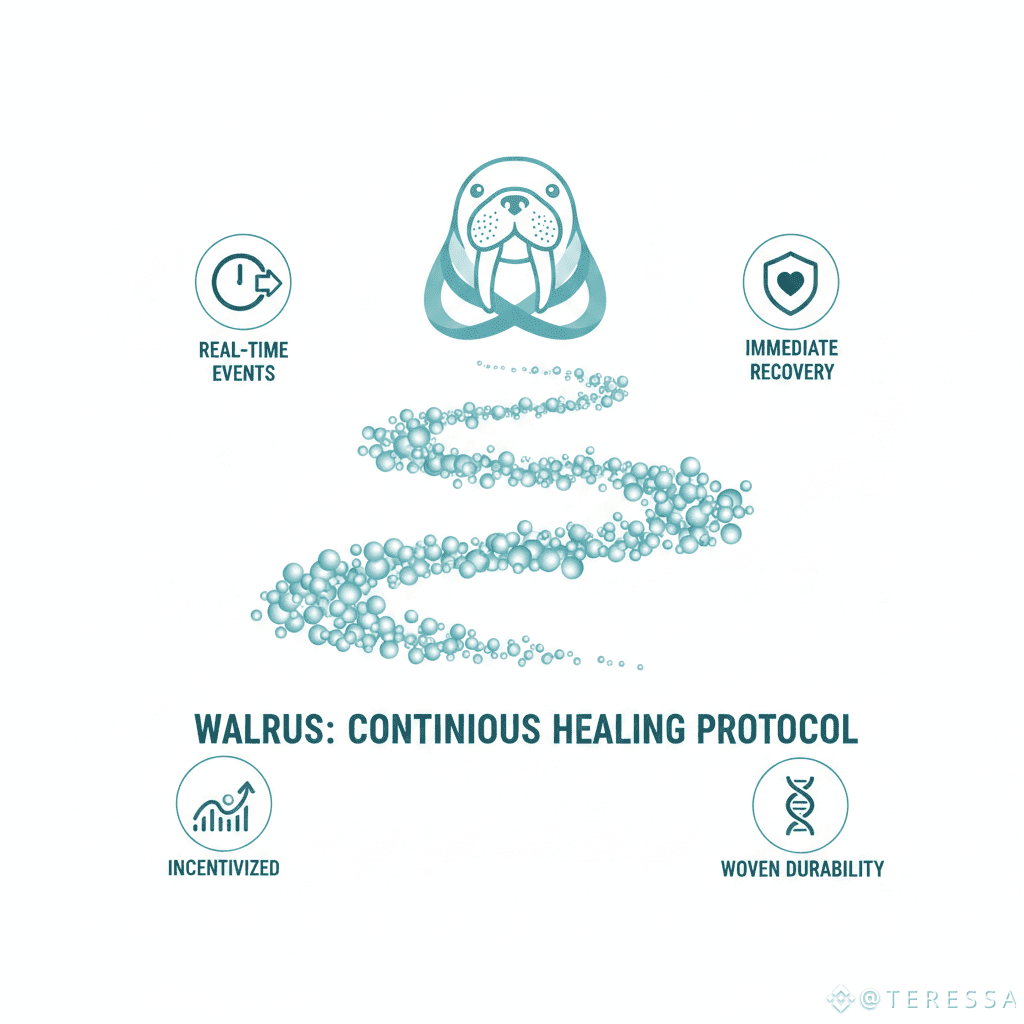
The Philosophical Shift: Events Over Epochs
This design represents a fundamental departure from blockchain-era thinking. Instead of freezing state at epoch boundaries and rebuilding from checkpoints,
@Walrus 🦭/acc maintains continuous healing. Events flow from nodes to chain in real time. Recovery happens immediately, recorded immediately, incentivized immediately. There is no batch process, no recovery epoch, no moment of vulnerability where the system waits. Durability and liveness are woven into the protocol's fabric rather than bolted on afterward.

