
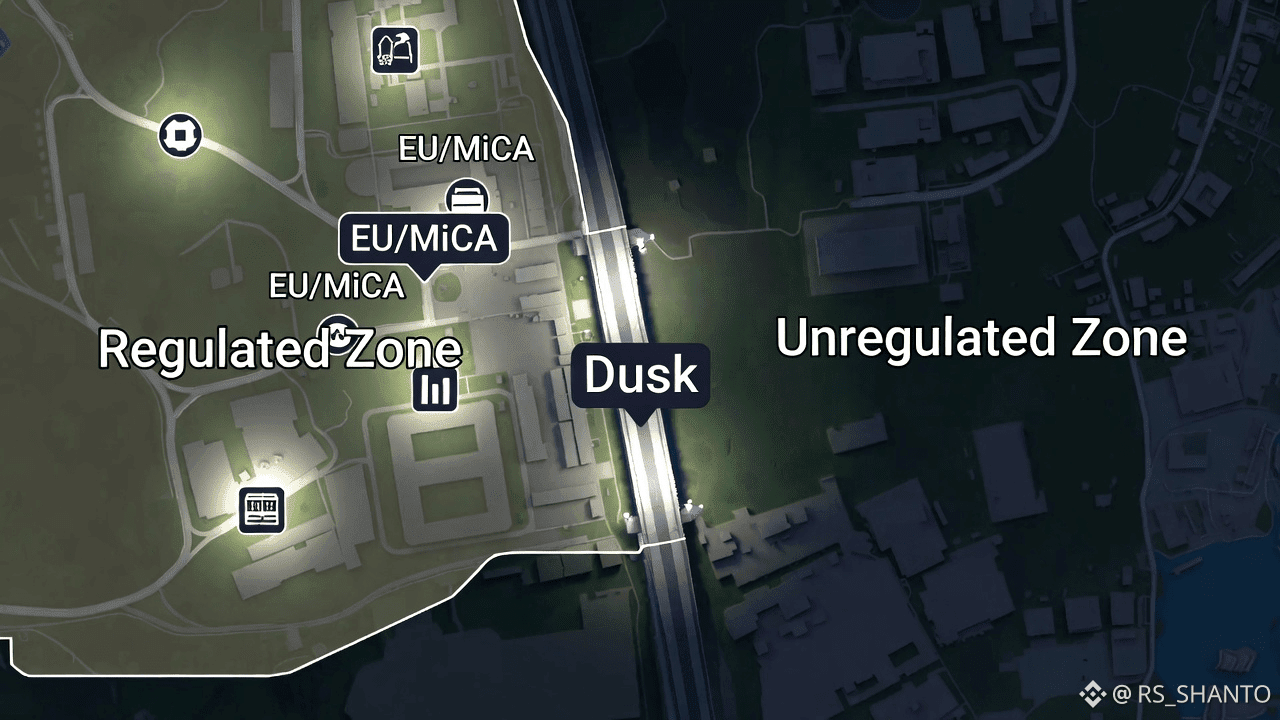
While the EU's MiCA regulation provides a long-term destination, the global regulatory landscape in 2024 remains a patchwork of "grey zones"—uncertain jurisdictions and evolving rules. Dusk's strategy isn't to wait for perfect clarity but to navigate this limbo with maximum credibility, turning regulatory uncertainty into a strategic advantage.
Dusk's approach is twofold. First, it establishes an unshakable home base by aligning perfectly with the most advanced framework (MiCA) and securing specific licenses (like the DLT-TSS application). This provides a "regulatory passport" for the EU and serves as a gold-standard reference for any other jurisdiction.
Second, for regions in the grey zone, Dusk leverages its privacy-by-design architecture as a critical tool. Institutions hesitant to operate on fully transparent chains due to commercial secrecy or unclear laws can use Dusk's Phoenix system. They gain the efficiencies of blockchain while keeping sensitive transaction details confidential until regulatory expectations crystallize. Dusk doesn't encourage evasion; it provides a technologically compliant waiting room.
This positioning is crucial for attracting early institutional partners. They aren't asked to bet on a regulatory outcome; they are given a platform that is already compliant in key markets and inherently adaptable elsewhere through its privacy features. Dusk becomes the lowest-regulatory-risk chain for experimentation.
The Bottom Line: In a world of regulatory fog, Dusk acts as a lighthouse and a reinforced ship. It offers a clear signal (MiCA compliance) for direction and a robust vessel (privacy tech) to safely navigate the uncertain waters, making it the preferred partner for institutions looking to explore blockchain without regulatory recklessness.
