
Most blockchains discover their weaknesses in public. A feature ships, usage grows, and only then do edge cases reveal themselves — usually through loss, downtime, or emergency fixes. Plasma takes a less theatrical path. It treats real deployment as the last step, not the first.
Plasma is built around the assumption that complex systems should be explored under stress before capital is exposed. Instead of relying on optimism and patch cycles, Plasma leans heavily on simulation-driven design.
This choice doesn’t generate headlines. It quietly changes the quality of everything that follows.
Why Production Is the Worst Place to Learn
Crypto has normalized learning through failure. “Battle-tested” often means “survived damage.” While that may work for experiments, it doesn’t scale to infrastructure expected to handle obligations, settlement, and regulated value.
Learning in production has hidden costs:
Users become involuntary testers
Capital absorbs design mistakes
Governance is forced into crisis mode
Plasma treats these outcomes as avoidable. Not by predicting the future perfectly, but by exploring possible futures systematically.
Modeling Behavior, Not Just Performance
Simulation on Plasma isn’t limited to throughput benchmarks or latency charts. The focus is behavioral.
How do participants react when incentives shift?
What happens when usage patterns cluster unexpectedly?
How do obligations interact under partial failure?
By modeling these scenarios ahead of time, Plasma surfaces fragilities that wouldn’t appear in clean, linear testing environments. The protocol is shaped around observed behavior, not assumed rationality.
This matters because real systems fail at the seams — where incentives, timing, and human decisions intersect.
Economic Stress Without Real Damage
One of Plasma’s quieter advantages is its ability to test economic assumptions without risking real funds. Fee behavior, validator incentives, and participation dynamics can be explored across extreme conditions.
What happens if activity spikes unevenly?
What if participation thins temporarily?
What if incentives drift subtly rather than catastrophically?
These questions are explored before deployment, not debated afterward. As a result, economic parameters are chosen with humility. They aren’t optimized for best-case scenarios. They’re chosen to remain stable across a wide range of plausible ones.
This produces systems that feel less clever — and more dependable.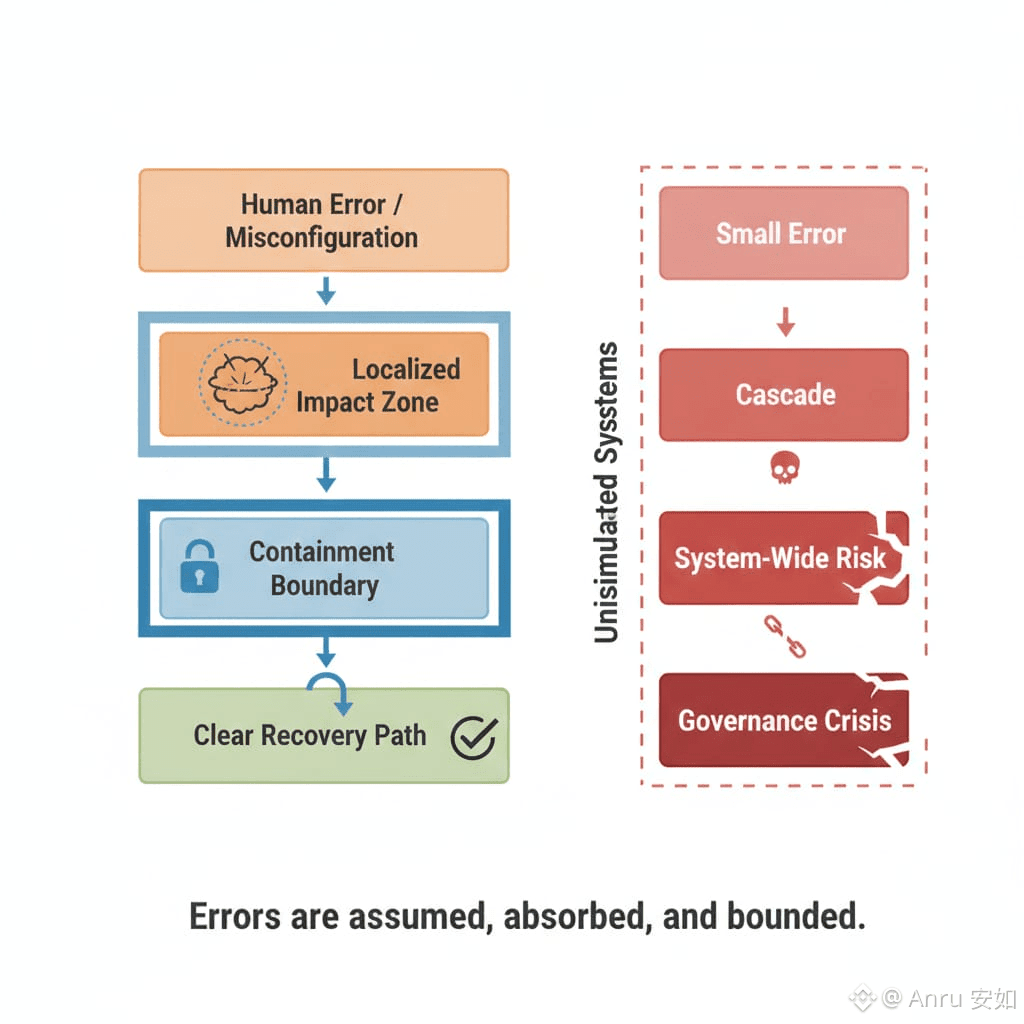
Designing for Human Error
Another benefit of simulation-first thinking is how it treats mistakes. Plasma assumes participants will misconfigure, misunderstand, or act imperfectly.
Instead of blaming users, the protocol is shaped to absorb that reality. Simulations reveal where small errors cascade and where they fade harmlessly. Design choices are then made to favor containment over punishment.
This results in systems that fail softly rather than sharply. Errors are local. Recovery paths are clear. Responsibility doesn’t spill unpredictably.
That tolerance isn’t accidental. It’s engineered.
Fewer Surprises, Slower Drama
When protocols skip deep simulation, surprises are inevitable. When surprises hit public systems, they become events. Events become narratives. Narratives create pressure to act fast — often at the expense of good decisions.
Plasma’s approach reduces the frequency of surprise. Not because nothing unexpected can happen, but because many classes of failure have already been rehearsed.
As a result, responses can be measured. Governance doesn’t need to sprint. Users don’t need to panic. The system behaves more like infrastructure and less like an experiment.
Better Defaults, Less Tuning
Systems designed through simulation tend to rely less on constant adjustment. Parameters are chosen because they behave acceptably across many conditions, not because they maximize a single metric.
This reduces governance load over time. Fewer tweaks. Fewer debates. Fewer emergency justifications.
Defaults become durable. That durability compounds.
Why This Matters for Trust
Trust in infrastructure isn’t built on claims. It’s built on the absence of unpleasant surprises. When systems behave as expected — even under stress — confidence grows quietly.
Plasma doesn’t ask users to trust intentions. It asks them to observe behavior over time. Simulation-first design increases the likelihood that observed behavior matches promised behavior.
That alignment is rare in crypto, where speed often outruns understanding.
Building for Boredom
There’s an unglamorous goal behind Plasma’s design philosophy: boredom.
Boring systems don’t trend. They don’t generate constant alerts. They don’t require frequent explanations. They just work — within known bounds, with known trade-offs.
Simulation-driven design is one of the few ways to approach that outcome intentionally.
When Infrastructure Grows Up
As blockchain moves from experimentation toward expectation, tolerance for “we’ll fix it later” diminishes. Users care less about innovation velocity and more about reliability curves.
Plasma is built for that transition. By learning in simulated environments instead of live ones, it shifts risk left — away from users and toward design.
That doesn’t make the protocol perfect. It makes it prepared.
Quiet Confidence Over Loud Launches
Plasma’s reliance on simulation won’t produce viral moments. It produces something less visible and more valuable: confidence without theatrics.
When systems don’t surprise people, they stop being discussed — and start being depended on.
In the long run, that’s how infrastructure earns its place.