
Public blockchains usually reveal their limits the moment they are exposed to real requirements like confidentiality regulation and accountability. Dusk exists because those limits are not edge cases but everyday conditions in the environments that actually matter.
I am going to write this the way I would speak to people who understand why Dusk was never meant to compete on hype or visibility. This is not a narrative and it is not an abstract vision piece. This is about engineering choices meeting real world pressure and why Dusk is deliberately positioning itself where generic blockchain designs start to break down.
If you examine most blockchain architectures closely a pattern becomes obvious. They are optimized for openness speed and simplicity of validation. That works for public experimentation and consumer use cases. It fails when confidentiality is required and compliance cannot be optional. Dusk was designed around that failure point rather than pretending it does not exist.
Dusk is not trying to retrofit privacy into a transparent system. It was built with privacy as a foundational constraint. That single design decision forces a completely different approach to execution validation and governance. It also raises the bar for correctness because mistakes in privacy systems carry far more serious consequences.
Recent progress on the network shows a clear shift from assembling components to integrating them into a cohesive system. Confidential execution zero knowledge verification and selective disclosure are no longer treated as separate concepts. They are coordinated parts of a single operational flow. That coordination is what moves a network from theory into use.
One of the most difficult challenges Dusk addresses is the coexistence of privacy and verifiability. Most chains sacrifice one to preserve the other. Dusk does not allow that shortcut. Transactions must remain confidential while still being provably correct. Recent protocol refinements have tightened this balance and reduced ambiguity around state transitions.
Zero knowledge proof systems within Dusk have been refined with operational efficiency in mind. Proof generation and verification paths have been optimized to reduce overhead while preserving security guarantees. This matters because privacy systems that cannot operate efficiently under continuous load never leave controlled environments.
Finality and execution consistency have also been strengthened. In regulated and institutional contexts uncertainty is unacceptable. A transaction must resolve cleanly and predictably. Recent changes in validation coordination and execution ordering have improved determinism across the network. This predictability is essential for settlement and contract enforcement.
Infrastructure hardening has been ongoing. Internal communication between network components has been streamlined. Resource contention has been reduced. Memory and computation pathways have been optimized to avoid gradual degradation. These changes are subtle but critical for long running systems.
Scalability has been approached conservatively. Instead of advertising extreme throughput the focus has been on sustaining consistent performance as usage grows. Privacy workloads behave differently from transparent ones and Dusk architecture reflects that reality. Stability under load matters more than peak capacity.
Selective disclosure remains one of the most important aspects of the design. Many real world workflows require confidentiality by default with the ability to disclose specific information under defined conditions. Dusk supports this without collapsing into full transparency. This enables compliance without surrendering privacy.
From a development perspective the environment has become more disciplined. Tooling reflects protocol constraints rather than hiding them. Documentation emphasizes correctness and assumptions. This signals that Dusk is intended for serious systems rather than casual experimentation.
Applications being built on Dusk increasingly reflect this seriousness. Confidential financial instruments regulated asset issuance and privacy preserving data workflows are becoming the dominant focus. These are use cases that demand reliability and precision.
Asset models on the network have matured. Ownership transfer rules compliance conditions and access control are encoded directly into system logic. This reduces reliance on off chain enforcement and manual oversight. Assets behave according to provable rules.
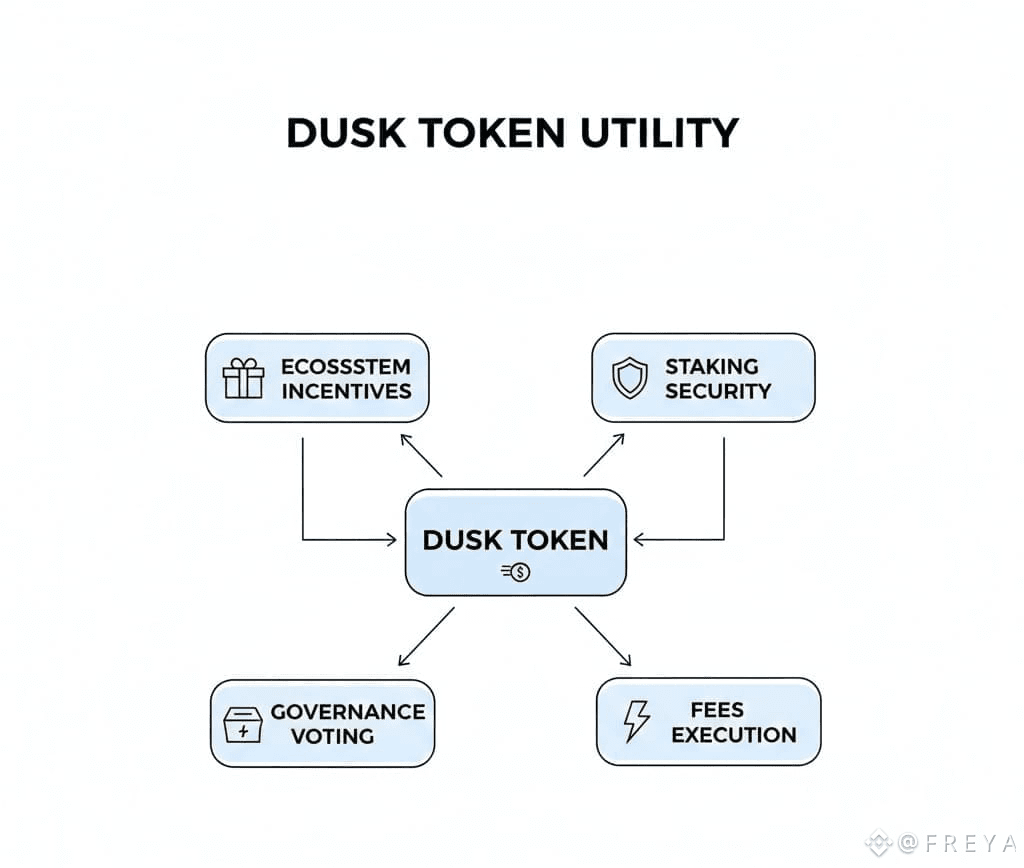
Participation incentives are aligned with long term network integrity. Validators are rewarded for consistency and correctness rather than opportunistic behavior. This alignment supports the reliability required for regulated environments.
Security is treated as a continuous process. Monitoring validation and fault detection are designed to surface issues early. In privacy focused systems silent failure is especially dangerous and Dusk architecture reflects awareness of that risk.
Governance mechanisms emphasize stability. Changes are introduced deliberately with attention to downstream impact. This reduces fragmentation and preserves trust among long term participants.
Communication around the project is restrained and precise. Updates focus on implemented changes rather than speculative outcomes. This builds credibility with stakeholders who value accuracy over excitement.
The broader blockchain market remains driven by short term narratives. Dusk has remained focused on its constraint set. This consistency is critical for institutional relevance where frequent pivots erode confidence.
Adaptation still occurs but it is evidence driven. Designs are revised when assumptions change. There is no attachment to ideology or branding. The system evolves based on operational feedback.
Ecosystem growth prioritizes depth. Supporting existing builders validating real workflows and strengthening core components take precedence over expansion. This reduces risk and increases reliability.
User experience is handled carefully. Privacy systems are inherently complex but unnecessary complexity is removed. Interactions are explicit and predictable which improves auditability.
For developers and integrators Dusk now presents a more credible foundation. Privacy verifiability and stability are integrated at the protocol level rather than bolted on.
Ownership access control and participation are system level concerns. Rules are enforced by code rather than convention. This reduces ambiguity and legal risk.
Community discussion reflects this maturity. Conversations focus on architecture tradeoffs and deployment scenarios rather than speculation. This is typical of infrastructure approaching real use.
Challenges remain. Privacy infrastructure is difficult. Regulatory landscapes are fragmented. Adoption takes time. Competition exists. Dusk does not deny these realities.
What distinguishes Dusk is that it designs around constraints instead of avoiding them. The network accepts complexity where it is unavoidable and simplifies only where it is safe to do so.
Dusk is not aiming to be a general purpose chain for everything. It is positioning itself for environments where most public blockchains fail under pressure.
Future progress will be measured in execution efficiency proof system refinement and real world integration. That is where credibility is earned.
Dusk is not selling an idea of privacy. It is constructing a system where privacy and accountability coexist without pretending the tradeoffs disappear.
That path is slower and harder. It is also one of the few that leads to meaningful use.
Dusk is being built for constraints most chains never plan for.
@Dusk $DUSK #Dusk
