

Privacy in crypto is often treated like a shield. Hide everything and trust will somehow follow. That approach usually collapses when verification is required.
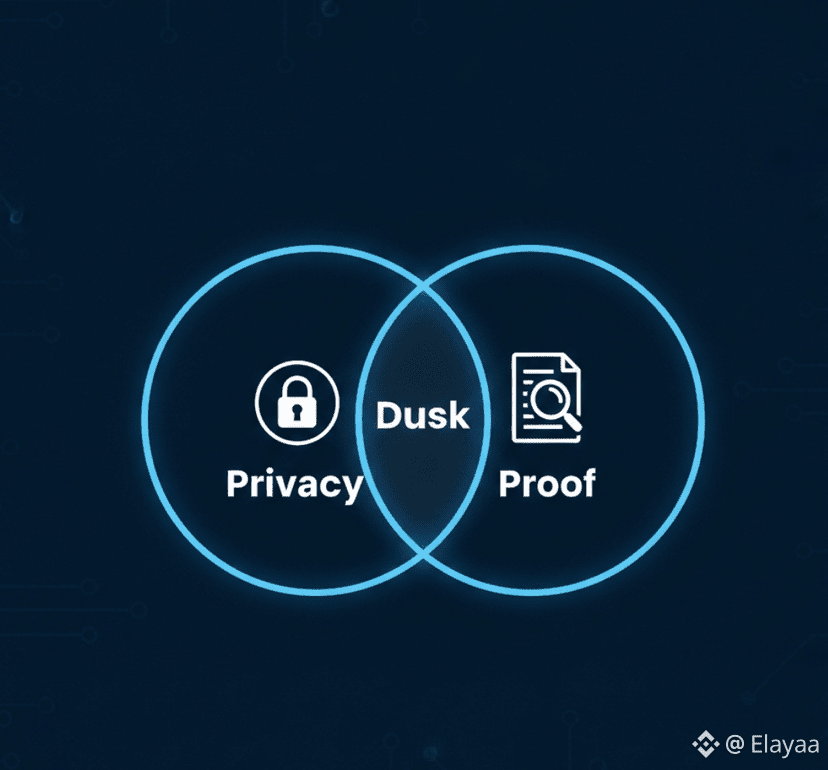
The opposite extreme is full transparency. Make everything public and let openness replace trust. That works until sensitive financial data is exposed forever.
Dusk doesn’t choose either side.
It chooses control.
On Dusk, privacy is default, but proof is always possible. This is achieved through privacy-preserving technologies that allow verification without disclosure. The details stay hidden, but compliance can still be demonstrated.
This matters for regulated finance.
In real markets, privacy and trust are not enemies. They exist together. Companies protect sensitive data while still undergoing audits. Financial systems reveal information selectively, not publicly.
Dusk mirrors this reality on-chain.
Through its design, Dusk allows regulators and auditors to verify transactions without turning the blockchain into a public ledger of confidential data. That’s a subtle but powerful shift from traditional blockchain models.
DuskEVM extends this idea further. Developers can deploy standard Solidity smart contracts while settling on Dusk’s Layer 1. This removes friction. Institutions don’t need to reinvent their workflows. They can build using familiar tools while relying on infrastructure designed for compliance.
This is where many projects fail. They focus on developers first and hope compliance comes later. Dusk treats compliance as a foundation, not an afterthought.
$DUSK powers this entire system. It supports settlement, proof generation, and network continuity. It doesn’t try to be loud. It tries to be reliable.
When systems work quietly under regulatory pressure, that’s usually because the hard decisions were made early.
Dusk makes those decisions visible only when needed.
