

Interoperability is one of the most over-simplified ideas in blockchain design. Most networks frame it as a routing problem: move assets from chain A to chain B as cheaply and quickly as possible. Dusk Network approaches interoperability from a very different angle. For Dusk, interoperability is not about speed or convenience. It is about preserving legal, economic, and privacy guarantees across system boundaries.
This distinction is critical—and it explains why Dusk is cautious where others are aggressive.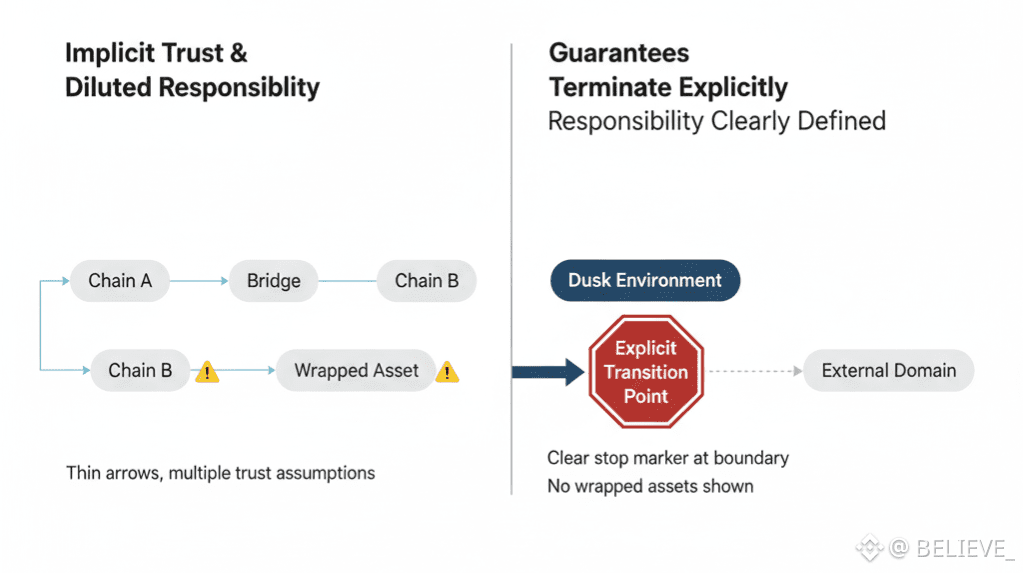
In many ecosystems, cross-chain interaction is treated as a bolt-on feature. Bridges lock assets, mint representations elsewhere, and hope that assumptions hold. The focus is almost entirely technical: cryptographic verification, relayers, oracles. What gets ignored is what happens to responsibility once an asset leaves its native environment.
Dusk does not ignore that question.
The protocol is designed with the expectation that value may need to interact with other networks, but only under conditions where Dusk’s guarantees are not diluted. Privacy, correctness, and compliance are not optional properties that can be relaxed for the sake of liquidity. If those properties cannot be preserved across a boundary, the boundary is treated as hostile.
This is why Dusk frames interoperability as a constrained interface, not a free-flowing bridge.
From the protocol’s perspective, an external chain is not just another execution environment. It is a different legal and operational domain. Moving value across that boundary without strict controls risks breaking assumptions that regulated systems rely on. Dusk refuses to pretend that cryptographic proofs alone can solve that.
Instead, the design favors explicit transition points. When value moves out of Dusk’s environment—or interacts with external logic—the protocol requires clear accounting, clear termination of guarantees, and clear responsibility. There is no illusion that privacy or enforcement magically persists beyond the system that enforces it.
This restraint is intentional.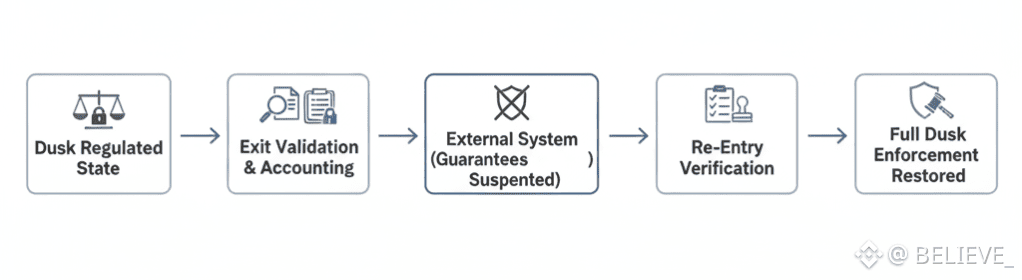
In regulated finance, interoperability does not mean assets lose their rules when they cross borders. Securities do not become bearer instruments just because they move between clearing systems. Obligations, restrictions, and audit requirements follow the asset. Dusk mirrors that reality in its technical architecture.
Rather than advertising frictionless cross-chain movement, Dusk prioritizes integrity of state transitions. The system ensures that when value leaves, it does so cleanly. When value returns, it re-enters under full protocol enforcement. There are no half-states where assets are “kind of” governed by Dusk and “kind of” governed elsewhere.
This design choice also protects users. In many cross-chain setups, users unknowingly assume risks they cannot see. They trust bridges, relayers, or wrapped representations without understanding what guarantees have been lost. Dusk avoids that ambiguity by making boundaries explicit and non-negotiable.
From a professional standpoint, this aligns with how serious infrastructure treats integration. Systems do not merge trust domains casually. They define interfaces, responsibilities, and failure modes before allowing interaction. Dusk applies that discipline to blockchain interoperability.
There is also a long-term security dimension. Bridges are among the most attacked components in the blockchain space—not because cryptography is weak, but because assumptions are stretched too far. By narrowing the scope of interoperability, Dusk reduces the incentive and surface area for catastrophic failures.
Importantly, this does not mean Dusk is isolationist. It means interoperability is intentional rather than opportunistic. The protocol is open to interaction where guarantees can be preserved or cleanly suspended, not where they are quietly eroded.
The DUSK token benefits directly from this philosophy. Its economic meaning remains stable because it is never casually abstracted into environments that cannot enforce its rules. Value is not multiplied through representations that dilute accountability.
Over time, this approach creates trust not through promises, but through consistency. External systems know exactly what they are interacting with. Users know exactly what changes when assets cross boundaries—and what does not.
In a market obsessed with liquidity at all costs, Dusk’s stance may appear conservative. But history favors systems that survive integration, not those that collapse under it. Interoperability failures are rarely minor. They are often systemic.
Dusk understands that connecting systems is easy.
Preserving guarantees across those connections is hard.
By treating interoperability as a legal and economic boundary—not just a technical one—Dusk positions itself for environments where mistakes are expensive, audits are real, and assumptions are tested under pressure.
That is not the loudest path forward.
But it is the one most likely to endure.