

When I first came across Walrus Protocol, I didn’t have that instant “aha” moment. Nothing jumped out. No bold claims. No grand vision of saving finance. At first, that almost made me overlook it. But the more I sat with it, the more I realized that this quietness was the point.
I kept coming back to the idea of privacy. I used to think of privacy as something absolute—either everything is hidden, or nothing is. But that view slowly fell apart. In real systems, privacy isn’t about secrecy for its own sake. It’s contextual. Some data needs to be visible. Some needs to be protected. And sometimes, the same data needs to be both—depending on who’s asking and why. That’s not a philosophical stance; it’s a practical one. Especially once audits, compliance checks, and real responsibility enter the room.
Walrus running on Sui started to feel less like a “crypto project” and more like infrastructure work. The way it handles storage—breaking large files into pieces, spreading them across the network, making them recoverable—feels designed for stress, not demos. It’s the kind of system you build when you assume things will go wrong, and you want them to fail gracefully.
What really changed my perspective was noticing the progress no one brags about. Improvements to monitoring. Better tooling for operators. Metadata handling that makes systems easier to inspect and explain. Node updates focused on reliability rather than speed headlines. These are not features that trend online. But they’re exactly the things that matter when someone asks, “Can you prove this worked the way you said it did?”
Even the token side made more sense once I stopped thinking of it as an investment object. Staking, governance, validators—it’s all there to coordinate responsibility. Validators aren’t just participants; they’re accountable operators. Staking isn’t a reward machine; it’s a way to make sure the people securing the system actually have something at risk if they fail. Framed that way, it feels less exciting and more honest.
There are trade-offs too, and I didn’t appreciate them at first. Compatibility layers. Supporting older deployments. Gradual migration instead of clean breaks. My instinct was to see these as compromises. But over time, I realized they’re necessary ones. Real users don’t move overnight. Real institutions don’t rewrite everything at once. Systems that expect that kind of perfection rarely survive contact with reality.
I think that’s what finally clicked for me. Walrus doesn’t feel like it’s trying to win an argument. It feels like it’s trying to hold up under questioning—by auditors, by operators, by people who have to explain failures, not just successes.
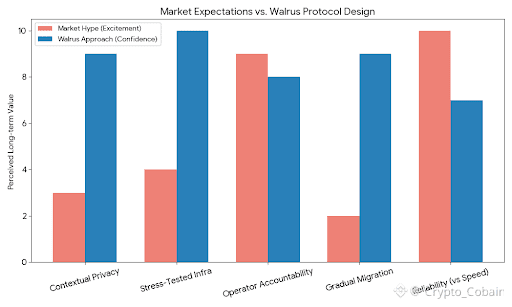
I wouldn’t say I’m excited.That’s not the emotion this project triggers. What I feel instead is calm confidence building slowly. The sense that someone designed this with the expectation of pressure, scrutiny, and responsibility—and didn’t flinch. And quietly, that’s what makes it convincing.

