

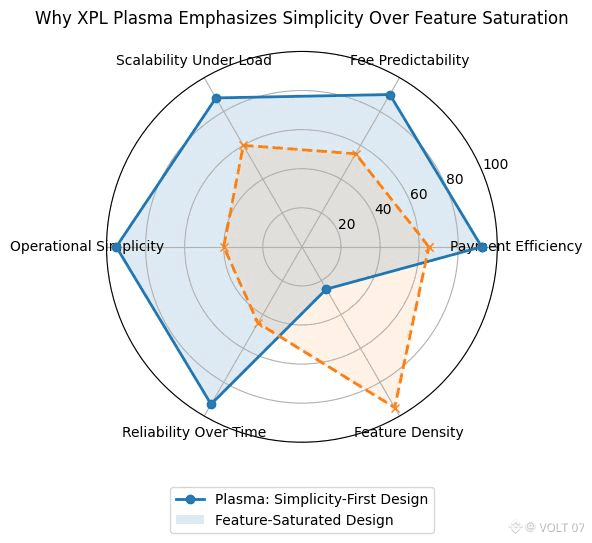
 In crypto, complexity is often mistaken for progress. XPL Plasma treats it as a liability.
Most ecosystems compete by shipping more: more modules, more virtual machines, more features, more composability layers, more token mechanics. On paper, this looks like innovation. In production, it often becomes fragility.
XPL Plasma takes a different path. It emphasizes simplicity because simplicity is not minimalism it is risk control, operational stability, and long-term scalability engineered into the system.
Feature saturation creates more surfaces for failure and scaling systems cannot afford fragile edges.
Every additional feature adds:
more code paths
more edge cases
more state complexity
more governance overhead
more upgrade risk
more security audit scope
In high-throughput environments, these risks compound faster than most teams expect.
XPL Plasma’s simplicity-first approach reduces the probability of catastrophic failures by keeping the protocol’s core responsibilities clear and bounded.
This is how infrastructure survives: not by doing everything, but by doing the essentials exceptionally well.
Simplicity improves predictability and predictability is the real UX advantage.
A chain with 200 features is not what consumers want.
They want a chain that behaves consistently:
transactions finalize reliably
fees stay stable
performance doesn’t collapse during spikes
failure modes are understandable
exits remain enforceable
Simplicity is what makes these guarantees easier to maintain.
The more complex the protocol, the harder it becomes to predict behavior under stress.
XPL Plasma is optimizing for the user experience that matters most: confidence.
Plasma architectures reward disciplined scope because security depends on enforceable rules.
Plasma’s security model relies on:
valid state commitments
contestability through challenges
reliable exit mechanisms
clear dispute rules
verifiable ownership proofs
If the system becomes overloaded with features, these core mechanisms become harder to audit and harder to enforce.
XPL Plasma’s simplicity ensures that the chain’s safety guarantees remain:
understandable
verifiable
enforceable
resilient in worst-case conditions
In Plasma systems, simplicity is not a design preference it is a security requirement.
The strongest scaling systems act like utilities, not experiments.
Web2 infrastructure wins because it is boring:
stable
predictable
repeatable
easy to integrate
hard to break
Feature-saturated chains often behave like experimental platforms, constantly evolving and increasing operational uncertainty.
XPL Plasma is taking the utility route building infrastructure that developers can trust for years, not just for one cycle.
Simplicity lowers validator burden and protects decentralization.
As protocol complexity rises, validator requirements rise:
higher hardware costs
more operational maintenance
greater monitoring difficulty
more specialized infrastructure
higher risk of misconfiguration
This leads to centralization pressure, because only professional operators can keep up.
By keeping the system simpler, XPL Plasma supports validator sustainability and validator sustainability is a decentralization strategy.
Feature saturation often produces “innovation debt.” Simplicity prevents it.
In crypto, teams frequently ship features faster than they can secure them. Over time, this creates innovation debt:
half-finished modules
risky upgrades
fragile integrations
broken assumptions
governance chaos
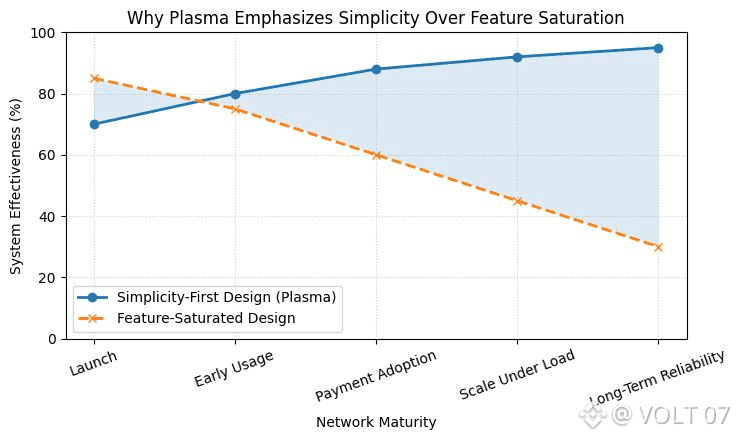
XPL Plasma’s simplicity-first philosophy reduces innovation debt by focusing on a smaller set of primitives that can be:
thoroughly tested
audited deeply
maintained reliably
upgraded safely
This is how systems avoid collapsing under their own complexity.
The product insight: mainstream adoption depends more on reliability than on optional features.
Consumer apps need:
low fees
fast confirmations
stable performance
predictable rules
recoverable funds
minimal friction
They do not need a chain to support every experimental DeFi feature from day one.
XPL Plasma is building for consumer-scale usage where simplicity becomes a competitive advantage because it improves performance, reduces risk, and stabilizes behavior.
Simplicity also creates a clearer trust contract between the protocol and the user.
Users trust systems when they can understand the guarantees:
What happens if the operator fails?
What happens if the network halts?
How do exits work?
What rights do I retain?
What risks are explicitly acknowledged?
Complex systems often hide these answers behind layers of abstraction.
XPL Plasma’s simplicity makes the trust contract explicit, which strengthens credibility.
In the long run, simplicity is what allows ecosystems to scale without becoming brittle.
Feature saturation wins headlines.
Simplicity wins longevity.
By focusing on:
predictable performance
stable economics
enforceable user autonomy
credible exit guarantees
validator sustainability
reduced attack surface
XPL Plasma positions itself as a chain that can survive real usage, real stress, and real time.
Complexity creates options, but simplicity creates reliability. In infrastructure, reliability is the rarest feature of all.

