
There’s a certain kind of quiet ambition that doesn’t announce itself with noise or spectacle. It doesn’t rush to dominate headlines or promise overnight revolutions. Instead, it builds patiently, layer by layer, with the confidence of something that understands time is its ally. Walrus belongs to that rare category. What looks, on the surface, like a decentralized storage and privacy protocol is actually unfolding into something much deeper: a long-term vision for how humans relate to data, value, and trust in a decentralized world.
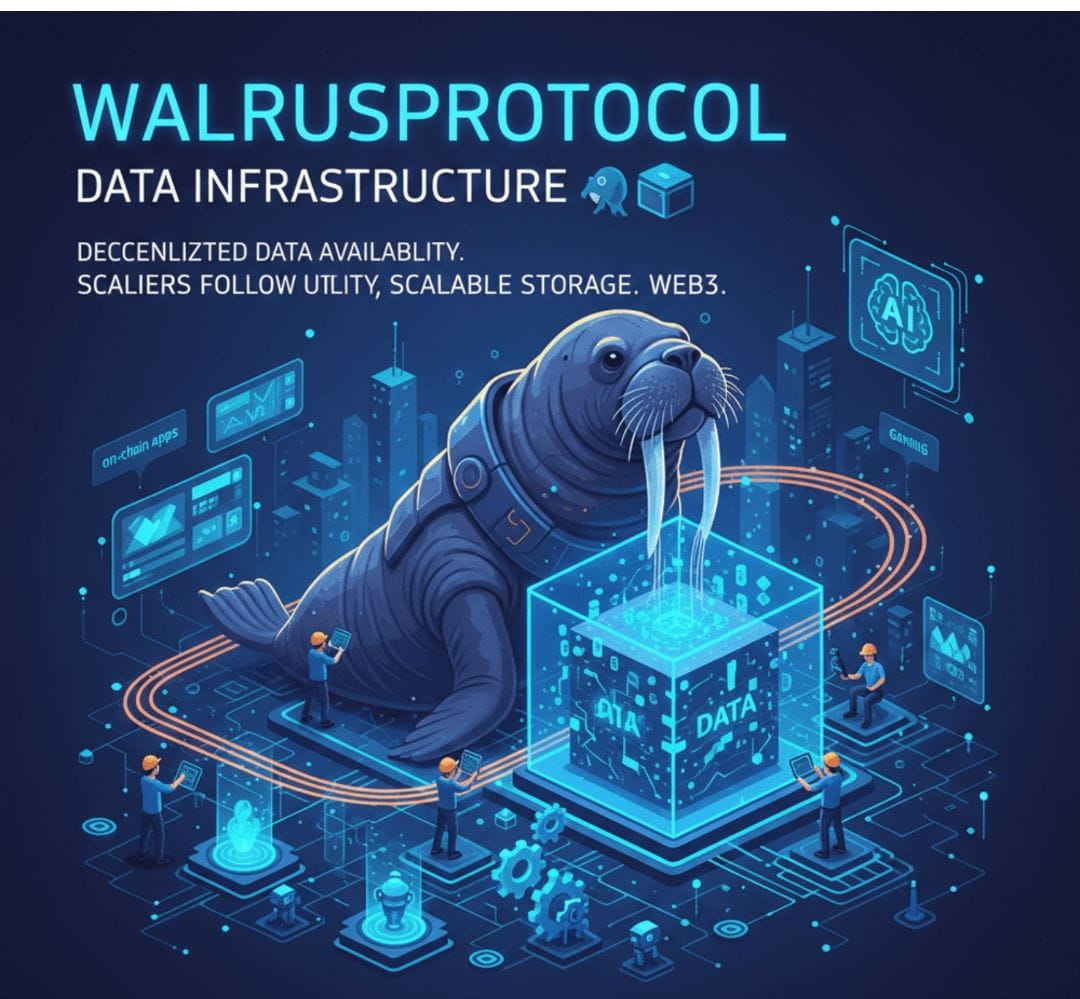
At its heart, Walrus is a response to a feeling many people share but rarely articulate. We generate enormous amounts of data every day, yet we barely own any of it. Our files live on servers we don’t control, our interactions are tracked by systems we never agreed to, and our digital lives are scattered across platforms that can disappear, censor, or change the rules overnight. Walrus doesn’t try to fix this with grand slogans. It starts with infrastructure, because real freedom online begins at the lowest level.
Built on the Sui blockchain, Walrus takes advantage of speed and scalability, but it doesn’t stop there. Its use of erasure coding and decentralized blob storage isn’t just a technical choice; it’s philosophical. Instead of trusting a single machine or provider, data is fragmented, distributed, and redundantly stored across a network. No single node holds power. No single failure breaks the system. In the future roadmap, this mechanism becomes increasingly refined, almost invisible to the end user. Uploading a file, storing application data, or interacting with a private transaction feels as natural as using a traditional cloud service, except the user never gives up ownership or control.
As the protocol matures, performance and reliability become a form of storytelling. Fast retrieval times, predictable costs, and resilient storage aren’t marketed as features; they’re experienced. This is where Walrus starts earning trust not through promises, but through consistency. Applications built on top of it don’t need to explain why they’re safer or more private. Users feel it instinctively, because nothing breaks, nothing leaks, and nothing disappears without consent.
Then comes the creative explosion. As Walrus opens deeper access to developers through intuitive APIs and SDKs, the ecosystem begins to breathe. Builders stop worrying about how to store data securely and start imagining what they can create when privacy and decentralization are defaults, not afterthoughts. Decentralized social platforms emerge where users own their content and identities. NFT ecosystems store rich, permanent metadata without relying on centralized servers. DAOs experiment with private deliberation while maintaining transparent outcomes. Walrus quietly becomes the backbone for applications that refuse to compromise on user sovereignty.
The WAL token evolves alongside this growth, gaining weight and meaning. In the early stages, it functions as utility, governance, and incentive. But over time, it becomes something closer to a symbol of participation. Holding WAL isn’t just about value; it’s about voice. Governance transforms from simple parameter adjustments into genuine collective decision-making. The community debates not just what upgrades to deploy, but what kind of protocol Walrus should be. How private is private enough? How open should the network be to enterprises? How should rewards balance between early supporters and long-term contributors? These questions don’t have easy answers, and that’s the point. Walrus is designed to evolve through human disagreement and consensus, not top-down control.
Staking adds another emotional layer to the system. It’s not framed as passive income, but as commitment. Those who stake aren’t just chasing yield; they’re anchoring the network. Storage providers and validators who show reliability, honesty, and performance are rewarded not only economically, but reputationally. Over time, the network develops a kind of memory, favoring those who consistently act in its best interest. This creates an ecosystem where trust is earned through action, not branding.
Privacy, always central to Walrus, grows more expressive as the roadmap unfolds. The future isn’t about hiding everything; it’s about choice. Walrus moves toward selective disclosure and programmable privacy, allowing users to decide exactly who can access which pieces of data and for how long. This subtle shift unlocks powerful real-world use cases. Enterprises can store sensitive records while granting auditors verifiable, time-bound access. Individuals can prove credentials without exposing their entire identity. Privacy becomes flexible, human, and intentional, rather than rigid or absolute.
As Walrus gains confidence, it looks outward. Interoperability becomes a natural next step, not as an escape from Sui, but as an expansion of purpose. Bridges and integrations allow Walrus to serve applications across multiple blockchains, positioning it as a neutral layer for decentralized storage and private data. In this future, Walrus doesn’t compete with other ecosystems; it supports them. It becomes the place where data goes when it matters.
One of the most compelling chapters in Walrus’s future is its quiet courtship with the real world. Institutions, enterprises, and organizations eventually recognize the cost and risk of centralized infrastructure. The roadmap anticipates this shift, preparing features that align with regulatory realities without betraying decentralization. Audit trails, compliance-friendly access models, and long-term data guarantees allow Walrus to step into environments where trust isn’t optional. It doesn’t replace traditional systems overnight, but it offers a parallel path for those who value sovereignty and resilience over convenience alone.
Through all of this, the community remains the soul of the protocol. Education initiatives, grants, and collaborative research ensure that innovation stays decentralized. Walrus isn’t built for spectators; it’s built for participants. Developers, validators, writers, and users shape its direction through use, feedback, and experimentation. Over time, it feels less like a protocol you log into and more like a shared space you belong to.
In the long view, Walrus starts to resemble a self-sustaining organism. Storage supports applications. Applications drive demand. Demand strengthens governance. Governance refines incentives. Incentives reinforce trust. WAL flows through this system as energy rather than hype. Nothing is rushed. Nothing is forced. The protocol grows because it’s needed, not because it’s loud.
The thrill of Walrus isn’t explosive. It’s magnetic. It’s the quiet realization that something solid is forming beneath the noise of the crypto world. A place where data is respected, privacy is deliberate, and decentralization is practical, not performative. If Walrus succeeds, it won’t be remembered for a single feature or moment. It will be remembered for something far rarer: building infrastructure that humans could finally trust, and doing it without ever needing to shout.
@Walrus 🦭/acc #walrus #Walrus $WAL

