
There’s a moment of quiet clarity that comes when you realize a system wasn’t built to rebel, but to endure. Dusk lives in that moment. While much of blockchain history has been shaped by loud disruptions and ideological extremes, Dusk was founded in 2018 with a calmer, more daring conviction: that the future of finance would not be won by rejecting regulation or sacrificing privacy, but by harmonizing the two. From the very beginning, Dusk set out to build something most believed was impossible—a blockchain that institutions could trust and individuals could respect.
At its core, Dusk feels less like a technology experiment and more like infrastructure with a conscience. It recognizes a truth many systems ignore: finance is not just code and capital, it’s people, laws, responsibilities, and consequences. The roadmap ahead reflects this understanding. Every layer of Dusk’s evolution is shaped by the idea that privacy should protect dignity, compliance should enable trust, and decentralization should bring resilience rather than chaos.
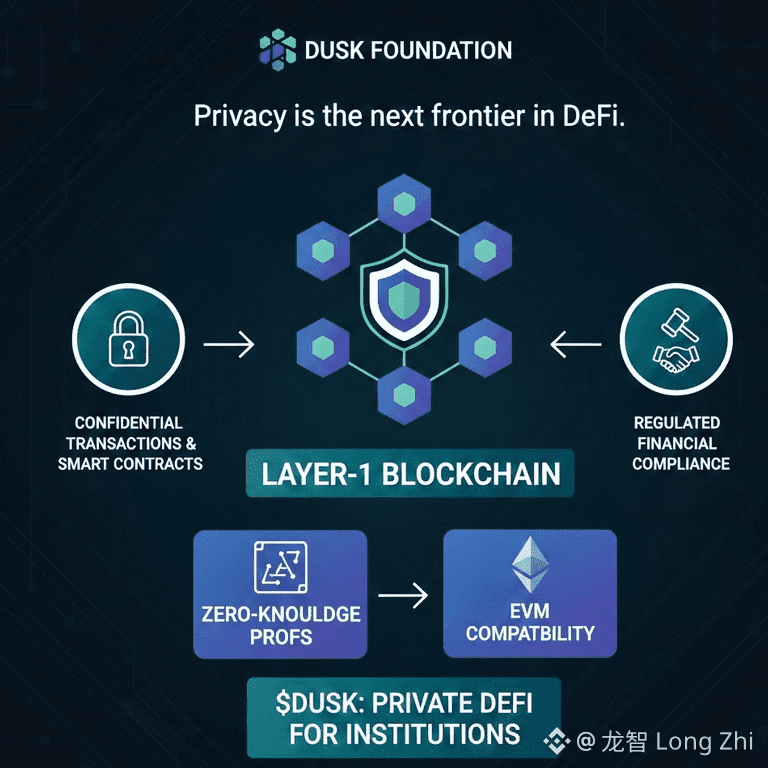
The architecture tells the story first. Dusk’s modular design was never about convenience; it was about survival. Financial systems evolve slowly, but relentlessly. Regulations change. Standards tighten. New risks emerge. By separating its core components—consensus, privacy, execution, governance—Dusk ensures it can adapt without breaking. This becomes increasingly powerful in the future roadmap, where upgrades are no longer disruptive events but natural progressions. The chain doesn’t lurch forward; it grows, like a city expanding around solid foundations.
Privacy is where Dusk’s vision truly deepens. Unlike blockchains that treat privacy as total invisibility, Dusk approaches it as selective truth. Its future roadmap expands advanced zero-knowledge proof systems that allow participants to prove what matters without revealing what doesn’t. Transactions can remain confidential, identities protected, balances hidden, yet the system itself remains verifiable. Regulators can audit without spying. Institutions can comply without exposing clients. Users can transact without becoming transparent targets. In this world, privacy is no longer suspicious—it’s structured, intentional, and respected.
As this cryptographic maturity unfolds, Dusk’s role in decentralized finance becomes increasingly distinct. This is not DeFi built for adrenaline and speculation; it’s DeFi designed to last decades. Lending markets, exchanges, settlement layers, and payment systems built on Dusk are engineered with deterministic finality and predictable execution. These are not features meant to impress retail traders; they are requirements for institutional adoption. Over time, Dusk-powered financial applications begin to feel familiar to traditional market participants, not because they mimic old systems, but because they uphold the same standards of reliability while eliminating inefficiencies.
The tokenization of real-world assets emerges as one of the most transformative arcs in Dusk’s future. The roadmap envisions a world where securities, bonds, funds, and other regulated instruments live natively on-chain. Ownership transfers settle instantly. Corporate actions execute automatically. Compliance checks are embedded into the logic of the asset itself. Yet throughout this process, investor privacy is preserved. Identities are shielded, sensitive positions are concealed, and disclosures happen only when legally required. This is not tokenization as a buzzword; it is financial infrastructure rewritten for a digital age.
Governance within Dusk evolves with the same careful restraint. Rather than embracing chaotic decentralization, the protocol grows into a system of stewardship. Token holders, validators, and ecosystem participants gradually gain influence, but always within a framework that prioritizes stability. Decisions are not rushed. Upgrades are debated with the awareness that real capital and real institutions depend on the outcome. Over time, governance becomes less about voting power and more about responsibility, reflecting the seriousness of the network’s mission.
Consensus and performance improvements quietly reinforce everything else. Dusk’s roadmap continues to refine finality, scalability, and efficiency, recognizing that financial systems cannot tolerate ambiguity or delay. As transaction volumes grow and applications become more complex, the network remains composed, secure, and predictable. This reliability becomes one of Dusk’s most underrated strengths. It doesn’t seek attention, but it earns trust.
Perhaps the most human aspect of Dusk’s future is how it invites the traditional world into Web3 without demanding transformation through shock. Banks, asset managers, regulators, and enterprises are not asked to abandon their frameworks. Instead, Dusk integrates with them. Identity standards, reporting requirements, compliance tooling, and existing workflows are acknowledged and respected. APIs and developer environments are designed to feel familiar to financial engineers, reducing friction and fear. Over time, institutions don’t feel like outsiders experimenting with blockchain—they feel like participants in an upgraded system.
Behind the scenes, the ecosystem grows deliberately. Developers collaborate with legal experts. Cryptographers work alongside compliance professionals. Grants and partnerships prioritize depth over hype. Education is treated as infrastructure, ensuring that those building on Dusk understand both the technology and the responsibility it carries. This creates a culture that feels grounded, serious, and quietly ambitious.
As the roadmap stretches further into the future, Dusk begins to resemble something rare in the blockchain space: a system that doesn’t need to prove itself through disruption. It proves itself through continuity. It becomes the place where private, compliant financial activity simply happens. Where institutions no longer ask whether blockchain is ready for them, because it already feels familiar. Where users no longer have to choose between privacy and participation.
The thrill of Dusk isn’t explosive. It’s steady. It’s the feeling of watching something solid take shape in an industry known for impermanence. While others chase attention, Dusk builds relevance. While others promise revolution, Dusk delivers evolution. And in the long run, that may be the most powerful story of all—a blockchain that didn’t try to escape the real world, but quietly rebuilt it from the inside.
