

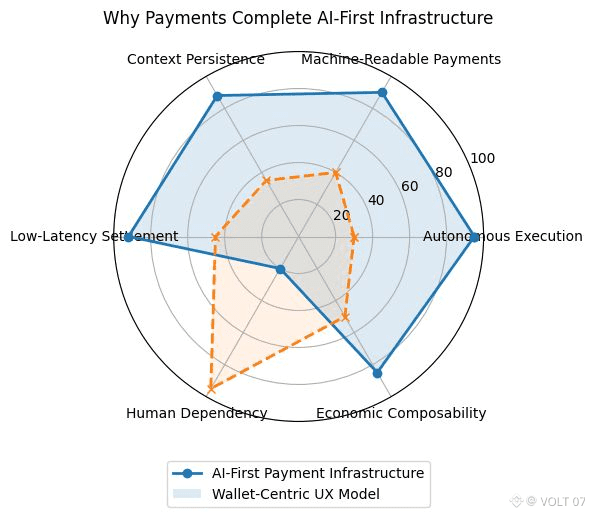
 AI-first infrastructure is incomplete without payments because intelligence without settlement cannot become an economy.
Most AI + crypto discussions focus on compute, models, data, and agents. Those layers are important, but they’re not enough to create a self-sustaining system.
A real AI economy requires one final primitive: payments that work at machine speed, machine frequency, and machine logic. Without that, agents remain “smart tools” controlled by humans instead of independent economic actors.
Payments are the missing piece that turns AI-first infrastructure from capability into commerce.
Wallet UX was designed for humans and it breaks the moment machines become the primary users.
Wallets assume a human workflow:
open an interface
review a transaction
approve a signature
manage gas and network selection
confirm execution
That flow is tolerable for humans because humans transact occasionally.
AI agents transact continuously.
If an agent must depend on wallet UX, it becomes impossible to scale because:
signatures require human attention
transaction approval becomes a bottleneck
execution speed collapses
the agent cannot operate autonomously
every workflow becomes fragile and interrupt-driven
Wallet UX is not a payment system for machines. It’s a permission gate for humans.
Agents don’t need “better wallets.” They need programmable payment rails.
A machine-native payment system must support:
autonomous spending under constraints
recurring micro-payments
dynamic pricing based on task demand
conditional execution logic
safe delegation to sub-agents
real-time settlement
predictable fee behavior
Wallets can’t express these rules natively.
They only express ownership.
AI agents need something deeper: policy-based financial autonomy, where intent and constraints define what can happen not UI clicks.
Microtransactions are not optional they are the natural unit of machine commerce.
Human commerce happens in chunks.
Machine commerce happens in streams.
Agents pay for:
data access per query
inference per request
compute per second
routing per task
verification per proof
content generation per output
marketplace fees per completion
This creates a world where thousands of tiny payments are more important than a few large ones.
Wallet UX cannot support this volume without becoming a permanent friction point.
AI-first infrastructure needs a settlement layer designed for microtransactions by default.
Without payments, AI agents remain dependent and dependency kills scale.
If an agent cannot:
earn on-chain
pay for resources
hire other agents
settle tasks autonomously
manage a treasury
budget across workflows
it is not an economic actor.
It is a feature attached to a human-controlled wallet.
This is the difference between:
AI as automation
and
AI as a self-sustaining market participant
Payments complete AI-first infrastructure because they enable closed economic loops.
Payment rails also solve the biggest AI risk problem: uncontrolled autonomy.
The fear of autonomous agents is not that they are intelligent it’s that they can act financially without limits.
A proper agent payment system must enforce:
spending ceilings
category budgets
whitelisted counterparties
time-based restrictions
multi-sig approvals for large spends
kill-switch logic
audit trails for every action
This turns autonomy into something safe, testable, and governable.
Wallet UX cannot do this because it is reactive.
Payment rails can do it because they are architectural.
AI-first payments enable agent-to-agent commerce the foundation of the machine economy.
Once payments are machine-native, agents can trade services like:
research
summarization
trading signals
portfolio optimization
data labeling
risk scoring
content generation
workflow automation
This creates an economy where:
agents specialize
tasks are outsourced
skills are priced dynamically
output quality is rewarded
supply and demand become automated
Without payments, none of this becomes real.
It remains theoretical.
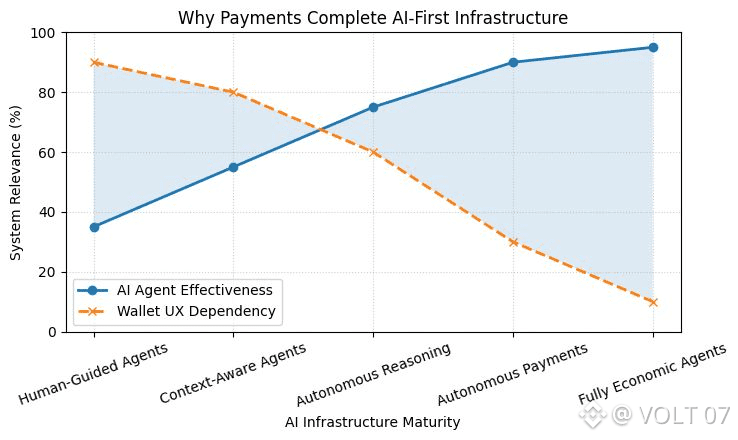
The winners of the AI era will be the networks that make payments invisible and continuous.
The most powerful payment systems are not those users notice they are those users forget exist.
AI-native commerce requires:
seamless settlement
instant execution
predictable costs
minimal friction
built-in constraints
interoperability with stablecoin rails
The infrastructure that achieves this becomes the default foundation for AI economies not because it’s flashy, but because it works.
Conclusion: Wallet UX is the wrong abstraction for autonomous systems payments must become programmable infrastructure.
AI-first infrastructure is not complete when it has:
compute
data
models
agents
It becomes complete when it can support:
earning
spending
budgeting
settling
hiring
routing
microtransaction economies
Wallet UX was built for humans.
AI agents require payment rails built for autonomy.
In the AI era, the most valuable chains and protocols won’t be those that simply host agents but those that let agents participate in commerce safely, continuously, and at scale.
Autonomy becomes real only when it can settle value. In the machine economy, payments aren’t a feature they’re the operating system.
