
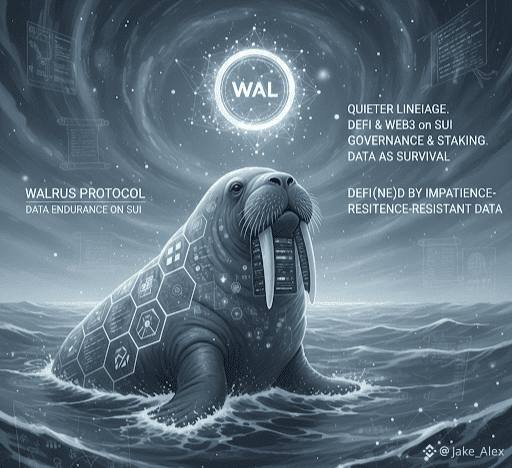
Walrus and its token $WAL belong to that quieter lineage. At first glance, it sits comfortably within familiar frames of blockchain, DeFi, and Web3. It lives on Sui, participates in decentralized finance, and speaks the language of applications, governance, and staking. But the design choice that defines it most clearly is not financial at all. It is the decision to treat data as something that must survive human impatience.
The choice to build Walrus around decentralized, privacy-preserving storage using erasure coding and blob distribution is not merely technical. It reflects a belief that ownership without memory is hollow. Early blockchain systems taught us how to move value without intermediaries, but they often left data stranded, expensive, or fragile. Storage became an afterthought, delegated to centralized clouds while we spoke grandly about decentralization. Over time, that contradiction grew harder to ignore.
Walrus confronts it directly by making storage native to the protocol’s identity. Large files are not kept whole, nor entrusted to a single operator. They are broken apart, scattered, and made resilient through redundancy. No single participant holds the complete object, yet the object remains recoverable. This is not about secrecy alone. It is about removing singular points of failure, technical and human, from the act of remembering.
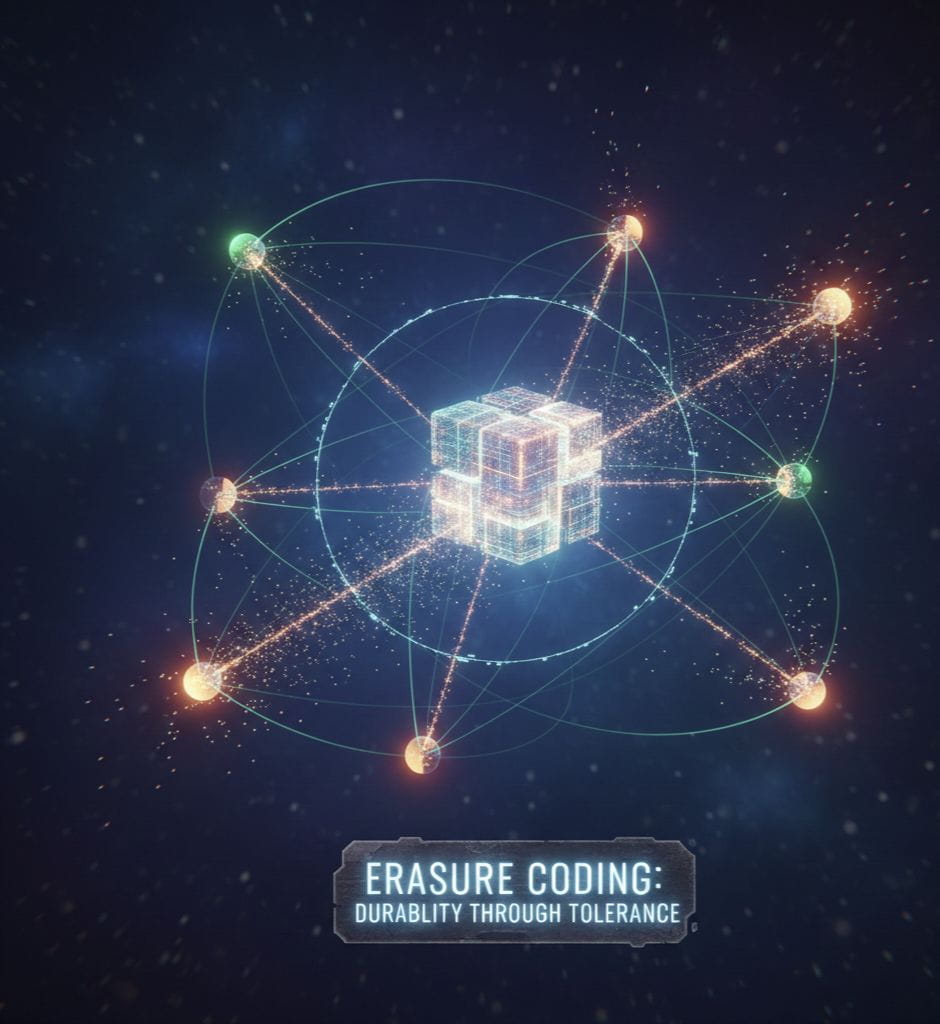
Having watched earlier storage networks struggle, I recognize the restraint in this approach. Erasure coding accepts that things will fail. Nodes will disappear. Incentives will fluctuate. Instead of pretending otherwise, it designs for loss as a normal condition. In doing so, it aligns more closely with how real systems age. Durability emerges not from perfection, but from tolerance.
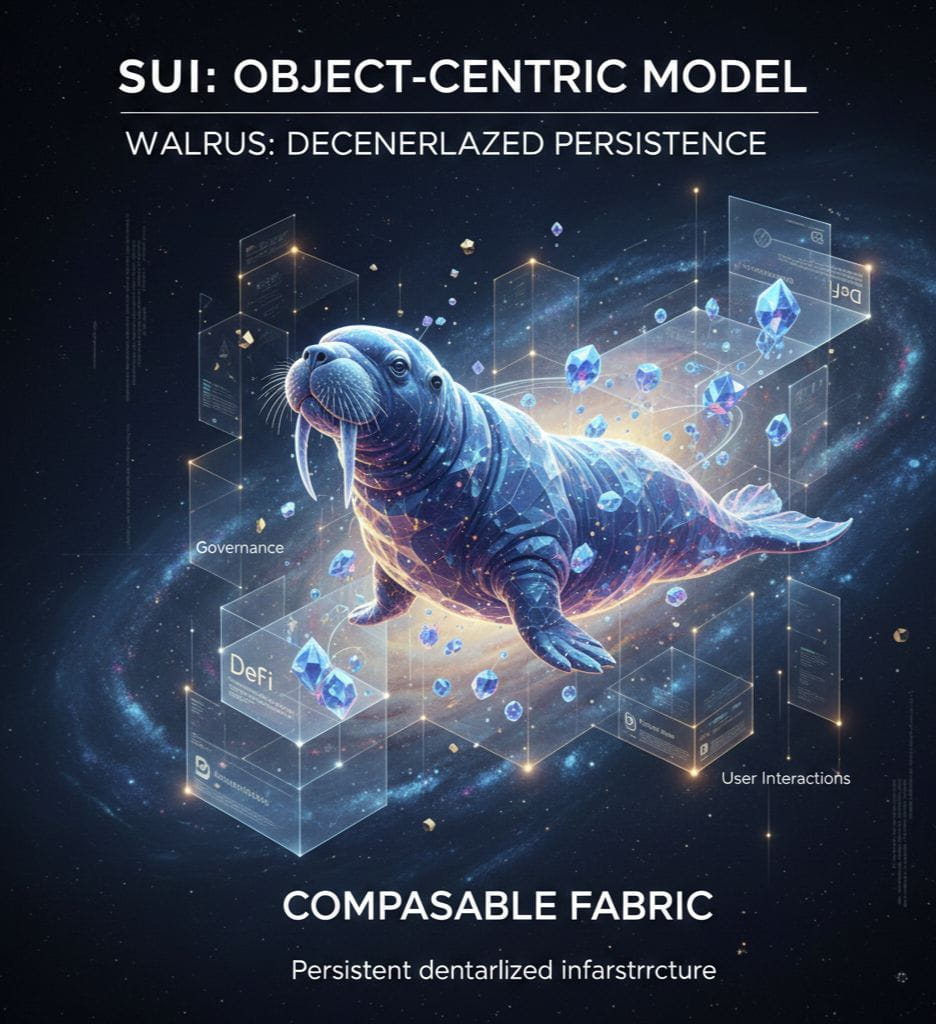
On $SUI , this design gains an additional dimension. Sui’s object-centric model treats data as first-class, mutable entities rather than passive records. Walrus fits naturally into this worldview. Storage is not an external service bolted onto a financial layer; it becomes part of the same composable fabric. DeFi applications, governance processes, and user interactions can reference data that is both decentralized and persistent, without quietly depending on centralized infrastructure behind the scenes.
This matters more than it initially appears. Over the years, I have seen governance fail not because of bad intentions, but because records vanished or became unverifiable. Proposals, votes, disclosures, and histories were lost to broken links or private servers. When data disappears, accountability soon follows. By anchoring storage within a decentralized system, Walrus reinforces the social layer of Web3, not just the technical one.
Privacy, too, is treated with a maturity that comes from experience. Rather than framing privacy as invisibility, Walrus frames it as controlled exposure. Fragmentation and distribution reduce the risk of coercion and surveillance without requiring absolute opacity. It acknowledges that institutions and individuals both need selective transparency over time. This balance is difficult, and many systems fail by swinging too far in either direction.
The WAL token’s role sits quietly within this structure. It is less about spectacle and more about alignment. Incentives exist to maintain storage, participate in governance, and sustain the network’s health over long horizons. I have learned to distrust systems where tokens exist primarily to attract attention. Here, the token feels more like a maintenance instrument, rewarding behavior that preserves continuity rather than accelerates extraction.
In the broader Web3 landscape, Walrus represents a subtle shift in priorities. DeFi once revolved almost entirely around liquidity and yield. Storage networks chased scale before trust. Governance was often symbolic. Projects like Walrus suggest a different center of gravity, one where infrastructure is built to be lived with, not flipped. Where responsibility to future users outweighs convenience for present ones.
What stays with me most is how this design choice reflects a deeper understanding of time. Data, unlike capital, accumulates meaning as it ages. Records gain weight. Histories become context. By designing for persistence, Walrus implicitly respects the idea that decentralized systems are not just machines, but archives of human coordination.
After many cycles, I have come to believe that trust forms slowly, through systems that remember what they are entrusted with. Walrus does not ask to be believed in immediately. It asks to be used, maintained, and tested across years of quiet operation. In choosing resilience over immediacy, and memory over momentum, it strengthens the kind of trust that does not announce itself, but remains when everything else has moved on.

