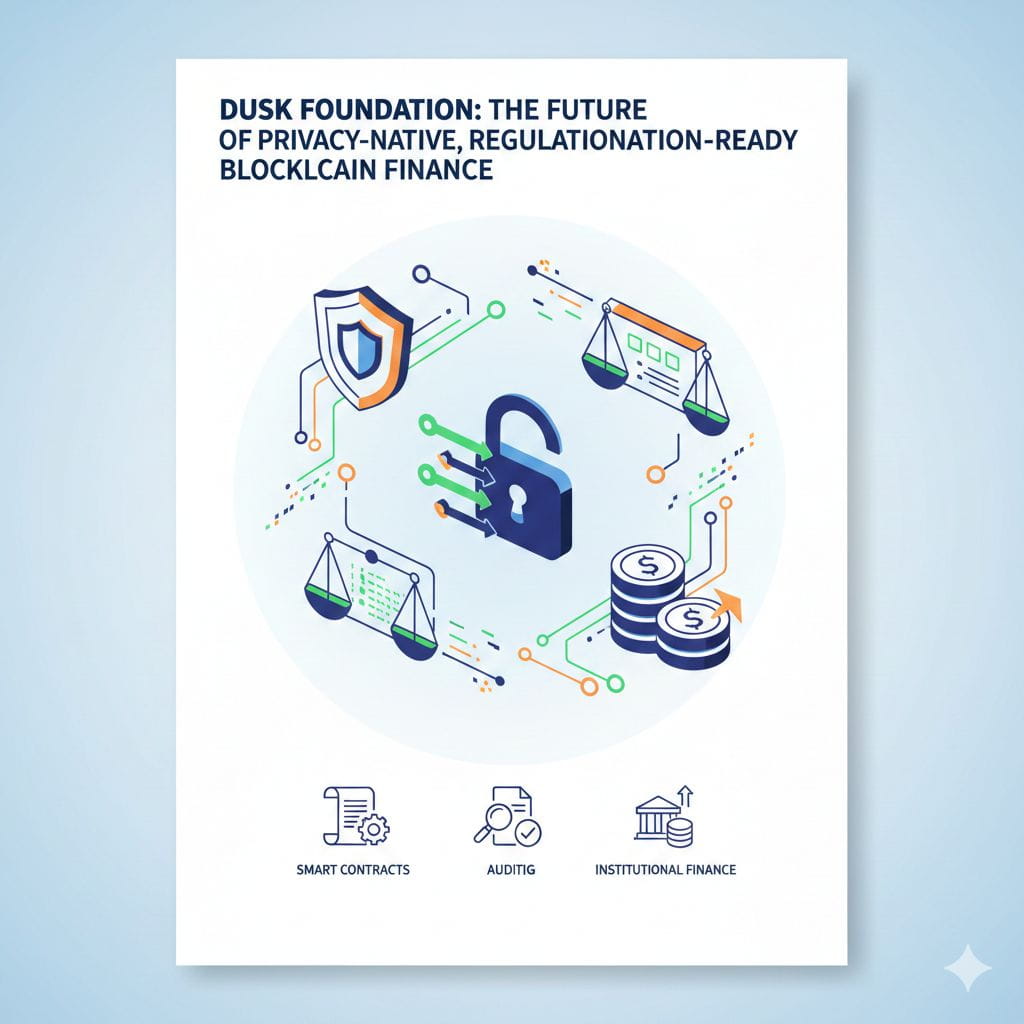
For more than a decade, blockchain innovation has moved at breakneck speed, yet one fundamental question has remained unresolved: how can decentralized finance truly integrate with the real financial system without sacrificing either privacy or regulation? Today, that question matters more than ever. Governments are drafting clearer crypto frameworks, institutions are exploring tokenization, and capital markets are slowly moving on-chain. In this moment of transition, the gap between permissionless experimentation and regulated finance has become impossible to ignore. The Dusk Foundation exists precisely to close that gap.
To understand why Dusk matters now, it helps to look at where on-chain finance struggles. Public blockchains are transparent by default, which makes them powerful for verification but unsuitable for many real-world financial activities. Institutions cannot expose trading strategies, investor identities, or sensitive transaction data to the entire world. At the same time, fully private systems often fail the other side of the equation: regulators, auditors, and counterparties need assurance that rules are being followed. Most networks force a trade-off between secrecy and compliance. Dusk was designed to reject that trade-off entirely.
At its core, the Dusk Network introduces a different philosophy for decentralized finance. Instead of treating privacy and regulation as opposing forces, it treats them as complementary requirements of modern finance. The network is built around zero-knowledge cryptography, which allows transactions to remain confidential while still being verifiable. In simple terms, this means participants can prove that a transaction is valid, compliant, and authorized without revealing the underlying sensitive details. Ownership, balances, and identities remain private, yet correctness and rule enforcement remain intact.
The Dusk Foundation plays a critical role in stewarding this vision. It supports research, protocol development, and ecosystem growth with a clear focus on regulated use cases. Rather than chasing short-term hype, the Foundation positions Dusk as infrastructure for long-term financial adoption. This includes digital securities, regulated tokens, confidential payments, and on-chain settlement systems that mirror the expectations of traditional markets while benefiting from blockchain efficiency.
A practical example makes this clearer. Consider the issuance of a tokenized security. On most blockchains, issuing such an asset either exposes investor data publicly or requires heavy off-chain processes that undermine decentralization. On Dusk, issuers can embed compliance rules directly into the asset. Only approved investors can hold or transfer it, transactions remain confidential, and regulators can still audit activity when legally required. The result is a system that feels familiar to institutions but operates with the speed and programmability of blockchain technology.
Another important dimension is execution and settlement. Financial markets depend not just on record-keeping, but on reliable execution under load. Dusk’s design emphasizes deterministic finality and predictable behavior, which are essential for institutional confidence. A system that technically works but fails during peak demand is unusable for real finance. By prioritizing verifiable execution alongside privacy, Dusk aligns itself with the operational realities of capital markets.
The DUSK token itself underpins this ecosystem. It is used for staking, securing the network, and paying transaction fees, ensuring that validators are economically incentivized to act honestly. Importantly, these incentives are distributed rather than centralized, reinforcing decentralization while maintaining network stability. This balance is crucial: compliant finance cannot depend on trusted intermediaries alone, nor can it rely on purely experimental incentive structures.
No serious analysis would be complete without acknowledging risks. Regulated on-chain finance operates in a moving legal landscape. Standards differ across jurisdictions, and compliance requirements evolve. Dusk’s selective disclosure model must continuously adapt to new regulatory expectations. There is also the challenge of education: institutions move cautiously, and adoption will require not just technology, but trust, tooling, and legal clarity. However, these risks are inseparable from the opportunity itself. Any network aiming to bridge crypto and traditional finance must navigate them.
Looking ahead, the direction is clear. Tokenization of real-world assets, confidential DeFi primitives, and regulated settlement layers are no longer theoretical concepts. They are emerging demands from banks, funds, and governments alike. Networks that ignore compliance will remain niche, while systems that sacrifice decentralization will struggle to justify their existence. Dusk’s approach positions it in the narrow but powerful middle ground where both sides can coexist.
The most important takeaway is this: the future of on-chain finance will not be built on transparency alone, nor on secrecy alone. It will be built on verifiable trust. The Dusk Foundation is laying the groundwork for that future by proving that privacy, compliance, and decentralization do not have to compete. They can reinforce each other. In a world where finance is steadily moving on-chain, Dusk is not just another blockchain project; it is an argument for how serious, compliant, and human-scale finance can finally work in a decentralized