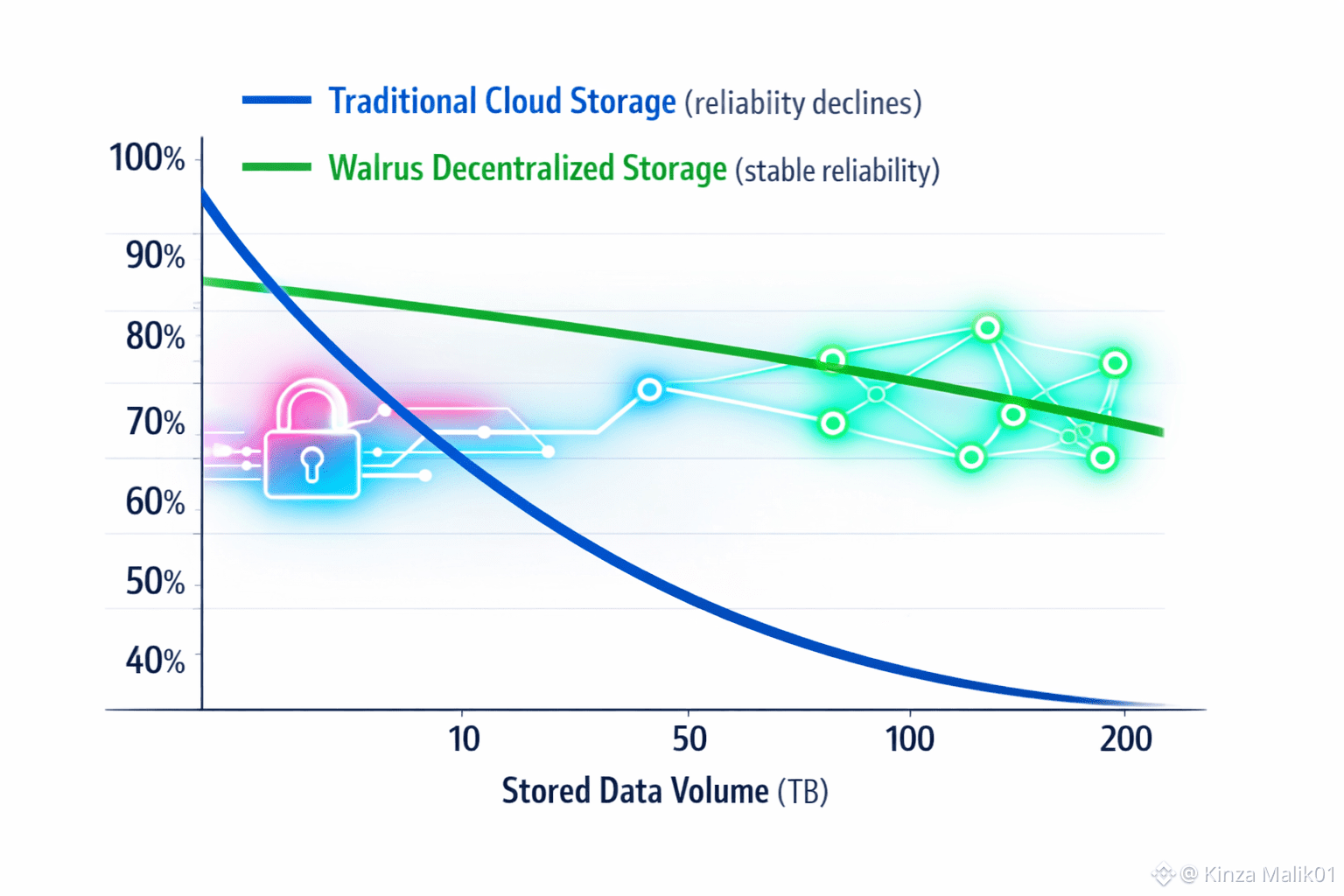
For years, the blockchain conversation has revolved around consensus, transactions, and execution. Yet beneath every rollup, every decentralized application, and every on-chain promise lies a quieter dependency that is becoming impossible to ignore: how data is stored, accessed, and reliably delivered at scale. As decentralized systems move from experimentation to real-world utility, storage is no longer a background technical detail. It is fast becoming one of the defining constraints of the decentralized era. This is where Walrus enters the picture, not as another storage network chasing redundancy for its own sake, but as a system designed around the reality of how decentralized applications actually operate under pressure.
At its core, Walrus addresses a fundamental mismatch in Web3 infrastructure. Blockchains are excellent at recording state changes and preserving history, but they are inefficient and costly when asked to store or serve large volumes of data. Off-chain storage solutions emerged to fill this gap, yet many of them inherited assumptions from Web2 systems: centralized coordination, best-effort availability, and trust that someone else will keep the data reachable when it matters most. In decentralized environments, these assumptions break down quickly. A rollup that cannot retrieve its data during peak usage, or a bridge that stalls because off-chain data is unavailable, is effectively broken—even if the data technically exists somewhere on the network.
Walrus reframes storage around availability rather than mere persistence. The distinction is subtle but critical. Data persistence answers the question of whether information still exists. Availability answers whether that information can be retrieved quickly, reliably, and verifiably when demanded by users or applications. In decentralized systems, availability is the difference between theoretical decentralization and practical usability. Walrus is engineered with this reality in mind, distributing data across a network in a way that prioritizes retrieval guarantees, fault tolerance, and predictable performance rather than raw replication alone.
The technical philosophy behind Walrus reflects lessons learned from modern distributed systems. Instead of assuming that more copies automatically lead to better outcomes, Walrus focuses on how data is encoded, dispersed, and reconstructed across independent nodes. This approach reduces single points of failure while also optimizing for real-world network conditions such as latency, node churn, and uneven demand. The result is a storage layer that behaves less like an archive and more like critical infrastructure—something applications can depend on during moments of stress rather than only during ideal conditions.
Real-world use cases make this distinction tangible. Consider data availability for rollups, where transaction data must remain accessible for verification and dispute resolution. If availability fails, the security model collapses regardless of how strong the underlying cryptography may be. Similarly, decentralized social platforms, NFT metadata hosting, and on-chain gaming environments all rely on fast, consistent access to off-chain data. In these contexts, storage is not passive; it is an active participant in application correctness. Walrus positions itself as a dependable backbone for these scenarios, enabling developers to build systems that degrade gracefully instead of failing catastrophically when demand spikes.
From a strategic perspective, Walrus aligns closely with the broader evolution of Web3. As regulation, institutional interest, and user expectations converge, infrastructure must meet higher standards of reliability and predictability. Enterprises and developers alike are less willing to tolerate “best effort” guarantees when real value and reputation are at stake. By emphasizing secure, distributed storage with availability as a first-class property, Walrus addresses one of the key barriers preventing decentralized applications from competing with centralized alternatives on user experience.
That said, no infrastructure solution is without risks or trade-offs. Distributed storage networks face challenges around economic incentives, long-term sustainability, and network coordination. Ensuring that nodes remain honest, well-incentivized, and geographically diverse requires careful mechanism design. There is also the broader challenge of interoperability—storage layers must integrate seamlessly with execution environments, verification layers, and developer tooling to reach their full potential. Walrus’s success will depend not only on its technical design but on ecosystem adoption and the strength of its surrounding developer community.
Looking ahead, the importance of decentralized storage is likely to intensify rather than fade. As zero-knowledge proofs, modular blockchains, and real-time verification systems become more prevalent, the demand for highly available off-chain data will grow in parallel. Storage will increasingly be treated as a shared utility layer, much like networking or computation, rather than an afterthought. In this future, systems like Walrus could play a defining role, shaping how trust, performance, and decentralization coexist at scale.
The lasting takeaway is simple but profound. Decentralization does not fail because data disappears; it fails because data becomes unreachable at the moment it is needed most. Walrus recognizes this reality and builds accordingly. By treating availability as the cornerstone of secure, distributed storage, it offers a practical path toward decentralized systems that work not just in theory, but in the messy, high-demand conditions of the real world.