


Walrus feels opinionated the first time something goes wrong and nobody can punt the answer elsewhere.
Early on, builders like neutral storage. One blob. Anywhere. No assumptions. It feels clean. If something misbehaves, it must be the app... or the chain, or the network in between. Plenty of places to look. Plenty of places to defer responsibility.
Then the seam starts getting real.
A reference resolves late. A Sui object fetch retries twice. The app is still alive. The chain is fine. Storage is 'up'. Users are waiting anyway.
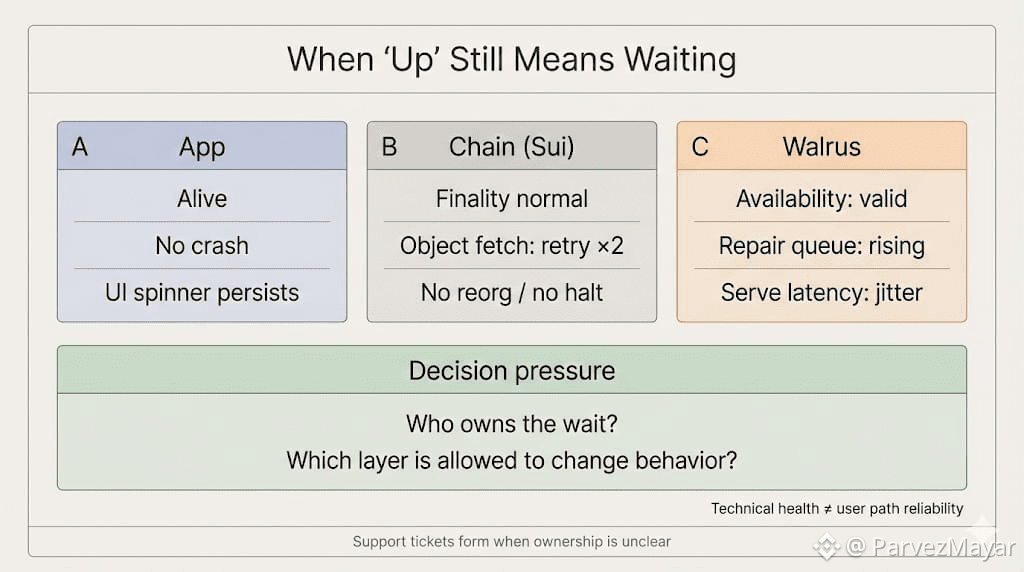
So who owns the wait?
With Walrus, storage sits closer to execution reality.
Object references behave the way the chain expects. Availability on Walrus isn't abstract. Repair isn't invisible... when the repair queue swells and slivers start moving, that bandwidth steals from serving. And when it stretches, it stretches inside the same timing model builders already live in.
Not elegant. Just contained.
Chain-agnostic storage pushes the mess outward.
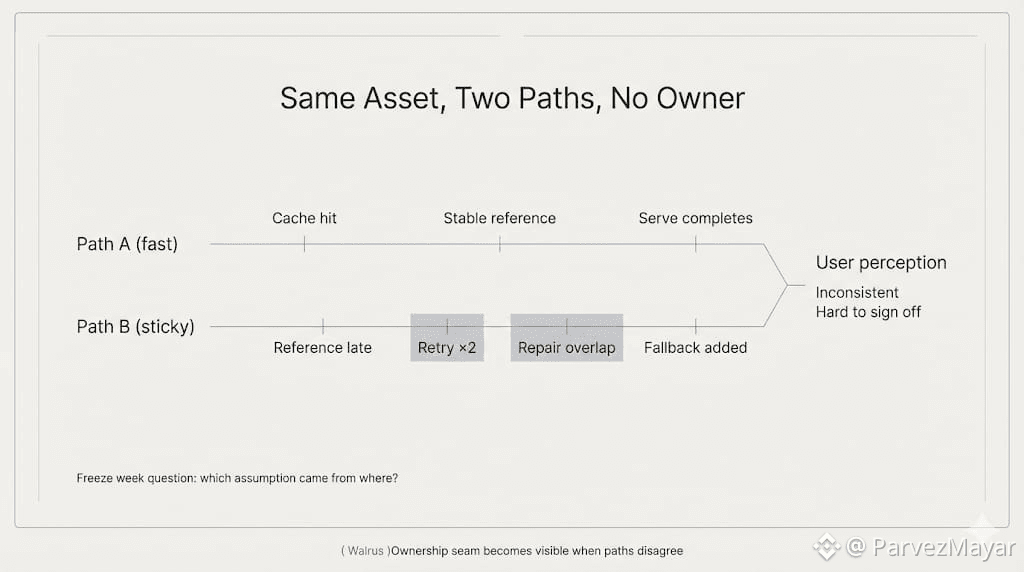
Identity mapping lives in glue code. Auth, retries, caching rules drift between systems. You don't notice at first. Then two paths disagree about the same file. Then it's layered retries, "temporary" fallbacks, one more cache, one more exception... until nobody can say which assumption came from where.
Nothing loud enough to page.
Still wrong enough to stall a release.
I've seen this during a freeze. Someone asked why the same asset felt instant in one flow and sticky in another. Same data. Same user. Different path. The answer wasn't technical.
Nobody owned the seam.
Walrus collapses some of those seams by refusing neutrality. Storage behavior carries opinions about availability, repair, and responsibility. Builders don't get to pretend the blob is "somewhere else." It's here. It's referenced. It's being worked on.
If it's slow, it's your slow.
And yeah, it costs.
You give up the story that storage is interchangeable. You accept constraints earlier. You feel pressure sooner, not later. But pressure shows up in one place instead of leaking across five systems and three teams.
Infra doesn't want to own that seam. Someone has to.
Chain-agnostic models feel safer because they spread risk. Sui-native models feel heavier because they concentrate it. Sometimes that concentration is mercy. Sometimes it's just honesty you can't route around.
The uncomfortable part is you lose the seam as an excuse. #Walrus $WAL @Walrus 🦭/acc


