

As blockchain adoption grows, so do its growing pains. Network congestion, high fees, and limited throughput remain familiar challenges for developers building real-world applications. While Layer 2 scaling solutions have evolved rapidly, one framework continues to influence how developers think about efficiency and scalability: Plasma.
Originally proposed as a way to offload computation from main chains like Ethereum, Plasma introduced ideas that still shape modern scaling design. For developers, understanding Plasma is less about nostalgia and more about grasping foundational concepts that improve performance, cost efficiency, and user experience.
The Scalability Problem Developers Face
Public blockchains prioritize decentralization and security, but these strengths come with trade-offs. Every transaction competing for block space leads to:
Rising gas fees during peak usage
Slower confirmation times
Limited capacity for complex applications
For developers, this directly impacts product design. Features must be simplified, user interactions minimized, and sometimes entire ideas abandoned due to cost constraints. Plasma was designed to ease these pressures by shifting activity away from the main chain.
What Is Plasma, in Simple Terms?
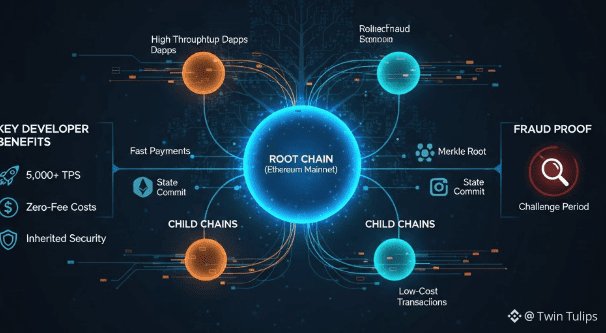
Plasma is a Layer 2 scaling framework that allows developers to create child chains anchored to a main blockchain. Instead of executing every transaction on Layer 1, Plasma chains handle most activity independently while periodically committing summaries back to the main chain.
Think of the main chain as a court of record, not a busy marketplace. It doesn’t need to process every trade, only to step in if disputes arise.
This design dramatically reduces on-chain load while preserving security guarantees.@Plasma #Plasma $XPL
How Plasma Improves Efficiency
1. Off-Chain Transaction Processing
Plasma chains process transactions off-chain, meaning developers can build systems that handle:
High-frequency transfers
Gaming logic
Microtransactions
without paying Layer 1 fees for every action. Only critical data, such as state commitments, is posted on-chain.
This offloading leads to faster execution and lower costs — two things users notice immediately.
2. Reduced Gas Costs
From a developer’s perspective, gas optimization is often a battle of small compromises. Plasma changes the equation.
By batching transactions and committing them periodically, Plasma allows thousands of operations to be secured by a single on-chain transaction. For applications with heavy user interaction, this can reduce operational costs significantly.
Lower fees also mean fewer UX hurdles, which helps adoption.
3. Hierarchical Scaling
One of Plasma’s most interesting ideas is chain hierarchy. Plasma chains can spawn child chains of their own, forming a tree-like structure.
For developers, this opens the door to:
Application-specific chains
Custom logic isolated from network congestion
Scalable ecosystems without bloating Layer 1
While not always implemented fully in practice, this concept influenced later designs across the Layer 2 landscape.
Security Model: Why Developers Should Care
Plasma relies on a fraud-proof model. Instead of validating every transaction on-chain, the system assumes correctness unless proven otherwise.
Users can challenge invalid transactions during dispute windows. If fraud is detected, funds can be safely exited back to the main chain.
For developers, this means:
Strong security without constant Layer 1 verification
Clear rules for dispute handling
Predictable failure modes
However, it also requires careful design. Exit mechanisms, challenge periods, and user safeguards must be implemented correctly to avoid UX friction.
Trade-Offs Developers Need to Understand
Plasma is powerful, but it isn’t a silver bullet.
Limited Generalization
Early Plasma implementations worked best for simple asset transfers. More complex smart contract logic proved difficult to support without added complexity.
This limitation pushed developers toward newer solutions like rollups, but Plasma’s lessons remain relevant.
Exit Complexity
Withdrawing funds from a Plasma chain can involve waiting periods and proof submission. For developers, this introduces:
Additional UI complexity
User education challenges
Longer withdrawal times
These trade-offs must be balanced against performance gains.
Plasma’s Influence on Modern Layer 2 Design
Even though Plasma itself is less common today, its ideas live on.
Many modern scaling solutions borrow Plasma concepts such as:
Off-chain execution
On-chain security anchors
Fraud detection models
Understanding Plasma helps developers better evaluate rollups, sidechains, and hybrid Layer 2 systems. It also builds intuition about where efficiency gains come from — and where risks may hide.
When Should Developers Still Care About Plasma?
Plasma may not be the default choice anymore, but it’s still relevant in specific scenarios:
Applications focused on transfers rather than complex logic
Systems prioritizing minimal on-chain footprint
Developers studying foundational scaling trade-offs
More importantly, Plasma teaches an essential lesson: not everything needs to happen on-chain.
Final Thoughts
Plasma marked a turning point in how developers think about blockchain scalability. By separating execution from security, it showed that efficiency doesn’t have to come at the cost of decentralization.
For today’s developers, Plasma is less about implementation and more about perspective. It highlights the importance of architecture choices, user experience trade-offs, and long-term scalability planning.
As Layer 2 solutions continue to evolve, the core ideas behind Plasma remain a valuable part of any developer’s mental toolkit.
What do you think — are foundational frameworks like Plasma still shaping how you evaluate new scaling solutions today?