
Web3 applications don’t just need blockchain execution; they need persistent, verifiable data. This is where @Walrus 🦭/acc steps in. Walrus turns storage into first-class infrastructure on Sui, ensuring that blobs — NFT media, AI datasets, audit proofs, and game state — remain accessible, verifiable, and continuously available.
$WAL is not speculative fluff. It is the economic mechanism that enforces uptime, incentivizes validators, and secures network integrity. Without Walrus, decentralized applications risk silent failure. With Walrus, storage becomes predictable and composable, integrated into the Web3 stack itself.
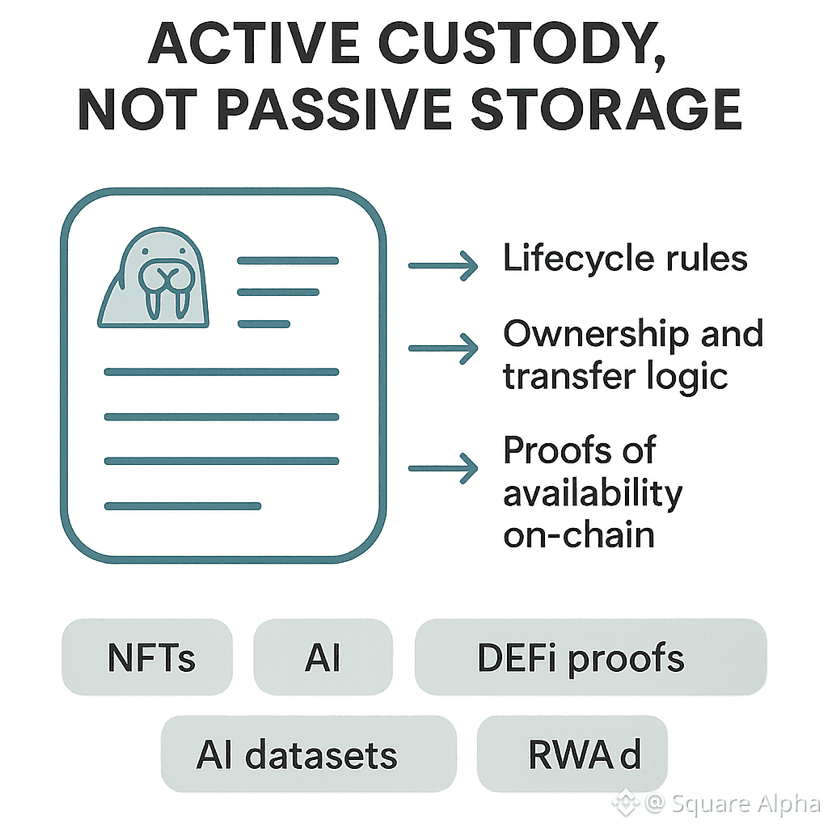
Active Custody, Not Passive Storage
Walrus treats data as stateful objects, not inert files. On Sui, every blob carries:
Lifecycle rules
Ownership and transfer logic
Proofs of availability on-chain
This means developers no longer have to rely on fragile, centralized storage backends. NFTs, AI datasets, DeFi proofs, and RWA documentation can all live entirely on-chain, backed by Walrus’s programmable custody model.
RedStuff: Resilience Built In
At the core of Walrus is RedStuff erasure coding, a two-dimensional approach that splits data across multiple nodes. Even if nodes leave, blobs can be reconstructed efficiently without downloading the full object.
Churn is normal in Web3. Most networks degrade silently when nodes exit or demand spikes. Walrus enforces continuous availability, ensuring applications remain operational when stability is most critical.
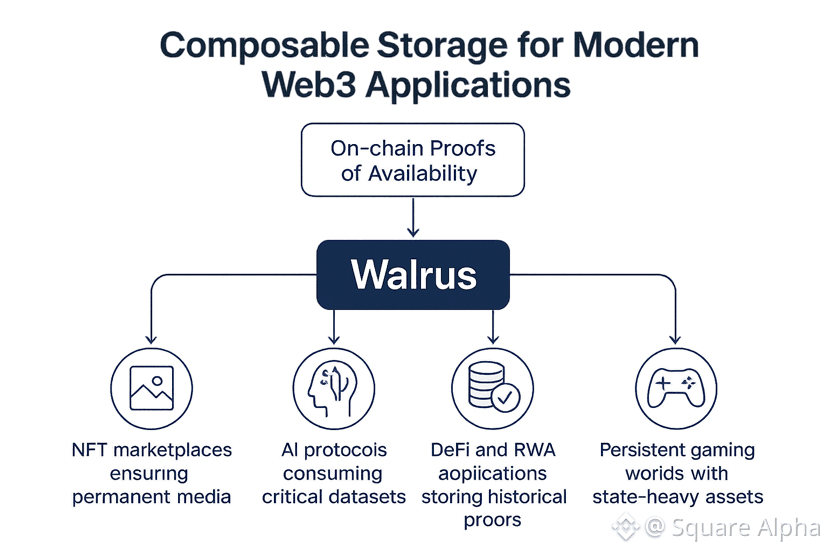
Composable Storage for Modern Web3 Applications
With on-chain Proofs of Availability, Walrus enables applications to verify storage trustlessly. This unlocks composability across:
NFT marketplaces ensuring permanent media
AI protocols consuming critical datasets
DeFi and RWA applications storing historical proofs
Persistent gaming worlds with state-heavy assets
Walrus becomes a reusable layer of infrastructure, not a siloed service.
WAL Aligns Incentives With Reliability
The token economy is simple but effective:
Validators are rewarded for uptime and reliability
Downtime or broken availability is penalized
Governance ensures the protocol evolves with usage
Every action in the network is tied to real operational outcomes, making Walrus more than a storage network — it is self-enforcing infrastructure.
Why Walrus Adoption Is Sticky
Storage is one of the hardest dependencies to migrate. Once an application integrates Walrus, switching costs are high. Developers adopt because it works, not because of marketing or hype. That organic adoption drives long-term utility and network growth.
Applications using Walrus benefit from:
Predictable, verifiable data availability
Resilient storage under real-world network conditions
Full integration with Sui’s execution model
This is how Walrus becomes infrastructure, not optional service.
Final Take
Walrus is building the invisible layer that Web3 needs: persistent, verifiable, and composable storage that applications can trust.
With Sui’s object model, RedStuff resilience, on-chain proofs, and $WAL incentives, @Walrus 🦭/acc is turning storage into a strategic, indispensable layer of Web3 infrastructure.
For builders, investors, and traders, #walrus is no longer optional. It is the backbone of reliable, decentralized applications.


