

Blockchain privacy is often framed as a visibility problem what should be public, and what should be hidden. Over time, many privacy-oriented networks have focused heavily on concealment. While this protects sensitive data it introduces a less discussed issue—systems that struggle to explain or verify outcomes once accountability becomes necessary.
This is where selective disclosure enters the conversation, not as an optional feature but as a structural requirement.
Selective disclosure allows a system to prove that something is correct without revealing everything behind it. Instead of exposing transaction details, balances or counterparties, the network can demonstrate validity through cryptographic proofs. What matters is not what happened internally but whether the outcome followed the rules.
Dusk provides a useful case study because selective disclosure is not treated as an application-layer workaround. It is embedded into the protocol’s design. Transactions are confidential by default but proofs of correctness remain accessible when verification is required. This approach avoids the false choice between privacy and trust.
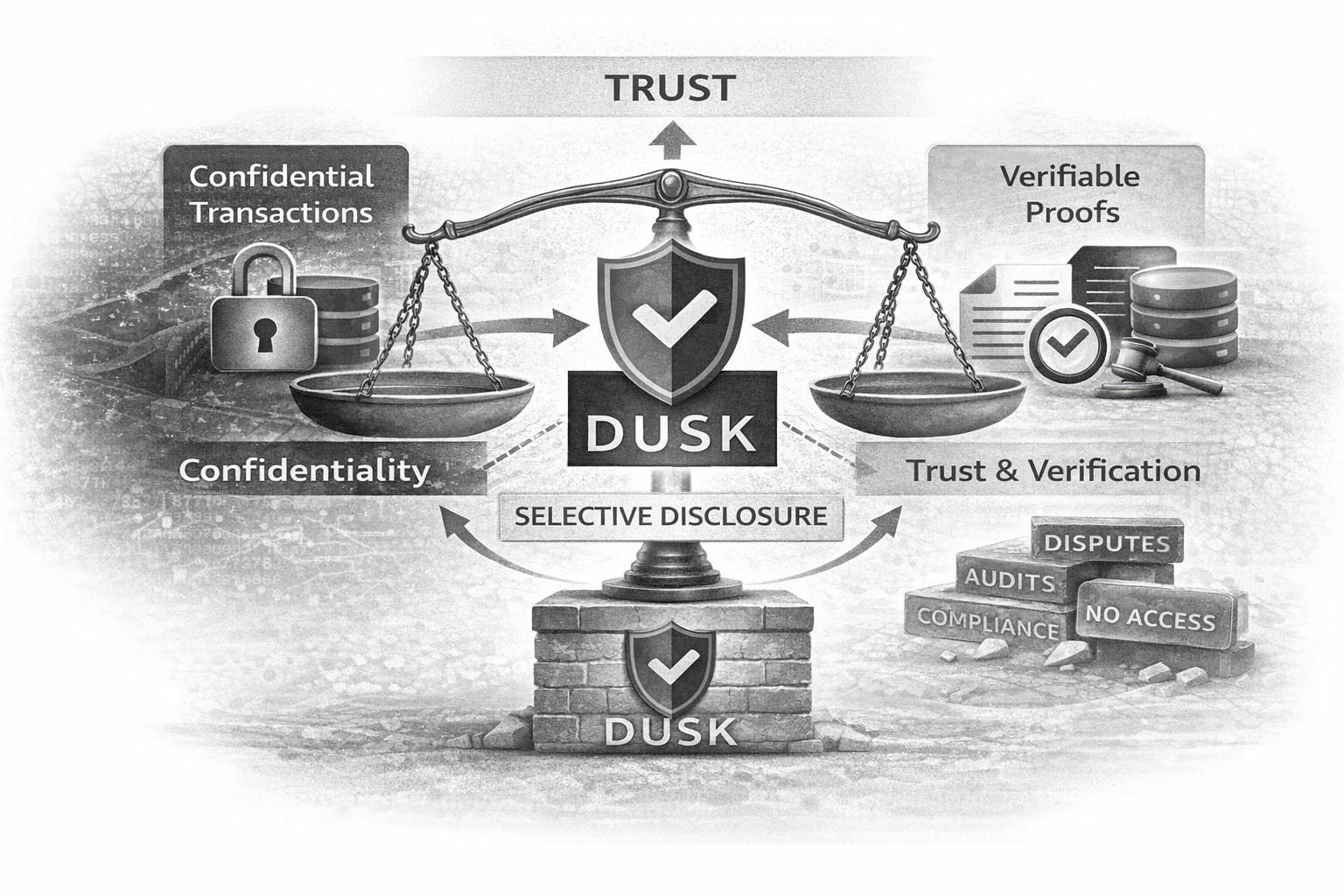
At the validation level Dusk shifts the focus from inspecting data to verifying state transitions. Validators confirm that rules were followed without seeing the underlying information. This separation is critical. Privacy does not weaken consensus because consensus depends on proofs, not disclosure. As a result confidentiality and network security reinforce each other rather than compete.
Selective disclosure also addresses a core weakness of fully opaque privacy models. When everything is hidden, disputes become difficult to resolve. Audits require full transparency and compliance checks often break privacy guarantees entirely. Dusk avoids this “all-or-nothing” outcome by allowing targeted proof revelation. Only the minimum necessary information is disclosed and only under specific conditions.
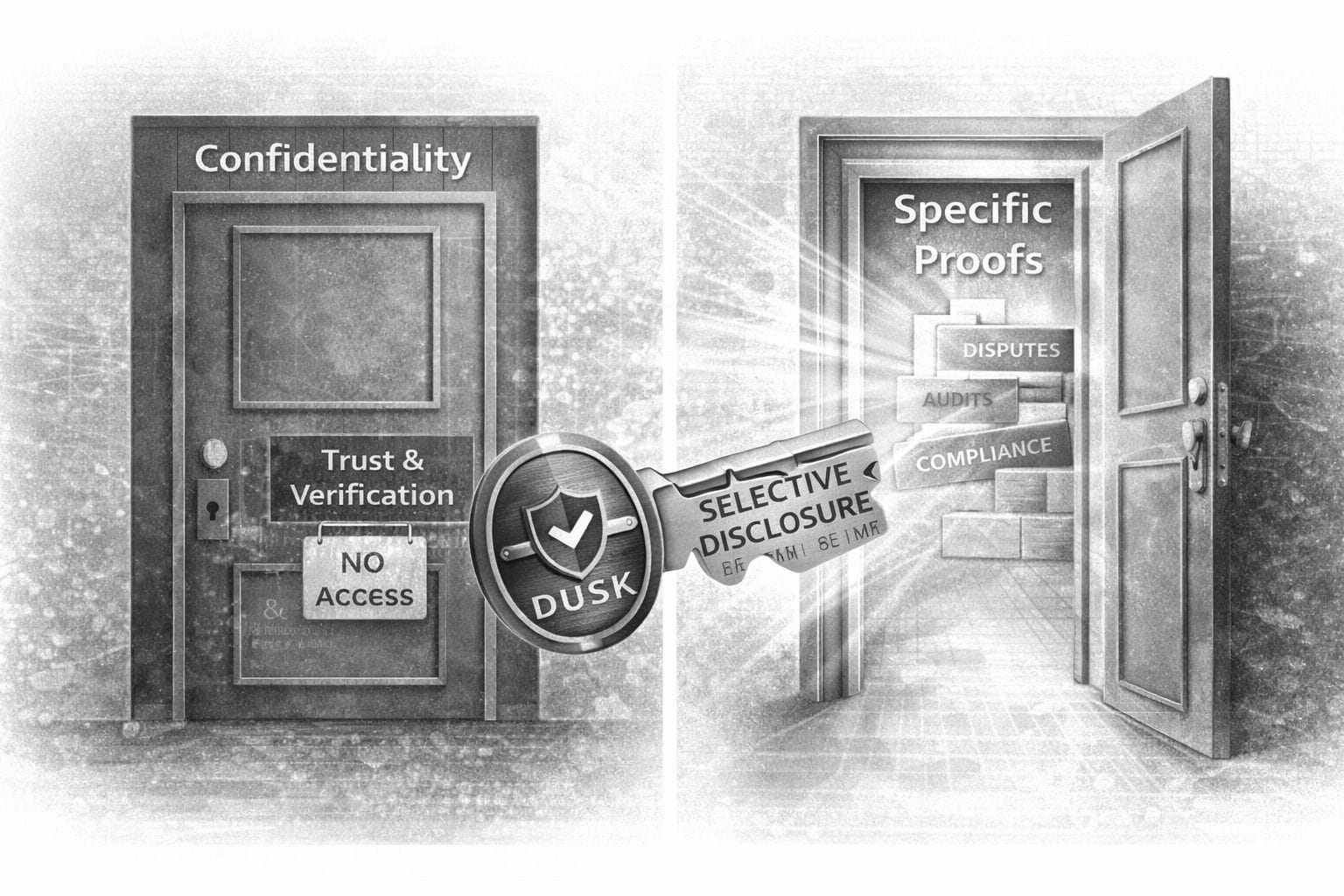
From an adoption standpoint this matters more than ideology. Real financial systems operate under constraints—legal operational and institutional. Privacy that cannot support audits dispute resolution or verification eventually limits its own usefulness. By contrast selective disclosure enables privacy to function within real-world environments instead of outside them.
There are trade-offs. Designing for selective disclosure increases cryptographic complexity and places greater importance on proof correctness and governance. Decisions around who can request proofs and under what conditions must be carefully defined. These challenges are not flaws they are reflections of real operational requirements.
As blockchain infrastructure matures the question is no longer whether privacy is desirable. It is whether private systems can still explain themselves when trust verification or accountability is required. Selective disclosure provides that missing layer. Dusk demonstrates how it can be integrated at the protocol level not added later as a compromise.
