

Dusk Network sits in a pretty specific lane: it’s a Layer-1 built for financial markets that want to move real-world assets on-chain without turning every transaction into public surveillance. Most chains force you to pick a side either you get transparency (great for auditors, terrible for confidentiality) or you get privacy (great for users, often a headache for compliance). Dusk’s pitch is that regulated finance shouldn’t have to make that tradeoff, and the tech choices they’ve made are clearly aimed at that problem set rather than “general-purpose everything.”
The basic idea is selective privacy. Instead of broadcasting every detail of a trade, position, or settlement event, you can prove something happened correctly without revealing the underlying sensitive data. That’s where zero-knowledge proofs come in. If you’ve heard “ZK” tossed around nonstop, this is the practical version: a cryptographic method to prove a statement is true (like “this transaction is valid and obeys the rules”) without exposing the private inputs (like identities, amounts, or the full compliance payload). Dusk’s documentation leans hard into fast, final settlement and a proof-of-stake, committeebbased consensus design with deterministic finalitymeaning once a block is ratified, it’s final in normal operation, which is exactly what you want for markets that can’t tolerate messy reorg risk. 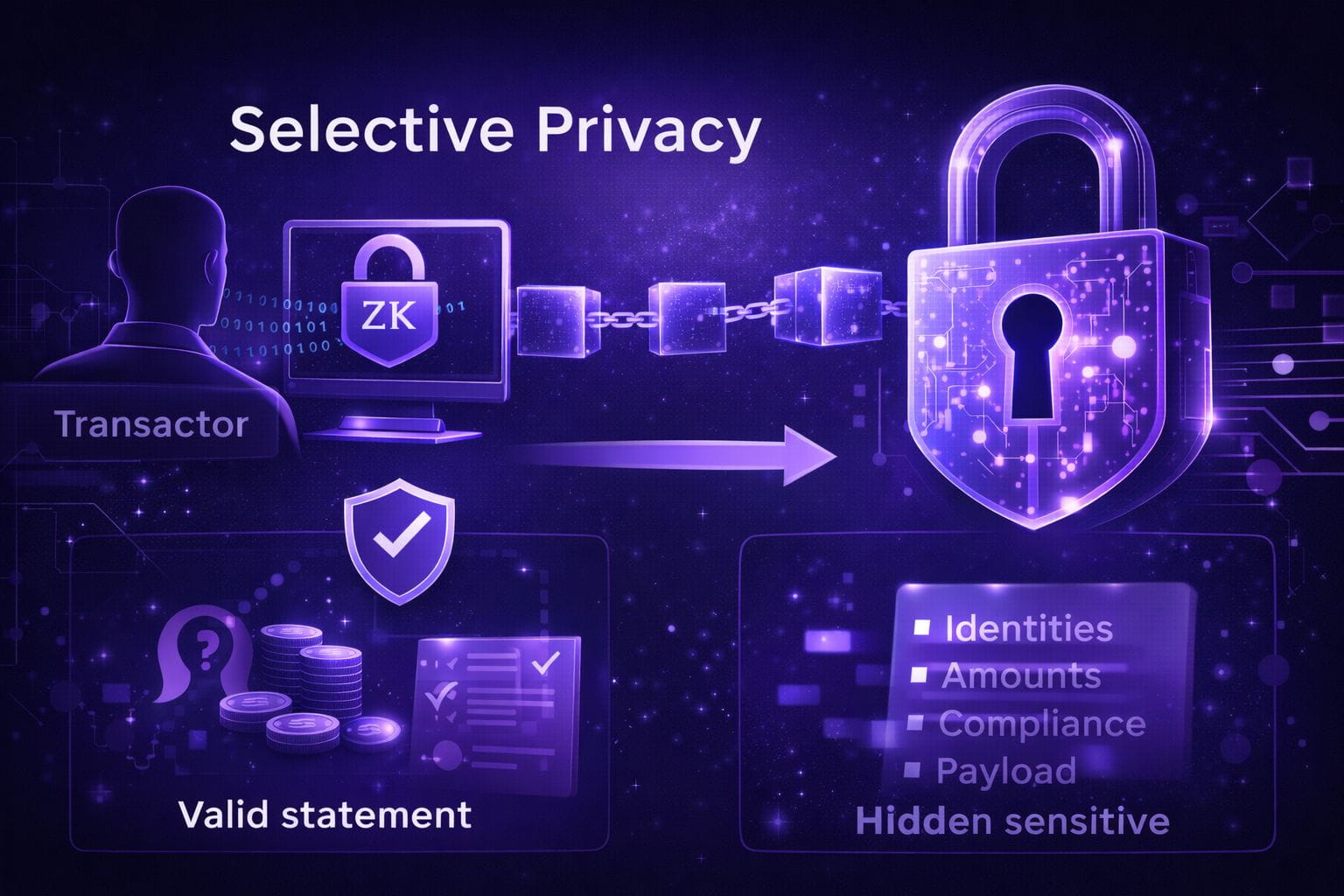
From a timeline standpoint, the project’s biggest “it’s real now” moment was the mainnet rollout that started on December 20, 2024. The team described activating the mainnet onramp contract, moving early stakes into the genesis state on December 29, and targeting the first immutable block on January 7, 2025. Traders tend to underestimate how much this matters. A lot of crypto narratives live in testnet land for years; when a network actually ships mainnet and starts producing final blocks on schedule, it changes how the market prices the story.
So why is Dusk trending again right now? Part of it is the broader rotation back into privacy and “regulated RWA” themes, and part of it is simply that catalysts stacked up. In the last couple of weeks (mid-to-late January 2026), multiple market recaps have pointed to sharp price appreciation and rising derivatives interest. One report pegged a seven-day move of more than 150% alongside open interest around $47.94 million, framing it as a compliance-plus-RWA narrative catching bids. Another analysis described DUSK as a leader in a privacy-coin rotation, citing roughly a 30-day market value surge of about 583% and price action around the $0.30 area. I treat numbers like these as “temperature checks,” not gospel, but they do tell you attention is back.
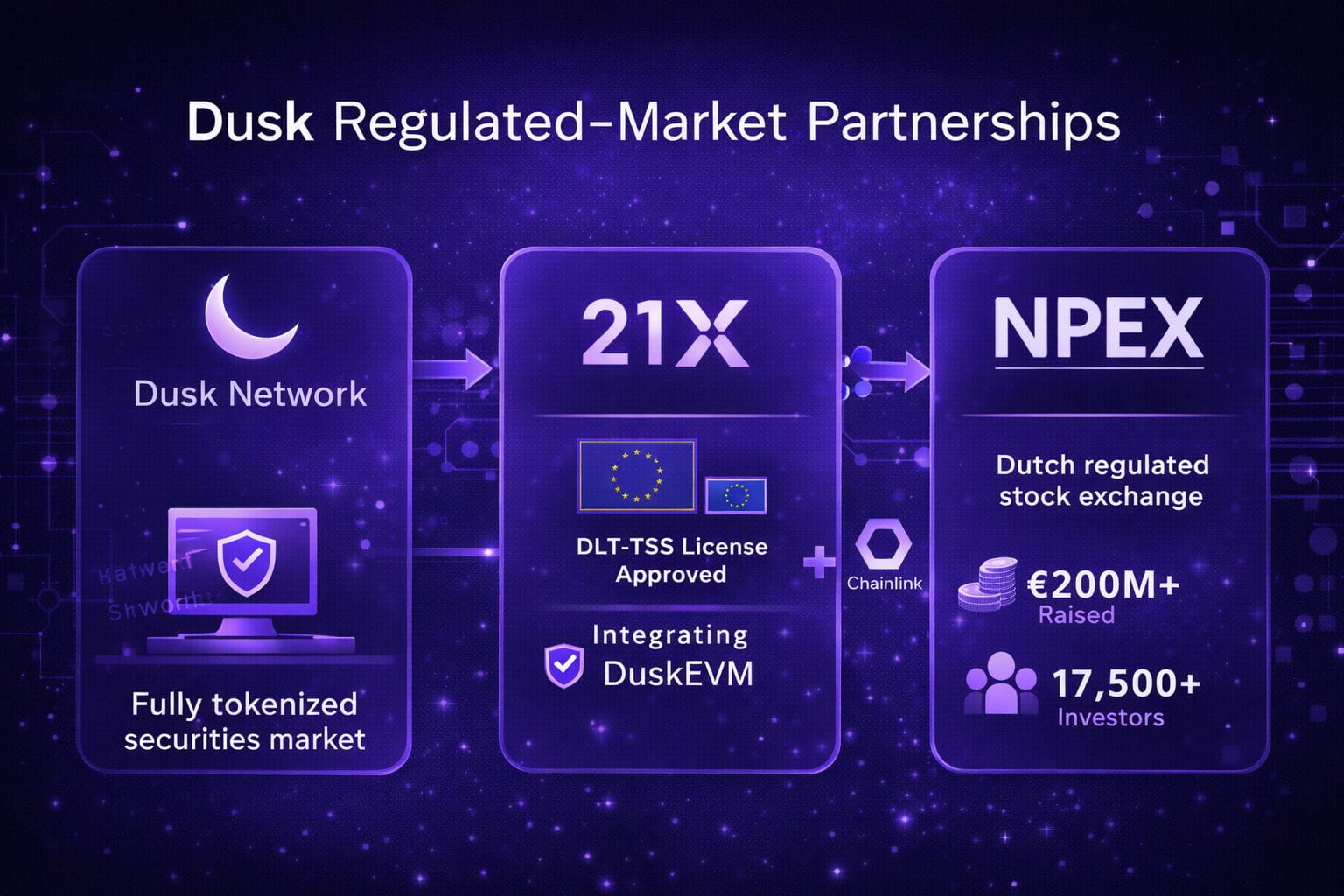
On the fundamentals side, Dusk has also been building regulated-market plumbing through partnerships. A notable one is 21X, which Dusk announced on April 17, 2025, describing 21X as the first company to receive a DLT-TSS license under European regulation for a fully tokenized securities market, with Dusk onboarded as a trade participant and deeper integrations planned (including 21X integrating DuskEVM). Then in November 2025, Chainlink, Dusk, and NPEX announced adopting Chainlink interoperability and data standards to bring regulated European securities on chain NPEX specifically is described as a fully regulated Dutch stock exchange with over €200 million raised via its platform and more than 17,500 active investors. That’s the sort of detail that makes traders pay attention, because it connects “blockchain narrative” to existing regulated infrastructure.
My personal read, as someone who’s watched a lot of “institutional” narratives come and go, is that Dusk is interesting precisely because it isn’t trying to be everything. It’s targeting confidentiality with compliance-friendly design, and it’s showing a pattern of progress: mainnet milestones with concrete dates, then partnerships that map to regulated venues. The market will still trade it like crypto volatile, reflexive, sometimes overhyped but the core question is straightforward: can Dusk become the chain where regulated assets settle on-chain without leaking everyone’s business? If that answer keeps moving toward “yes,” the trend makes sense.
