
When I initially dived into @Walrus 🦭/acc integration with Sui, I saw how Move smart contracts serve as the backbone for coordinating decentralized storage. Walrus handles the off chain data layer, but Sui's Move language enables on chain management, making the system composable and secure without central coordinators.
Move contracts on Sui record node registrations and staking. Nodes stake $WAL via Move functions, creating on chain objects that track stake amounts and delegation. This ensures a transparent, immutable view of network participants.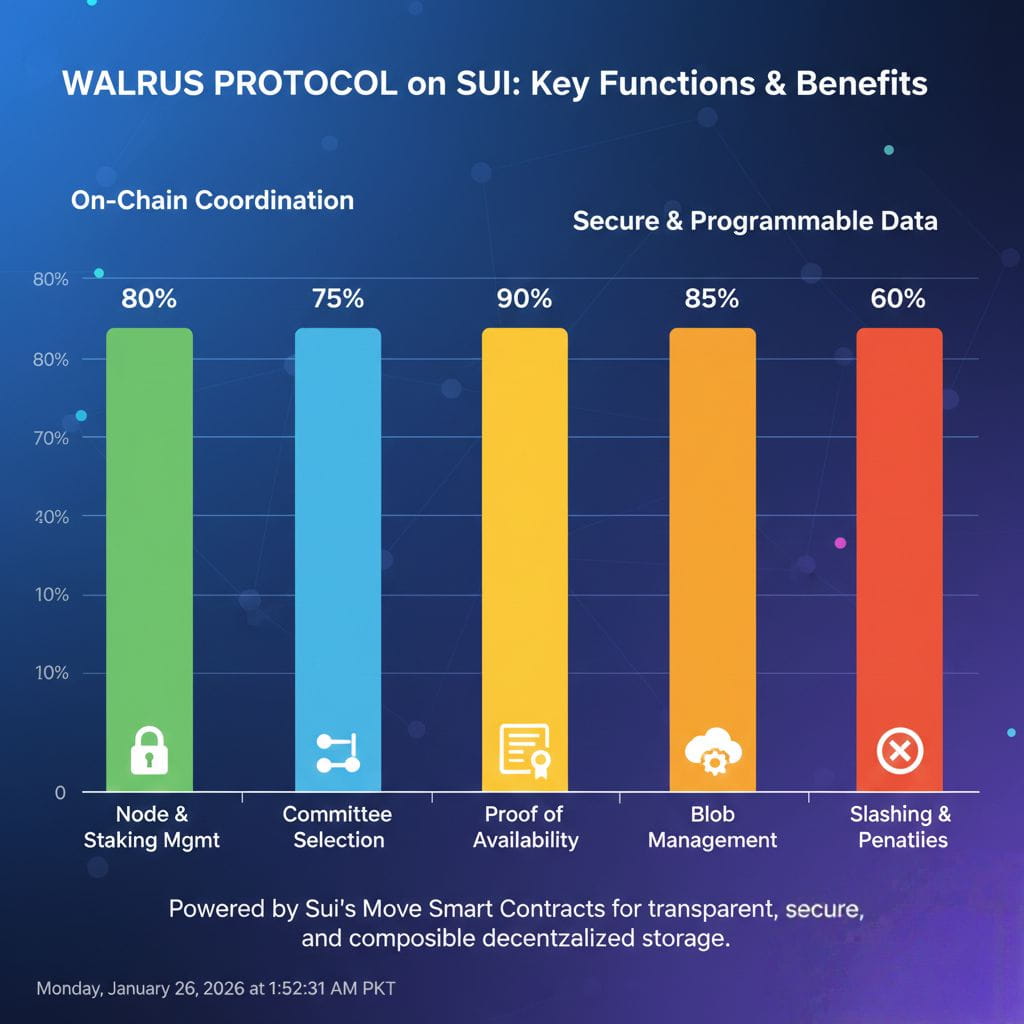
Committee assignments for storage tasks are determined through Move logic. Contracts use deterministic randomness from Sui blocks to select committees for each epoch, assigning slivers fairly based on stake. This onchain selection prevents disputes and keeps coordination consistent.
Proof of Availability certificates are minted as Move objects. After a blob uploads and nodes confirm slivers, a Move contract issues the certificate, verifying the data is stored and retrievable. Developers reference these objects in their own contracts for composability.
Blob management uses Move's object model. Contracts can extend storage durations, transfer ownership, or delete blobs through function calls. This programmability allows dApps to treat stored data as native assets, like updating NFT metadata onchain.
Epoch transitions are governed by Move. Contracts recalculate committees, distribute rewards from storage fees, and apply penalties for failures. Rewards go to staked nodes and delegators as $WAL transfers, all executed atomically on Sui.
Slashing for misbehavior is enforced in Move. If a node fails challenges, the contract deducts staked WAL, with portions burnt or redistributed. This turns coordination into a secure, incentive aligned process.
In my view, using Move for coordination makes Walrus more than storage it's infrastructure where data interacts seamlessly with smart contracts, fostering innovation in DeFi or AI apps that need reliable, on chain linked data.


