
Web3 applications are only as strong as the data they depend on. @Walrus 🦭/acc addresses a problem most builders underestimate: storage is the invisible risk layer. NFTs, AI datasets, DeFi proofs, and RWA documentation all require persistence, verifiability, and uptime. Without it, even the most innovative blockchain applications can fail silently.
$WAL is the economic engine behind this reliability. By rewarding validator uptime and penalizing failures, Walrus aligns incentives directly with operational outcomes. This turns storage from a passive service into enforceable infrastructure, integrated tightly with Sui.
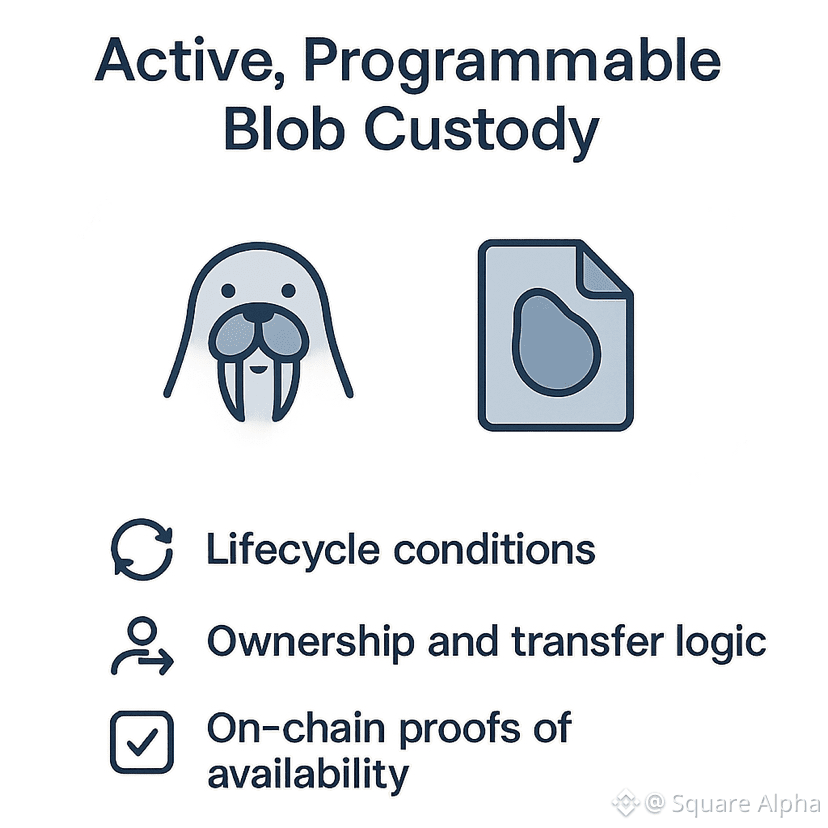
Active, Programmable Blob Custody
Walrus does not simply store files; it enforces custody rules programmatically. On Sui, each blob carries:
Lifecycle conditions
Ownership and transfer logic
On-chain proofs of availability
This means developers can rely on storage as part of application logic, not as a fragile external dependency. Blobs are treated as living objects, evolving alongside applications without compromising continuity or security.
RedStuff: Efficient Resilience Under Churn
Walrus implements RedStuff erasure coding, distributing data across nodes with minimal overhead. If nodes leave or network conditions fluctuate, blobs can still be reconstructed efficiently.
In Web3, churn is inevitable: nodes go offline, demand spikes, and fees fluctuate. Walrus anticipates these realities, ensuring availability is continuously enforced, not assumed.
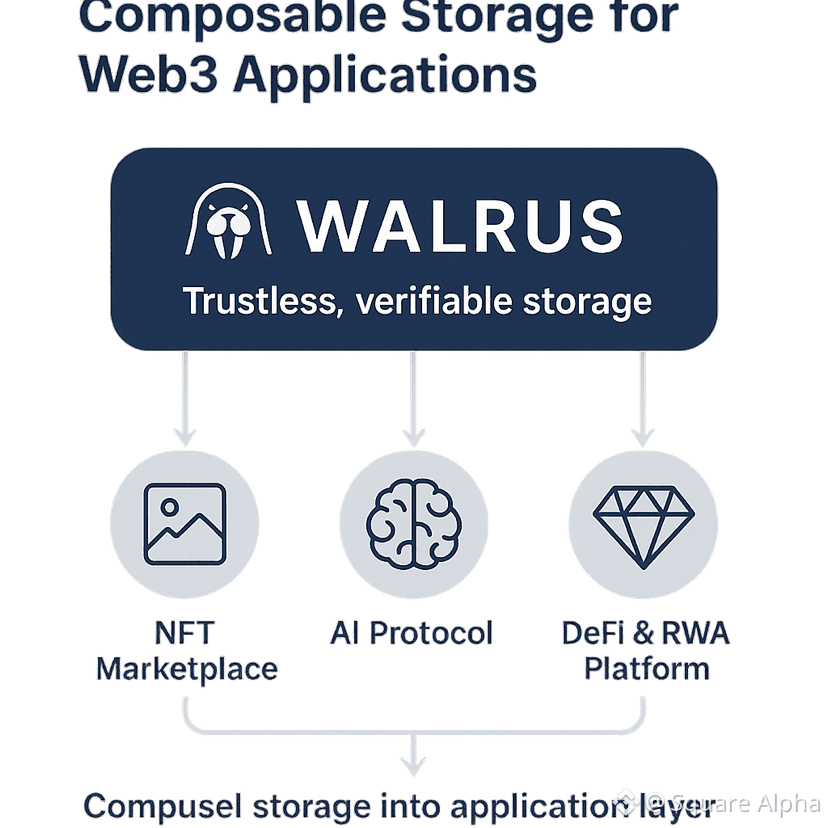
Composable Storage for Web3 Applications
Walrus enables trustless, verifiable storage that integrates directly with applications:
NFT marketplaces maintain permanent media without central servers
AI protocols fetch verifiable datasets reliably
DeFi and RWA platforms store critical proofs securely
On-chain games preserve persistent state
By embedding storage into the application layer, Walrus makes data a composable, strategic asset.
WAL: Incentives That Secure the Network
The token economy is designed to reinforce reliability:
Validators earn WAL for uptime
Penalties discourage downtime or failed verification
Governance ensures protocol upgrades align with real usage
$WAL is not speculative. It is tied directly to the persistence and availability of critical data, creating self-enforcing network security.
Why Walrus Adoption Will Stick
Storage is hard to migrate. Once an application relies on Walrus, switching becomes expensive and risky. Developers adopt because it works, not because of hype. This creates organic, sticky adoption, with usage naturally growing alongside application demand.
Applications benefit from:
Predictable, verifiable availability
Resilience under real network conditions
Integration with Sui’s object-centric execution
This makes Walrus indispensable infrastructure, not optional storage.
Final Take
Walrus is Web3’s data backbone. By combining Sui’s object model, RedStuff resilience, on-chain Proofs of Availability, and $WAL incentives, @Walrus 🦭/acc ensures data is persistent, verifiable, and composable.
For builders, traders, and investors, #walrus is the infrastructure layer that keeps applications alive, reliable, and scalable — the true foundation of decentralized ecosystems.


