
Picture a massive library where every book is a piece of data—photos, videos, AI models, documents—and nobody owns the building. Instead of one gatekeeper deciding who gets in, what gets stored, or how much it costs, the readers, writers, and shelf-keepers together set the rules. That shared control is the essence of decentralized governance, and WAL is the quiet but powerful key that lets ordinary people turn that idea into reality.
@Walrus 🦭/acc , built on the Sui blockchain, solves a hard problem: storing huge files cheaply, securely, and without censorship. Traditional clouds charge whatever they want, delete what they dislike, and lock your data in their vault. Walrus spreads pieces of every file across hundreds of independent nodes using clever erasure coding, so even if some disappear, your data survives. But technology alone does not guarantee fairness. Without good governance, the system could drift toward the same old power imbalances—big holders or early insiders calling all the shots.
This is where WAL becomes more than a payment coin. Yes, you use WAL to pay for storage in a way that keeps prices stable in dollars, not swinging wildly like many crypto tokens. But its deeper job is governance fuel. Holding WAL lets you propose changes, vote on them, and help steer the entire protocol. Adjust storage fees when demand spikes. Tweak penalties so honest nodes stay rewarded and bad actors lose. Decide reward splits between storage providers and the people who keep the network alive through staking. Every parameter that affects price, security, speed, or accessibility can be shaped by $WAL holders.
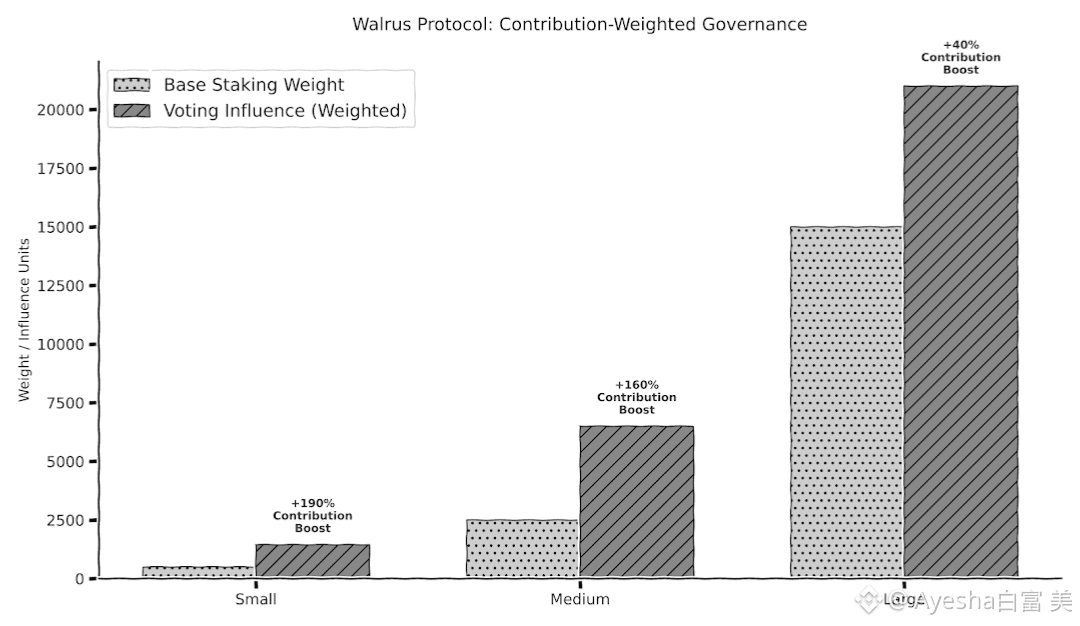
The beauty lies in how WAL spreads influence. Many protocols give voting power strictly by token count—one WAL, one vote would still favor whales. Walrus leans toward contribution-weighted models in practice, where staking to secure the network or running nodes earns you meaningful say. It is not perfect equality, but it is far from pure plutocracy. A developer in Karachi who stakes a modest amount and uses the network daily can influence decisions alongside someone in Silicon Valley holding millions. Your real engagement—running infrastructure, storing data, or simply locking tokens long-term—amplifies your voice.
Think of it like a village well. In the old centralized world, one landlord owns the well, sets the price per bucket, and can shut it off whenever. In a WAL-governed system, everyone who helps maintain the well—digging deeper when needed, repairing cracks, guarding against poison—gets a proportional say in how deep to dig next, what the fair price should be, and who gets priority during drought. Small contributors still matter because the well only stays reliable if many hands keep it working. Passive owners who never touch the rope have less pull. Active participants shape the rules.
This design creates natural incentives for inclusion. Low turnout plagues most DAOs—people forget, feel insignificant, or distrust the process. WAL counters that with simplicity and skin in the game. Staking is straightforward, rewards are predictable, and every vote directly impacts something tangible: your storage costs tomorrow, the network’s uptime next month, or whether new features (like programmable data for AI agents) get built. When you see a past vote lower fees by 15% or add better redundancy for low-bandwidth regions, you feel the difference in your wallet and your workflow. That feedback loop keeps people coming back.
Transparency seals the deal. Every proposal lives on-chain forever. Anyone can read the discussion, check vote tallies, trace how tokens moved during staking. No hidden boardroom deals, no surprise executive overrides. If something smells wrong, the ledger exposes it instantly. In an age where trust in institutions is thin, this radical openness rebuilds confidence one verifiable transaction at a time.
The inclusivity ripple reaches further than token holders. Developers building apps on Walrus benefit from predictable costs and community-driven upgrades. Node operators in emerging markets earn sustainable rewards without needing massive capital upfront. Users in censored regions store files knowing no single company can erase them. Even non-technical people can participate by staking through friendly wallets or delegating to reliable validators. WAL lowers every barrier it can—technical, financial, geographical—so the governance pool looks more like the real world and less like a private club.
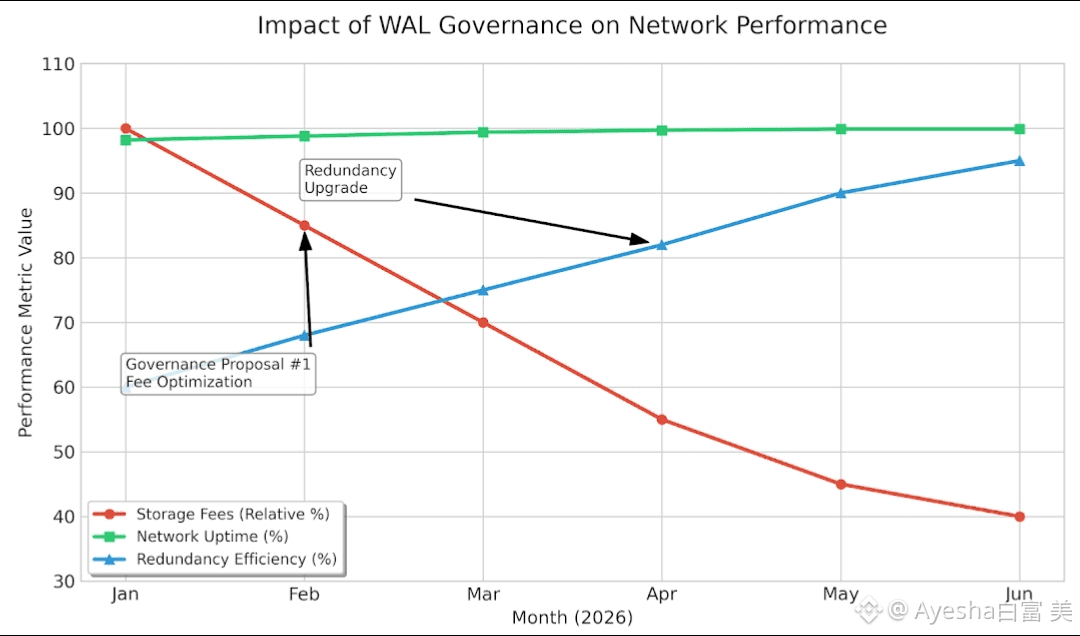
Compare it to upgrading a public park. In a centralized setup, the city council decides alone: concrete over the grass, raise entry fees, remove benches to save money. Residents complain but rarely change anything. With WAL-style governance, park users who volunteer time, donate equipment, or simply pay the small maintenance fee get votes on the next plan. Want more shade trees for hot summers? Propose it. Want accessible paths for wheelchairs? Rally support. The park evolves with the people who actually use it, not distant bureaucrats.
Of course challenges remain. Voter apathy, sybil attacks, and complex proposals can slow progress. Yet WAL’s pragmatic approach—stable payments plus staking rewards plus clear on-chain records—tackles them head-on. It does not pretend to solve human nature overnight; it creates conditions where good participation wins over time.
In the end, WAL is not flashy hype. It is infrastructure for collective intelligence. It turns “decentralized” from marketing buzzword into daily practice. When thousands of diverse voices—from students in Pakistan to engineers in California—help tune the same storage engine, the result is more resilient, more affordable, and more innovative than any single team could design alone.
Your stake, however small, is not noise. It is signal. Cast a vote, lock some tokens and suggest an improvement. The protocol listens. In a world drowning in centralized control, WAL quietly proves that distributed ownership can work—not as utopia, but as working software that gets better because ordinary people help steer it.
Participation is not charity; it is self-interest aligned with the common good. When you engage, you protect your own data costs, strengthen the network you rely on, and help build a digital commons where power flows to those who contribute. That is the quiet revolution WAL enables—one thoughtful vote at a time.

