

Hello family Today I want to talk about a project I have been reading, researching, and observing closely over time. In my view, Walrus is one of those rare infrastructure projects that does not try to win attention through noise. It builds quietly, and it waits for reality to test it. In this space, that kind of patience is unusual, but it is often the difference between systems that survive and systems that fade away.
At its core, Walrus is not trying to be just another decentralized storage option. It is trying to answer a deeper question that most people overlook until something breaks. What happens to data when the app disappears? What happens when a company shuts down, a website goes offline, or a business model fails? In traditional systems, the answer is simple and uncomfortable. The data usually goes with it.
Walrus is built around the opposite assumption. It assumes that applications, interfaces, and even companies are temporary, but data should not be. From what I understand, the protocol is designed so that data lives independently of the tools people use to interact with it. Interfaces are replaceable. Storage is not. This distinction sounds subtle, but it changes everything about how resilience is designed.
When I first started reading about Walrus, I thought it would feel similar to other decentralized storage networks. Many projects talk about redundancy, distribution, and censorship resistance. But the more I looked into Walrus, the more I noticed that its design choices were focused less on marketing narratives and more on failure scenarios. It is built with the assumption that things will go wrong. Nodes will go offline. Businesses will shut down. Products will fail. The question is not whether these things happen, but whether the system can absorb them without losing what matters.
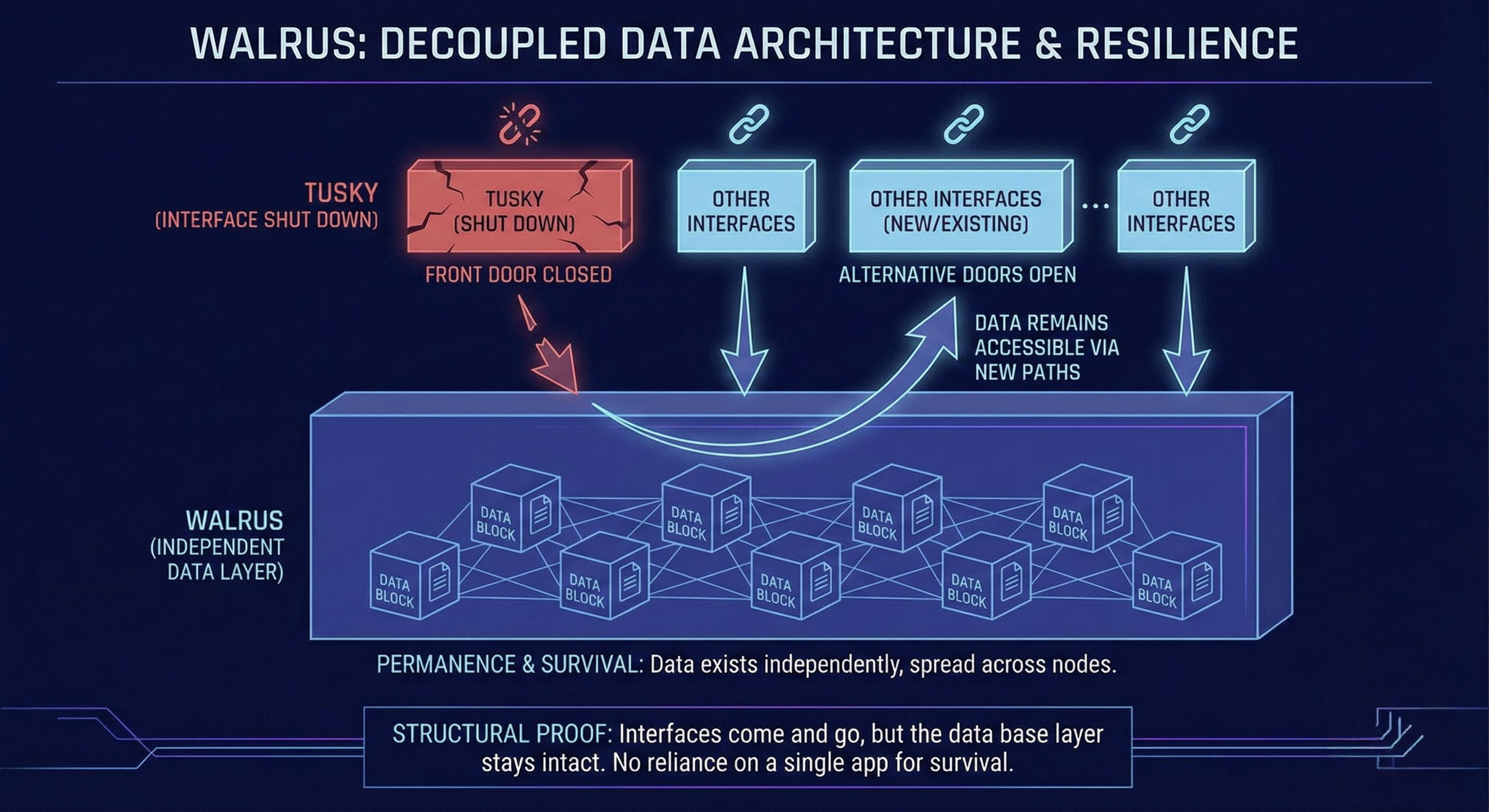
That philosophy was put to the test in a very real way during the Tusky shutdown. For those who followed Walrus early, Tusky was one of the most popular interfaces people used to upload and manage their data. For many users, Tusky felt like Walrus itself. Files were uploaded there, accessed there, and managed there. So when Tusky announced it was shutting down because the business was no longer sustainable, fear spread quickly.
This reaction was understandable. In most digital systems, when the front end disappears, the data disappears with it. People are trained by years of Web2 behavior to associate an app with the data it hosts. When the app dies, users expect loss. Panic is a rational response in that context. What happened next is the moment that, in my view, defined Walrus.
The data did not disappear. Files were not deleted. Content was not locked away. Tusky was never the storage layer. It was only one interface built on top of Walrus. When its servers went offline, the data remained exactly where it always was, distributed across independent storage nodes in the Walrus network. The door closed, but the house was still standing.
From a technical standpoint, this is what Walrus was designed to do. But seeing it happen in real life is very different from reading it in documentation. This was not a controlled demo or a planned showcase. It was an unplanned stress test caused by a real business failure. And the protocol behaved exactly as intended.
What impressed me further was how the situation was handled. The Walrus Foundation did not panic. They stepped in with clear communication and guided users toward alternative interfaces that could interact with the same underlying data. Migration paths were explained. Deadlines were communicated. Users were given time to move if they wanted different tools, but they were never at risk of losing their files.
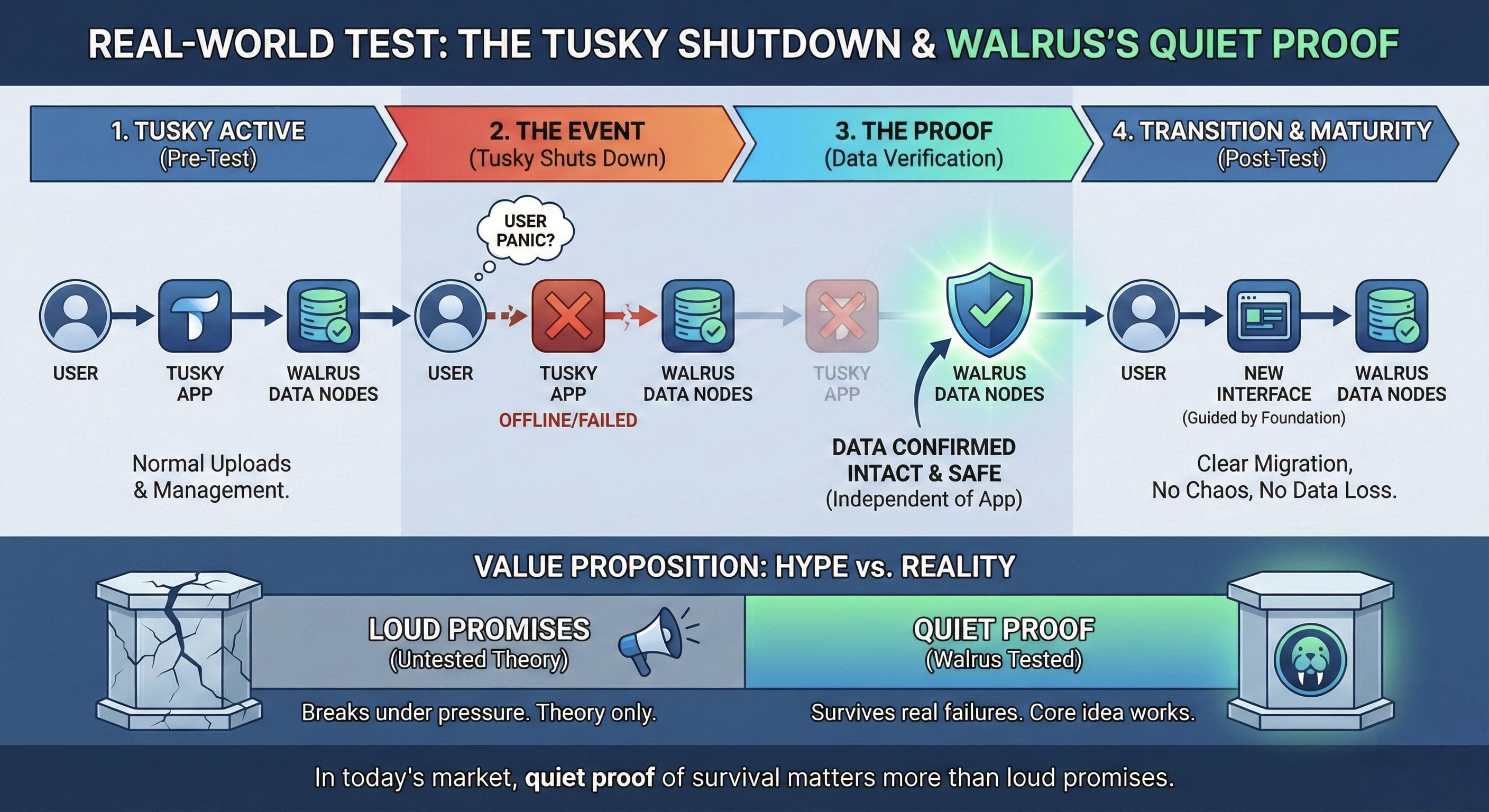
There was no scramble to rebuild data. No emergency recovery process. No centralized intervention to save the system. The protocol did what it was supposed to do quietly and reliably. In my experience, this is where decentralization stops being a slogan and starts being a property you can observe.
This event also forced many people to understand the difference between a protocol and a product. Tusky was a product. Walrus is infrastructure. Products can fail. Infrastructure should not. The fact that one could fail without harming the other is not a weakness. It is the entire point.
What stands out to me about Walrus is that it does not try to compete on excitement. It does not promise to replace every cloud provider or dominate every use case. It focuses on one thing and takes responsibility for it. Keeping data alive even when everything around it changes. That is not flashy. It is foundational.
In a market where many systems collapse under pressure not because they break technically, but because people lose confidence, this matters. Fear spreads faster than facts. Walrus showed that when fear hit, the facts held. Data availability did not depend on trust in a company, a founder, or an interface. It depended on incentives, redundancy, and protocol design.
This is why I believe the Tusky shutdown ended up strengthening Walrus rather than hurting it. It provided something most projects never get. Proof under stress. Not a claim. Not a roadmap. Proof.
Looking at the broader picture, this moment also sends a signal to builders. You can build on top of Walrus, experiment, succeed, or fail, without putting user data at risk. That lowers the cost of innovation. It tells developers that they are not building on fragile ground. They can focus on user experience and business models, knowing that the underlying data layer is not tied to their survival.
In the end, Walrus is interesting to me not because of trends or speculation, but because it demonstrated something rare in this space. It showed that decentralized data can outlive centralized failure. It showed that infrastructure can behave exactly as designed when reality intervenes.
In my knowledge, this is what long term systems look like. They do not dominate conversations. They do not rely on constant attention. They wait. And when the moment comes, they work.
That is what Walrus proved. And that kind of proof matters more than any promise ever could.

