Walrus Protocol begins with a quiet rebellion against how the digital world stores its memory. In an era where data is locked inside centralized clouds, fragile to control, outages, and censorship, Walrus chooses a different path, one that spreads information like waves across an open ocean. At its heart, Walrus is a decentralized protocol built to store data privately, securely, and permanently, while giving users real ownership over what they create, share, and preserve. The WAL token is the native force that powers this ecosystem, turning storage into an open economy rather than a rented service.
Built on the Sui blockchain, Walrus is designed to handle what most blockchains avoid, large files, rich media, datasets, and complex digital assets. Instead of forcing data into small blocks, Walrus embraces scale by breaking files into fragments and distributing them across a global network. Even if parts of the network go silent, the data remains alive, reconstructable, and accessible. This approach is not about speed alone, it is about resilience, trust, and survival without reliance on any single authority.
What makes Walrus feel different is how naturally storage becomes programmable. Data on Walrus is not just uploaded and forgotten, it becomes an on chain object that can be extended, renewed, transferred, or governed by smart logic. Applications can build directly on top of stored data, treating it as a living component rather than a static file. This opens the door to decentralized applications that rely on real data permanence, from NFT media and game assets to AI datasets and decentralized websites.
Privacy is woven into the design rather than added as an afterthought. Walrus allows data to be stored in a way that remains verifiable, yet protected, ensuring that users and enterprises can trust the network without exposing sensitive information. The protocol balances openness and confidentiality, making it suitable for individuals, creators, and large scale applications alike. Data integrity is maintained even in hostile conditions, because the network itself is designed to expect failure, and survive it.
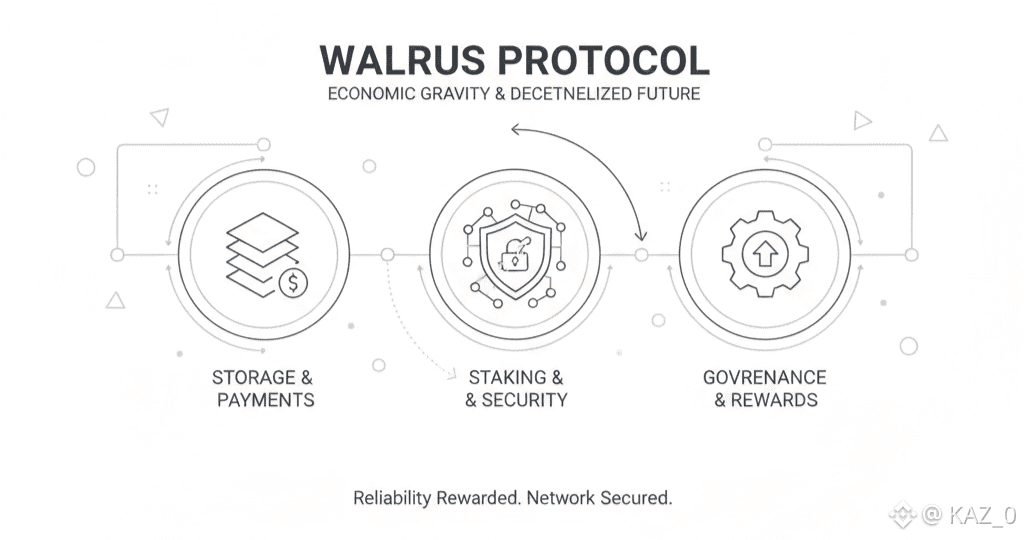
The WAL token gives economic gravity to the protocol. It is used to pay for storage, secure the network through staking, and participate in governance decisions that shape the future of Walrus. Storage node operators earn WAL by reliably serving data, while token holders can delegate their stake and share in the rewards. This creates a cycle where reliability is rewarded, and negligence is discouraged, keeping the network strong without centralized enforcement.
Walrus also stands out for its long term vision. It is not chasing short term trends, but building infrastructure meant to last decades. As artificial intelligence grows more data hungry, and digital ownership becomes more important, Walrus positions itself as the silent backbone that holds everything together. It offers developers simple tools and flexible access methods, so that both Web3 natives and traditional builders can adopt decentralized storage without friction.
There is a quiet confidence in how Walrus moves. It does not promise to replace everything overnight, instead, it focuses on doing one critical thing extremely well, preserving data in a decentralized world. As more applications search for alternatives to traditional cloud systems, Walrus becomes less of an experiment, and more of a necessity.
Walrus Protocol is not just about storage, it is about memory sovereignty. It is about ensuring that the stories, data, and creations of the digital age are not owned by gatekeepers, but shared across a network that belongs to everyone. With WAL as its heartbeat, and decentralization as its compass, Walrus is shaping a future where data no longer sinks when one server fails, but floats freely across an open, decentralized ocean.