

The AWS Wake-Up Call: Why Decentralized AI Infrastructure Is No Longer Optional
When Centralized Systems Fail, Everyone Feels It
October 2025 delivered a lesson the crypto industry won't forget. Amazon Web Services went down, and within minutes, Coinbase users couldn't access their funds. Robinhood froze. Multiple major exchanges displayed error messages instead of trading interfaces.
The irony was painful. An industry built on decentralization principles had quietly become dependent on a single cloud provider. Years of building "trustless" systems, and one AWS hiccup exposed the truth. Most of crypto's infrastructure runs on Jeff Bezos's servers.
This isn't an anti-Amazon argument. AWS is remarkable technology. But single points of failure are single points of failure, regardless of how reliable they usually are.
The Storage Illusion
Here's what most people don't understand about blockchain storage. It's mostly a lie.
When you mint an NFT, the blockchain stores a hash, a reference pointing somewhere else. The actual image? Usually sitting on IPFS, which might or might not be pinned. Or on AWS. Or Google Cloud. Or some startup's server that might not exist next year.
Your "permanent, immutable" digital asset depends entirely on external infrastructure you don't control. The blockchain recorded that you own something. Whether that something remains accessible is someone else's problem.
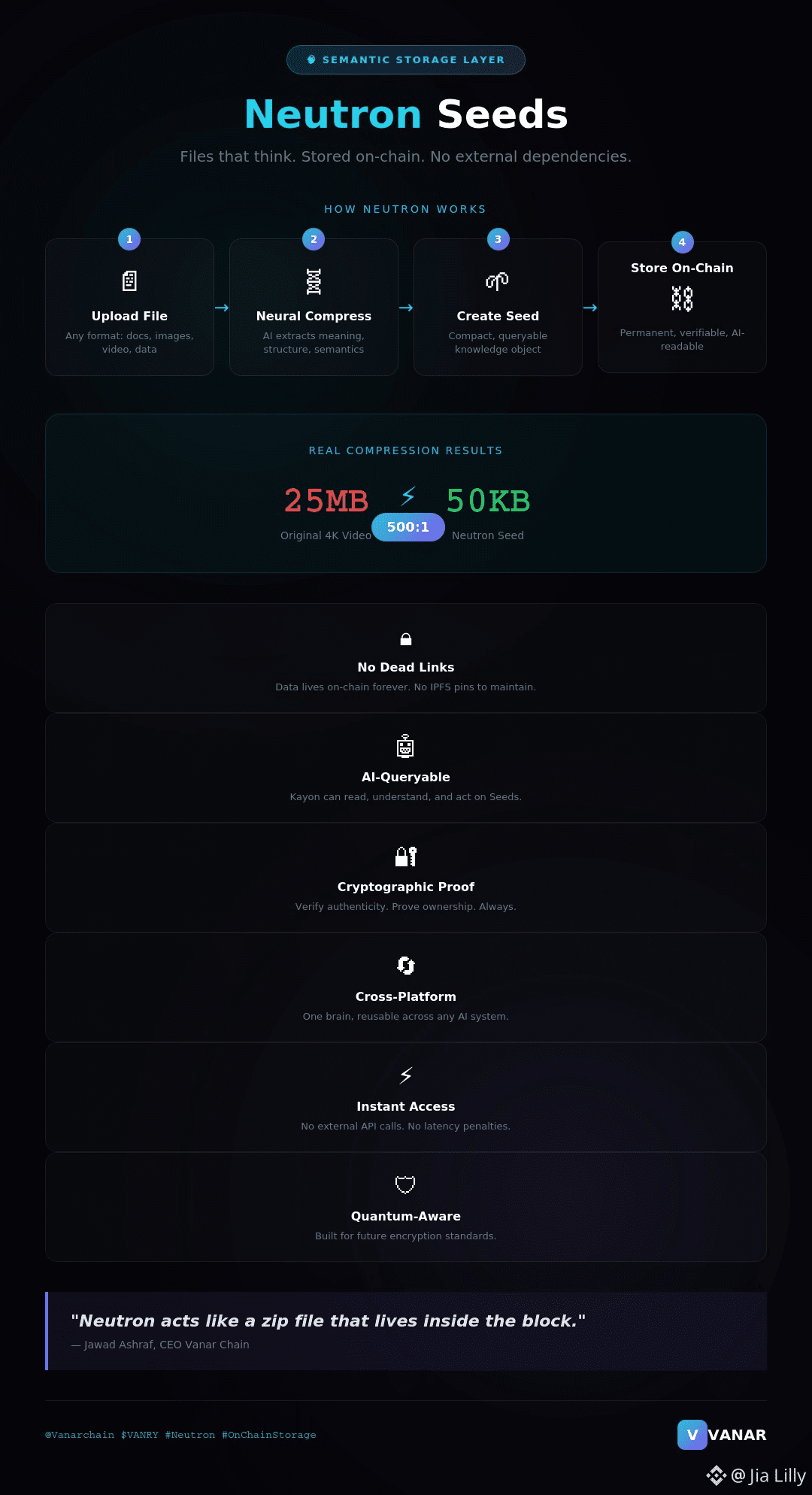
Vanar's Neutron technology attacks this problem directly. Instead of storing references, Neutron compresses entire files into what they call "Seeds," compact, queryable objects that live directly on-chain. A 25MB file becomes roughly 50KB. Not a pointer to the file. The file itself, compressed and recoverable without external dependencies.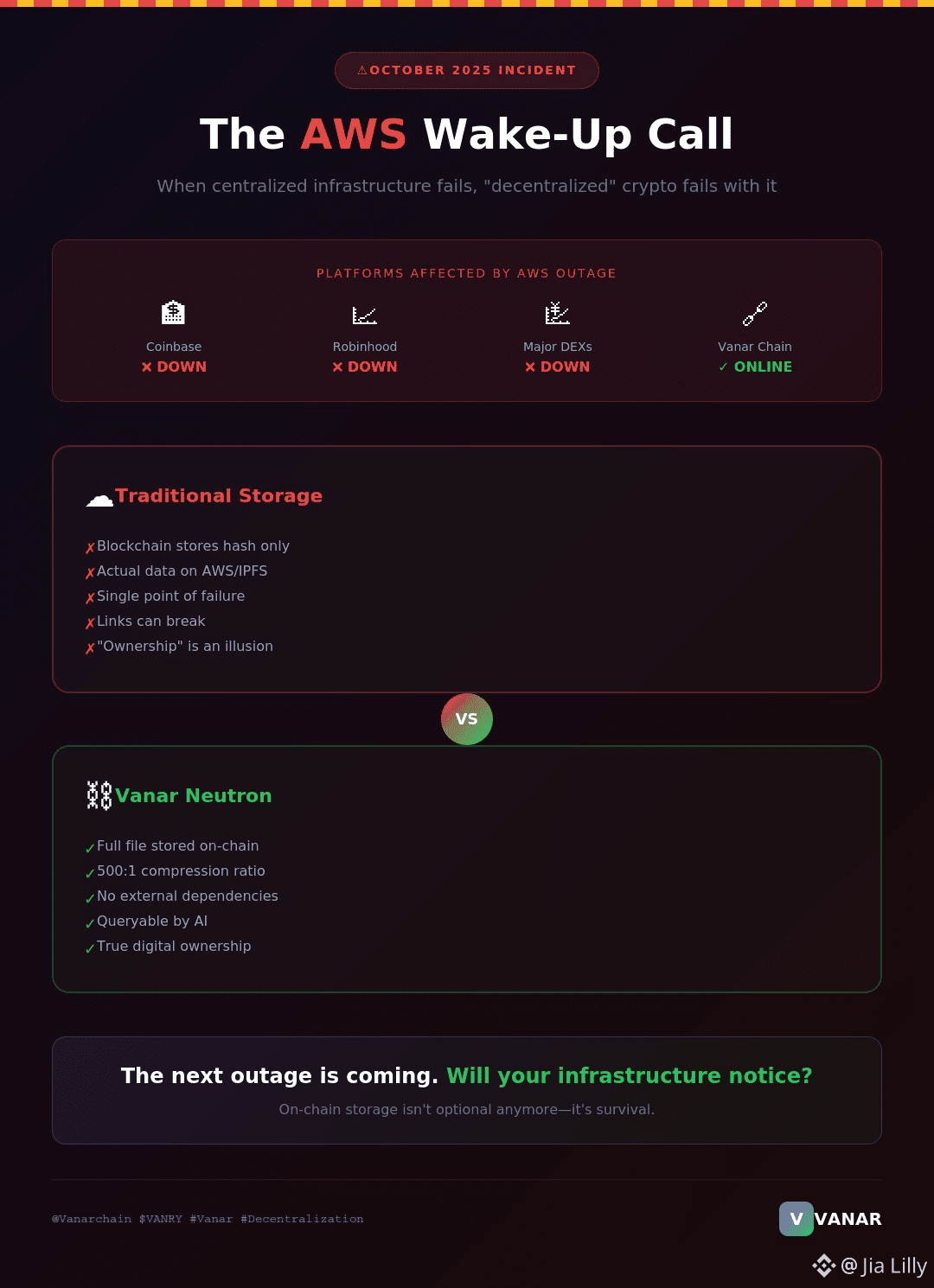
Why This Matters for AI
The storage problem becomes critical when AI enters the picture.
AI agents need persistent memory. They need to remember past interactions, understand context, and maintain state across sessions. Traditional blockchain architecture, stateless by design, wasn't built for this.
Current solutions store AI memory off-chain, in databases, or on cloud servers. This means your AI agent's intelligence depends on the same centralized infrastructure that failed in October.
Vanar's architecture treats AI memory as a first-class citizen. Neutron Seeds aren't just compressed files, they are semantic objects that AI can query and understand. Kayon, the on-chain reasoning engine, can process this data in real-time without external API calls.
The result is AI infrastructure that doesn't go dark when AWS has a bad day.
The Cost Equation
Decentralization usually comes with a price tag. Bitcoin's security costs billions in mining. Ethereum's decentralization means gas fees that spike unpredictably.
Vanar's approach differs. Fixed tiered fees, approximately $0.0005 for standard transactions, make costs predictable. The protocol updates VANRY price feeds at the block level, so builders can calculate budgets accurately.
For AI applications generating thousands of micro-transactions, predictable costs aren't a nice-to-have. They are essential for viable business models.
The Practical Reality
Theory is nice. Working systems matter more.
Vanar's infrastructure already powers World of Dypians, a 2,000 square kilometer metaverse on Epic Games Store with 30,000+ active players and over 155 million on-chain transactions. Emirates Digital Wallet, backed by 15 Middle Eastern banks serving 13+ million customers, chose Vanar for production infrastructure.
These aren't testnet experiments. They are real systems handling real loads.
The comfortable Question
October's outage raised a question the industry hasn't adequately answered. What happens when centralized infrastructure fails during a genuine crisis?
Not a brief hiccup, but a sustained outage during market volatility. When people most need access to their assets. When AI agents need to execute time-sensitive operations.
Vanar doesn't claim to solve every problem. But building AI infrastructure that stores data on-chain rather than pointing to external servers addresses a fundamental vulnerability.
The next AWS outage is coming. The question is whether your infrastructure will notice.
