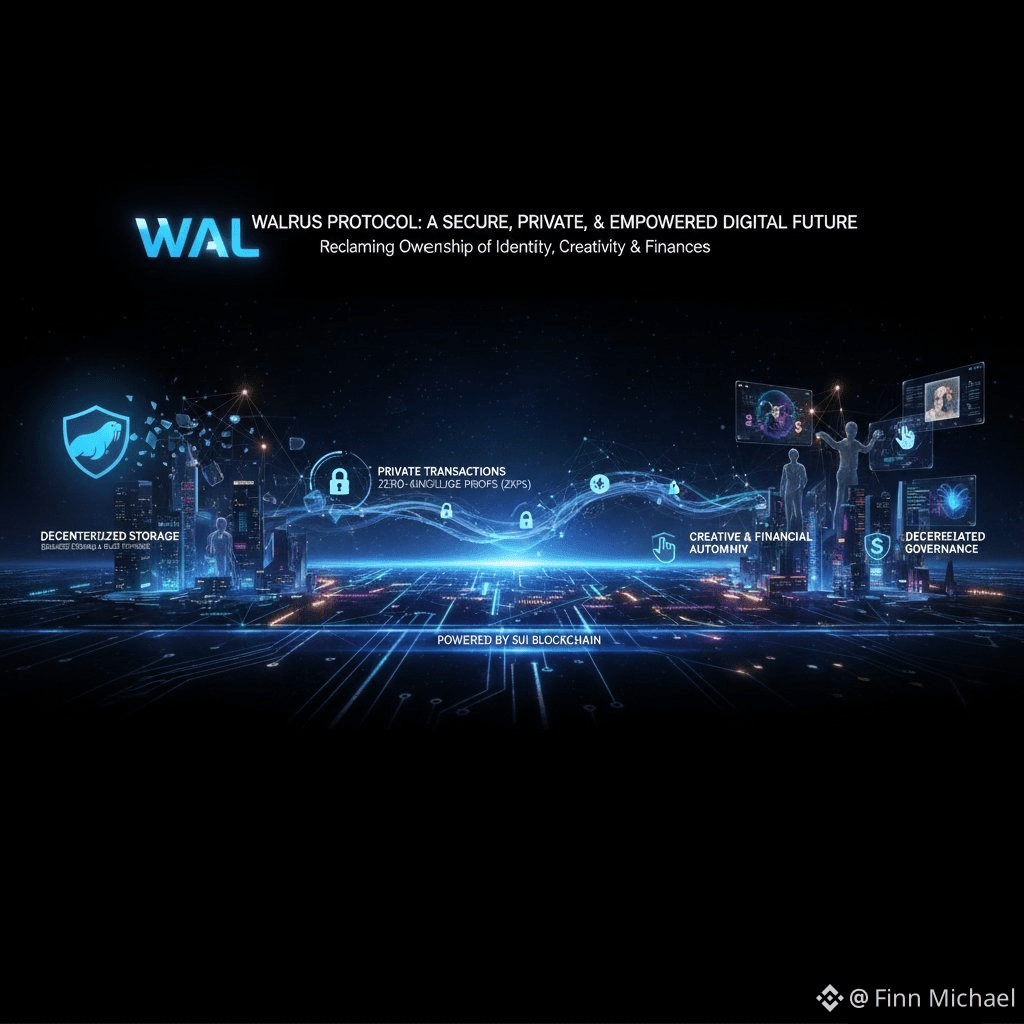
Cryptocurrencies and blockchain technology continue to mature beyond simple value transfer, expanding into areas such as decentralized applications, digital ownership, and secure data coordination. One of the most critical components of this evolution is how data is stored, accessed, and preserved without reliance on centralized entities. Walrus (WAL) addresses this challenge by introducing a decentralized data storage and availability protocol designed for scalability, security, and long-term reliability.
Walrus (WAL) is the native cryptocurrency of the Walrus protocol, a blockchain-based system built on the Sui network. Its purpose is to enable secure, decentralized, and cost-efficient storage of large data sets while maintaining strong guarantees around availability and integrity. Rather than placing entire files on a single server or provider, Walrus distributes encoded data fragments across a global network of independent nodes. This approach ensures that data remains accessible even in the presence of node failures, network interruptions, or regional outages.
The protocol employs advanced erasure coding techniques that allow original data to be reconstructed from a subset of stored fragments. This significantly reduces redundancy costs while preserving high fault tolerance. As a result, Walrus is able to support use cases that require both scale and resilience, including decentralized applications, digital media storage, artificial intelligence datasets, and long-term archival data.
Operating on the Sui blockchain enables Walrus to integrate storage directly with on-chain logic. Stored data is represented as verifiable on-chain objects, allowing smart contracts to reference, manage, and interact with that data programmatically. This design creates a seamless connection between data storage and blockchain-based applications, enabling developers to build systems where data availability and verification are native features rather than external dependencies.
The WAL token plays a central role in maintaining the network. It is used to pay for storage services, incentivize node operators who provide availability, and support staking and governance mechanisms. Participants who contribute to the health and reliability of the network are rewarded, while governance decisions are shaped by active stakeholders. This token-based model aligns economic incentives with network performance and long-term sustainability.
Security and privacy are core considerations within the Walrus protocol. Data can be encrypted before being distributed across the network, ensuring that decentralization does not compromise confidentiality. At the same time, cryptographic proofs allow users and applications to verify that data remains intact and accessible without exposing its contents. This balance makes Walrus suitable for both public and sensitive data use cases.
As blockchain technology moves toward broader adoption, the ability to manage data in a decentralized, reliable, and efficient manner becomes increasingly important. Walrus contributes to this progression by addressing data availability at scale while remaining deeply integrated with modern blockchain systems. Its focus on robustness, programmability, and economic alignment positions it as a meaningful component in the next generation of decentralized technologies.
In a landscape where trust, security, and permanence are essential, Walrus (WAL) represents a practical step forward for cryptocurrencies and blockchain-based data systems, enabling applications and users to operate with greater confidence in the longevity and integrity of their digital assets.