
Executive Summary
Symphony represents a novel approach to DeFi execution infrastructure, positioning itself as an AI-native coordination layer that abstracts cross-chain complexity through intent-based architecture and autonomous agent execution. While the protocol demonstrates strong early traction on Monad mainnet with $185M+ cumulative volume, institutional-grade assessment reveals critical transparency gaps that warrant cautious evaluation. Symphony
Key Investment Thesis: Symphony addresses genuine structural problems in fragmented DeFi liquidity and user experience complexity, but lacks the institutional-grade security disclosures and code transparency typically required for tier-1 investment consideration.
1. Project Overview
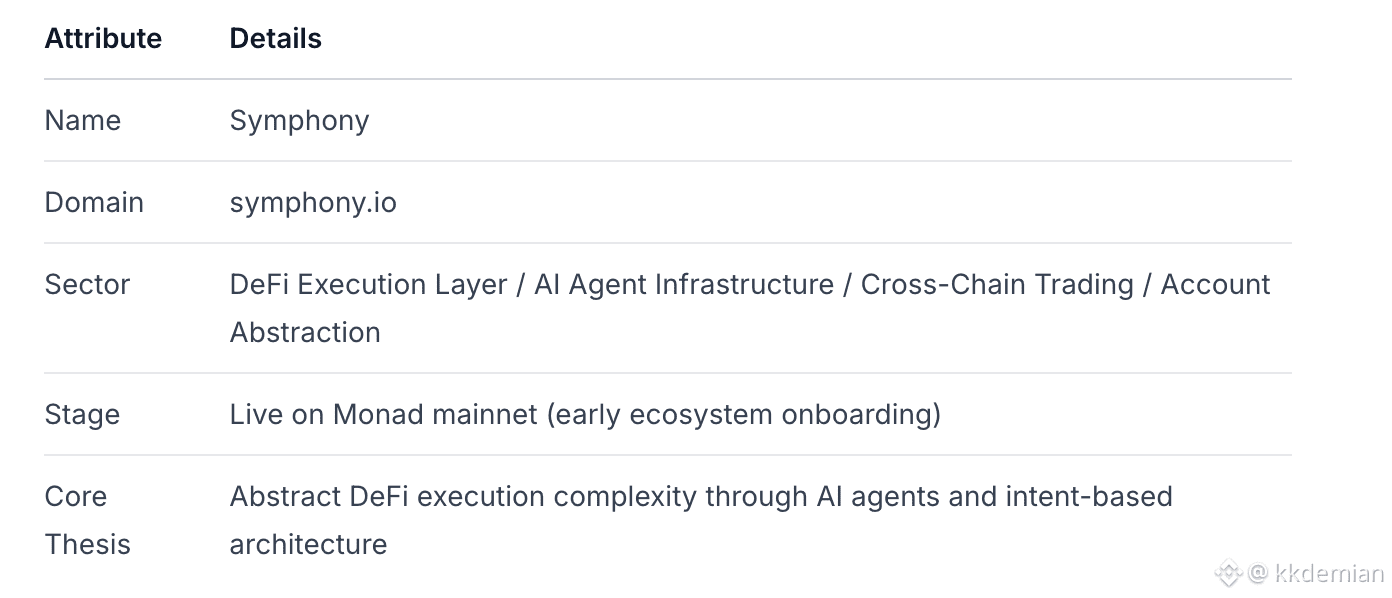
Protocol Vision: Symphony aims to unify fragmented DeFi liquidity through a comprehensive execution stack that enables both AI agents and human users to express high-level intents and execute complex, multi-chain strategies non-custodially. Symphony Docs
Team Origins: Led by CEO Vik and CTO Ben, with backgrounds spanning traditional finance institutions (Kava, Celsius, Ankr, Sei). The team transitioned from building Cadence Protocol (a perpetuals protocol on Canto) to developing Symphony's broader execution infrastructure. Symphony About
Classification: Symphony should be categorized as an AI-native coordination layer for on-chain capital rather than a traditional DeFi protocol, given its focus on intent expression, agent orchestration, and execution abstraction.
2. System Architecture and Execution Stack
Symphony's architecture comprises six interconnected systems designed for modular, scalable execution:
Core Components
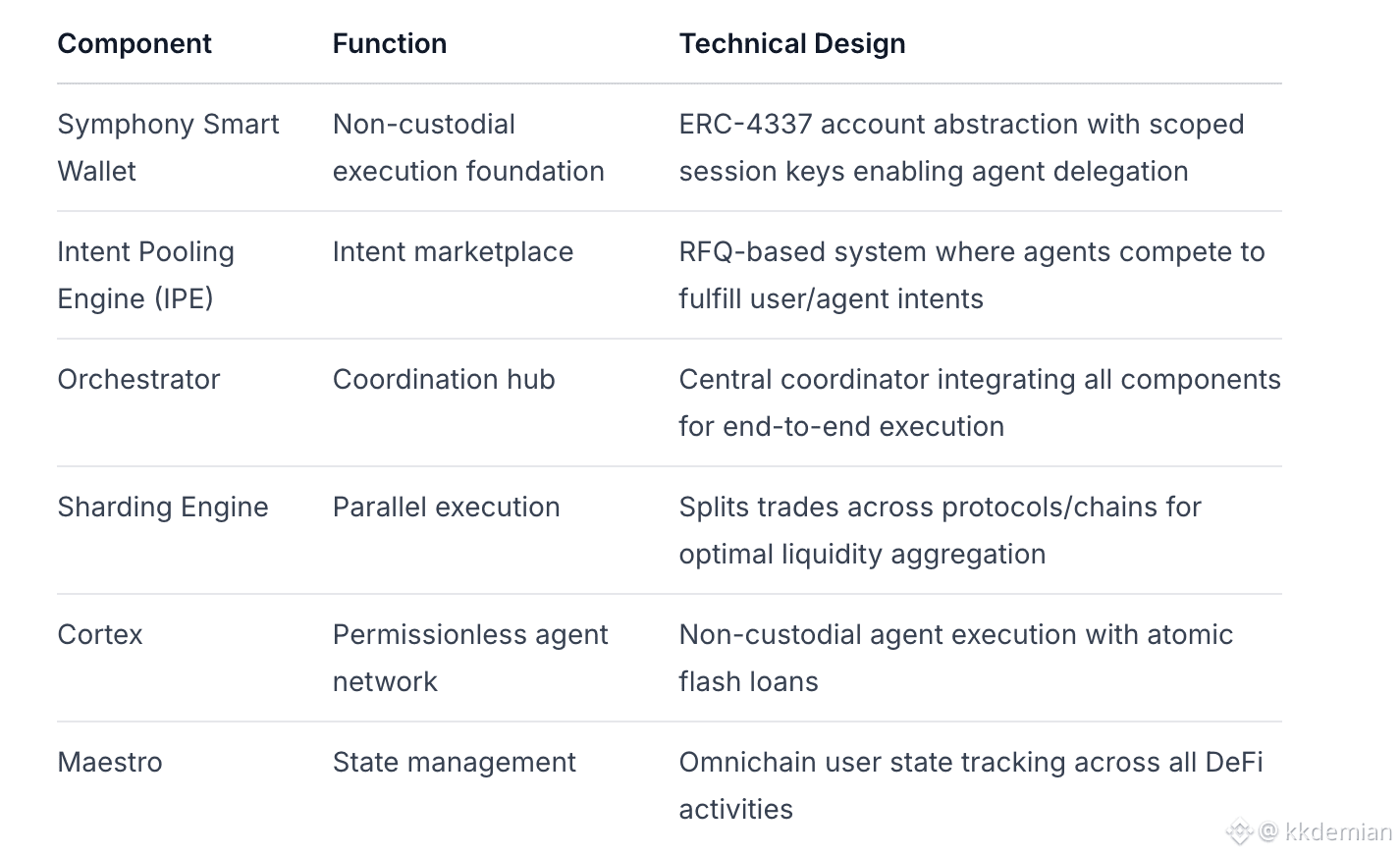
Execution Flow
Intent Submission: Users or agents express high-level outcomes (e.g., "swap 10 ETH for USDC at best rate across any chain")
RFQ Broadcasting: IPE broadcasts request-for-quotes to agent network
Agent Competition: Cortex agents submit optimized execution paths
Path Selection: Orchestrator selects optimal solution based on price, slippage, and execution guarantees
Sharded Execution: Sharding Engine executes across multiple venues/chains in parallel
Settlement: Atomic settlement ensures all-or-nothing execution Symphony RFQ System
Architectural Classification
Compared to existing systems:
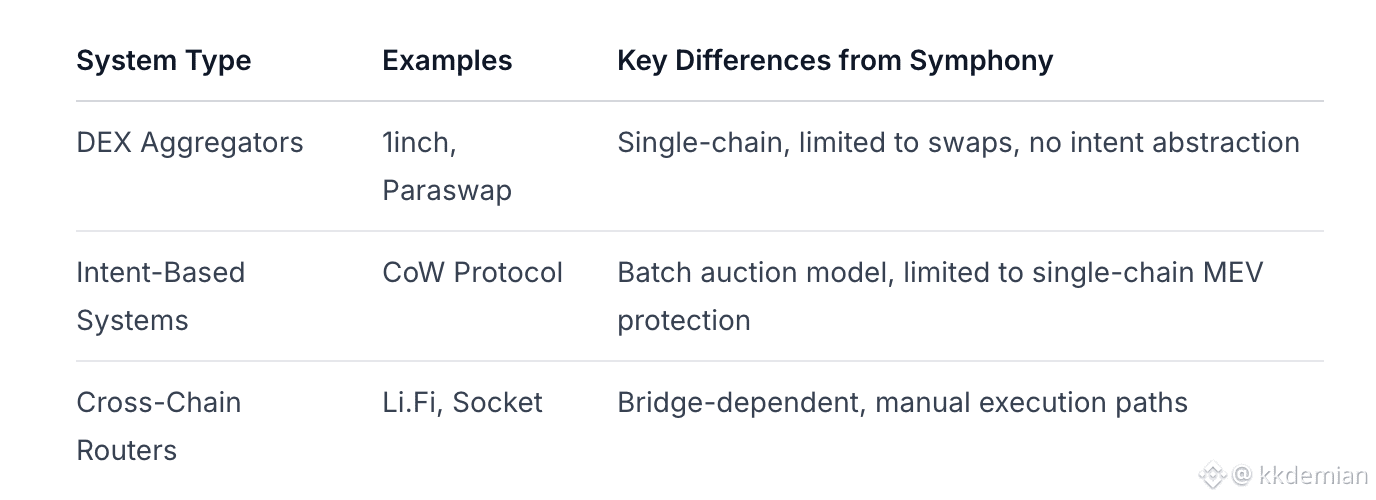
Symphony differentiates through its AI-agent composability, omnichain state management (Maestro), and parallel sharding execution rather than traditional batch auctions or bridge-based routing.
3. Non-Custodial Model and Trust Assumptions
Custody Architecture
Symphony's non-custodial model relies on ERC-4337 account abstraction with scoped permissions:
User Control Preservation:
Users retain ultimate control through smart wallet ownership
Agents operate within predefined execution boundaries via session keys
All transactions require user-signed permission scopes Symphony Smart Wallet
Trust Assumptions:
Reduced Trust: Modular separation isolates execution, state management, and agent coordination
New Dependencies: Orchestrator coordination logic introduces centralization risk during early phase
Agent Network: Cortex agents are incentive-aligned through staking/slashing mechanisms, though specific parameters remain undisclosed
Failure Mode Analysis
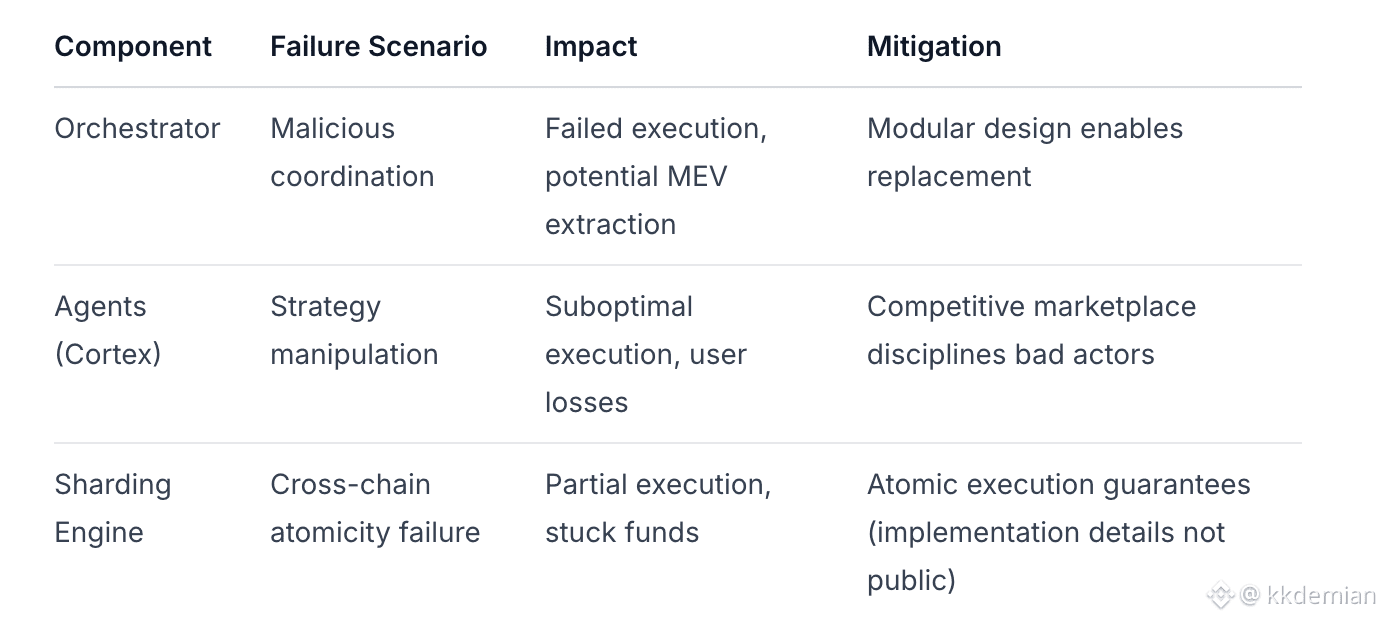
Assessment: Symphony reduces trust compared to custodial solutions but introduces new dependencies on agent network integrity and cross-chain coordination mechanisms.
4. Intent Expression and Strategy Execution Logic
Intent Structure
Symphony intents are declarative constraints expressing desired outcomes rather than execution paths:
// Example intent structure (inferred from documentation){ action: "swap", inputAsset: "10 ETH", outputAsset: "USDC", constraints: { minOutput: "39000 USDC", maxSlippage: "0.5%", chains: ["ethereum", "arbitrum", "polygon"], timeframe: "5 minutes" }}
Execution Prioritization
Symphony's execution logic prioritizes:
Capital Efficiency: Sharding across venues for optimal liquidity utilization
Atomicity: All-or-nothing execution prevents partial fills
Price Optimality: Agent competition drives toward best execution
Composability: Multi-step strategies can be chained within single intent Symphony Intent System
Strategy Composability: Advanced users and agents can compose complex multi-protocol strategies (e.g., Pendle PT/YT yield farming) within single execution context.
5. AI Agent Network (Cortex) and Incentive Design
Agent Participation Model
Cortex operates as a permissionless agent network with the following characteristics:
Agent Roles:
Strategy Generation: Agents analyze market conditions and propose execution paths
Execution Proposal: Competitive bidding on user/agent intents via IPE
Settlement: Agents can utilize atomic flash loans for capital-efficient execution
Incentive Structure:
Agents compete in RFQ marketplace for execution fees
Performance-based selection drives quality competition
Specific staking/slashing parameters not publicly disclosed Cortex Network
Economic Sustainability Assessment
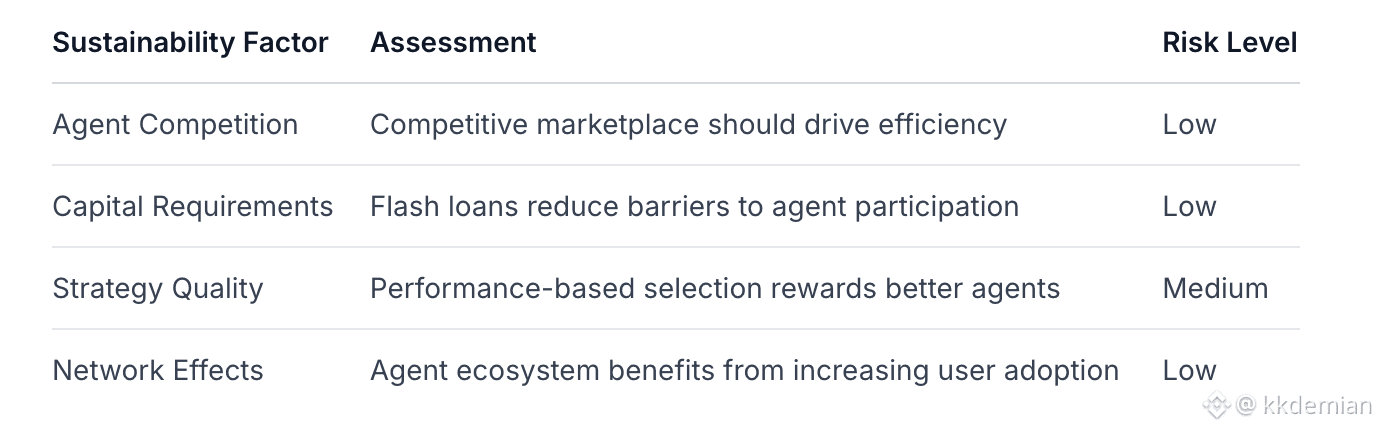
Vulnerability Assessment: The agent network appears economically self-stabilizing through competition, though agent collusion or strategy spoofing risks exist without disclosed monitoring mechanisms.
6. Protocol Economics and Monetization
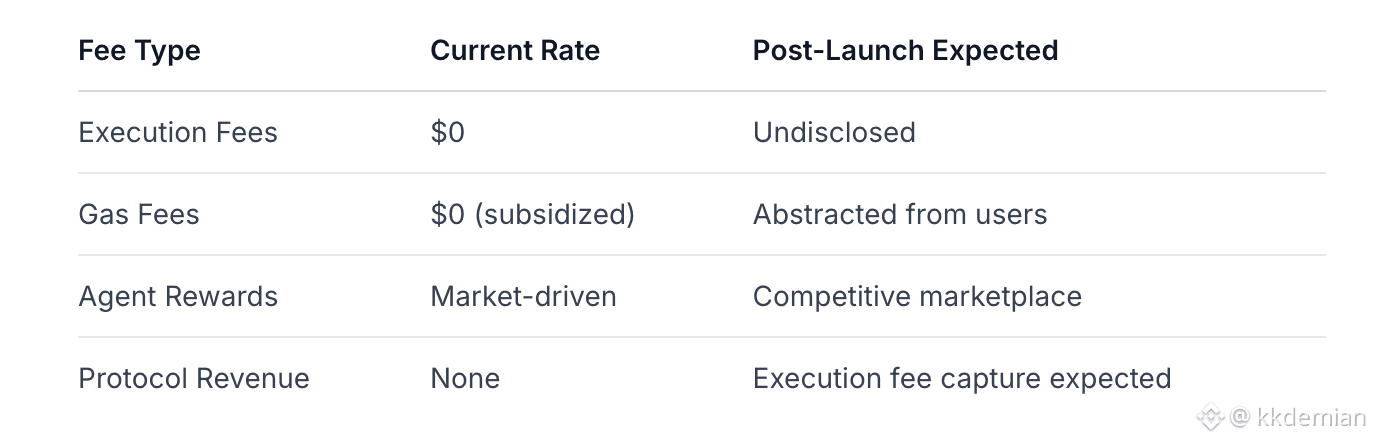
Current Fee Structure
Symphony currently operates with zero protocol fees during promotional phase: Terminal Fees
Token Economics: $CAD to $SMY Migration
Current Status: Token migration remains unimplemented as of January 2026:
$CAD (Cadence Protocol): Original token with no active trading
$SMY (Symphony): Proposed 1:4 migration ratio (1B max supply, no dilution)
Launch Timeline: No confirmed timeline for $SMY launch or trading Medium Announcement
Revenue Sustainability: Protocol economics remain underdeveloped without active token or established fee capture mechanism. Long-term sustainability depends on successful transition from subsidized to fee-generating execution.
7. Governance, Security, and Risk Surface
Current Governance Model
Governance Structure: Team-led development with planned DAO transition
No active token-based governance
Parameter control centralized during early phase
Upgrade mechanisms not publicly documented
Security Assessment
Critical Risk Factors:
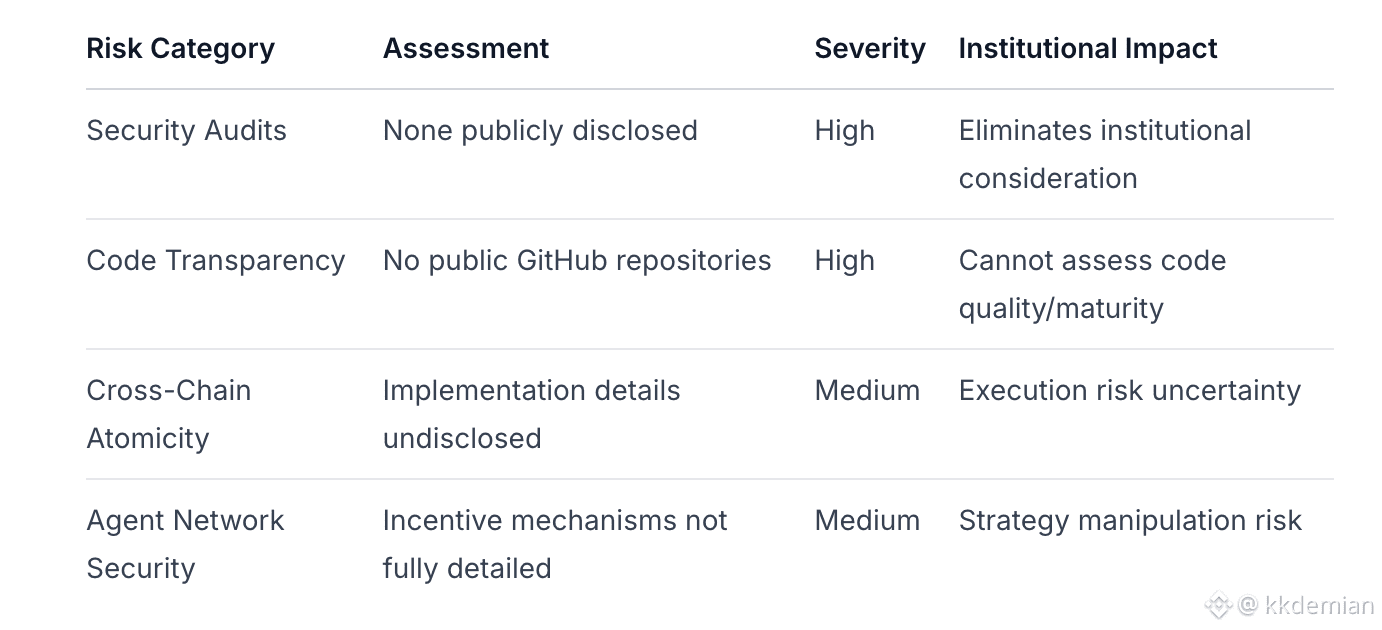
Risk Comparison
Compared to established protocols:
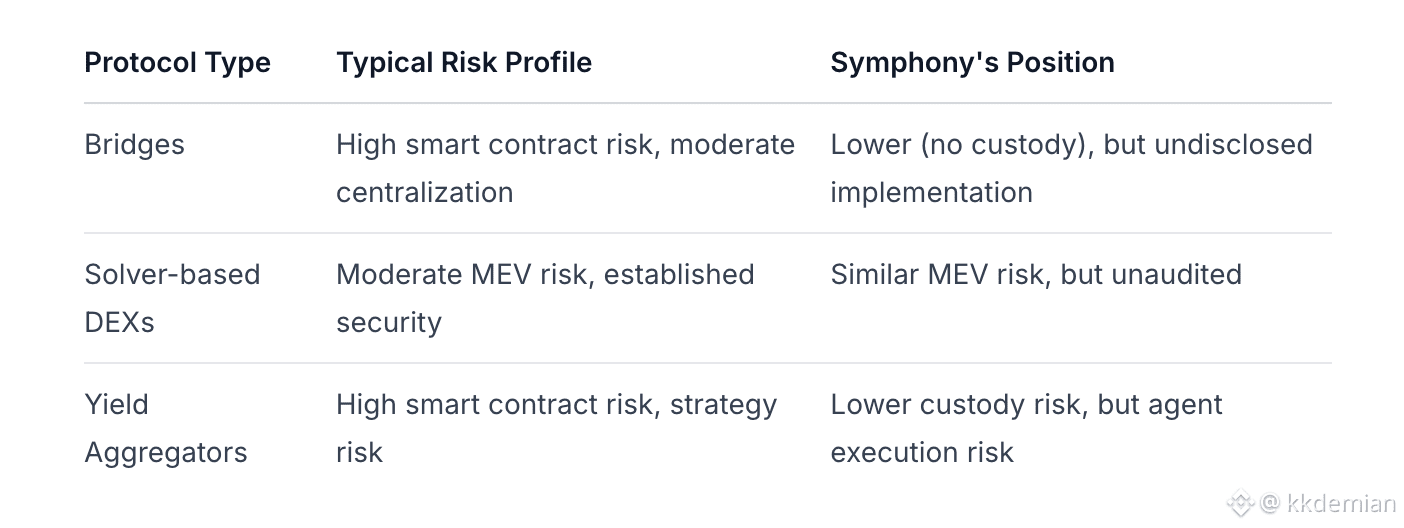
Institutional Assessment: The absence of public security audits represents a critical blocker for institutional investment, regardless of architectural innovation.
8. Adoption Signals and Ecosystem Fit
Current Traction Metrics
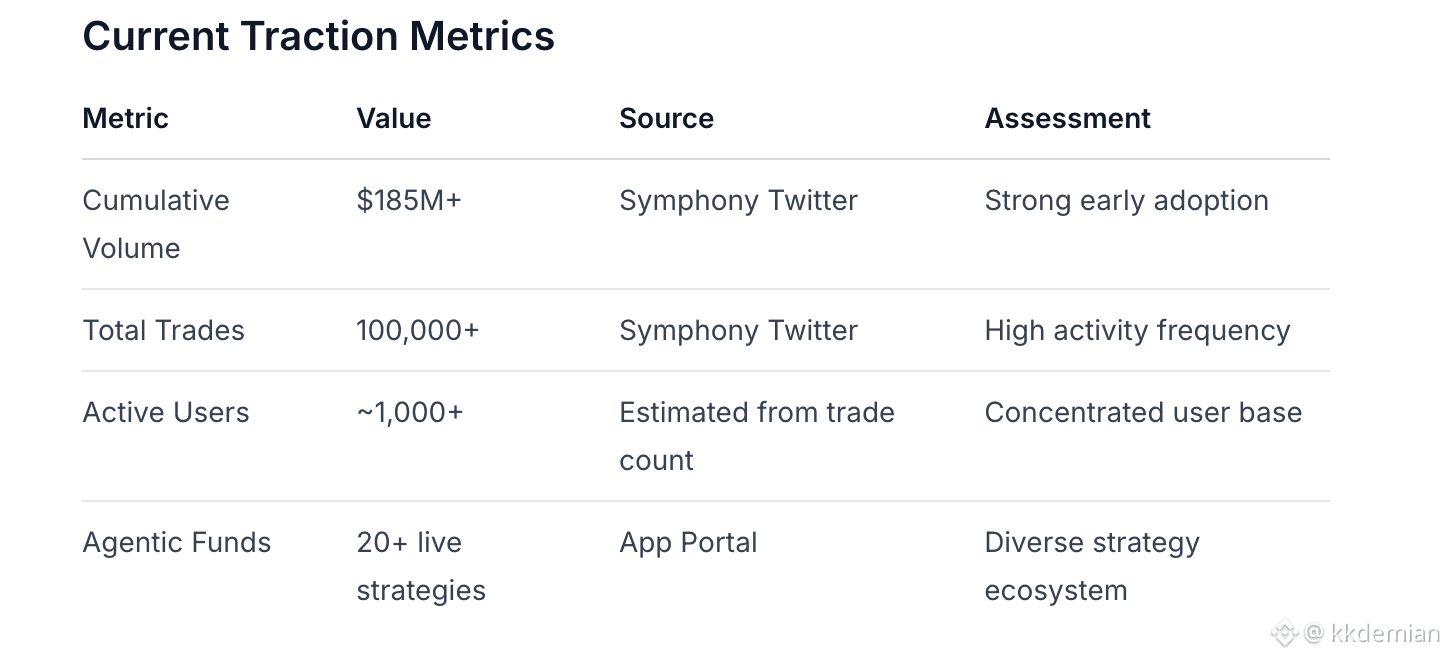
Strategic Partnerships
Deep Protocol Integrations:
Pendle Finance: Agentic yield strategies for PT/YT tokens, expanding DeFi composability X
Virtuals Protocol: Execution layer for ACP V2, serving 17,000 agents and 180,000 AI agent owners with $1M+ volume in first 24 hours X
Target Market Analysis
Primary User Segments:
Advanced DeFi Traders: Seeking execution optimization and cross-chain coordination
AI Agent Developers: Building autonomous trading strategies
Institutional Users: Requiring non-custodial execution with professional-grade infrastructure
Ecosystem Positioning: Symphony is well-positioned within the AI agent economy and chain abstraction trends, with strong narrative alignment around autonomous execution.
9. Strategic Assessment and Market Fit
Structural Problem Analysis
Symphony addresses structurally hard problems in DeFi:
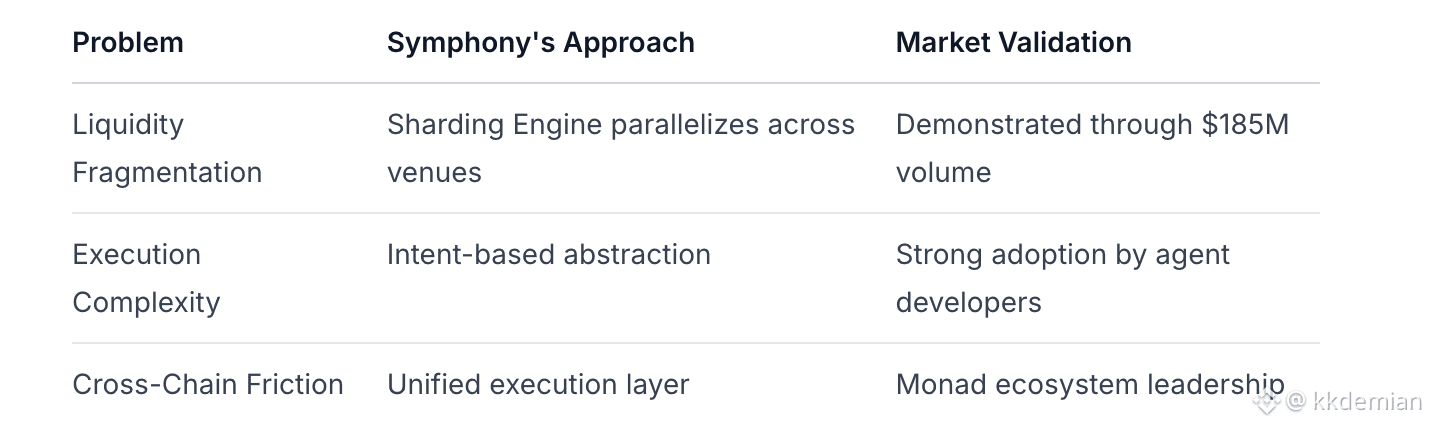
Critical Success Milestones (12-24 months)
Security Maturation: Public audit completion and code repository disclosure
Token Launch: Successful $SMY migration and sustainable tokenomics implementation
Multi-Chain Expansion: Expansion beyond Monad to Ethereum mainnet and major L2s
Agent Ecosystem: Growth to 100+ sophisticated trading agents with proven performance
Institutional Integration: Adoption by major DeFi protocols as execution infrastructure
Competitive Positioning
Symphony's Unique Value Proposition:
AI-First Design: Purpose-built for autonomous agent execution
Unified Architecture: Single stack handles intent expression through settlement
Non-Custodial Execution: Maintains user control while enabling agent autonomy
Competitive Threats:
UniswapX/CoW Protocol expansion into AI agent execution
Traditional aggregators adding intent-based features
Chain abstraction solutions with execution capabilities
10. Final Investment Assessment
Dimensional Scoring (1-5 Scale)
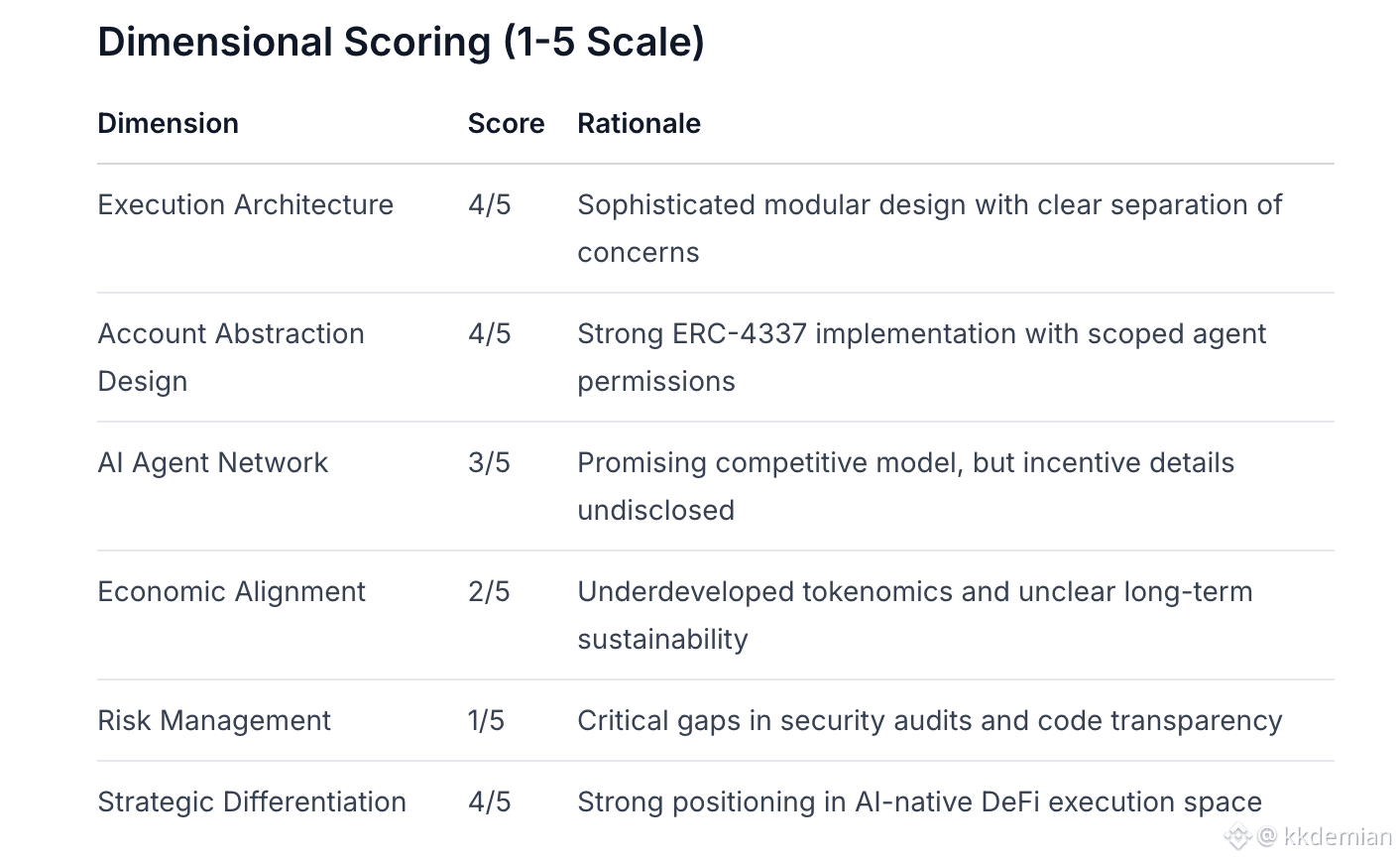
Overall Score: 3.0/5
Summary Verdict
Investment Recommendation: MONITOR WITH SIGNIFICANT RESERVATIONS
Symphony demonstrates exceptional architectural innovation in AI-native DeFi execution and strong early market validation through its Monad ecosystem leadership. The protocol addresses genuine structural problems in DeFi liquidity fragmentation and user experience complexity.
However, critical institutional-grade deficiencies prevent current investment consideration:
Blocking Factors:
No public security audits from reputable firms
Absent code transparency with no public repositories
Underdeveloped economics with unclear token launch timeline
Limited institutional backing with no disclosed Tier-1 VC investment
Path to Investment Grade:
Complete comprehensive security audits by firms like Trail of Bits or Spearbit
Open-source core protocol components for community review
Launch $SMY token with clear value accrual mechanisms
Expand beyond Monad to demonstrate multi-chain execution reliability
Strategic Recommendation: Symphony warrants close monitoring as the protocol has positioned itself advantageously within the emerging AI agent economy. If the team addresses security and transparency gaps over the next 6-12 months, it could become a compelling investment opportunity in the execution infrastructure space.
Appendix
A. Competitive Comparison Matrix
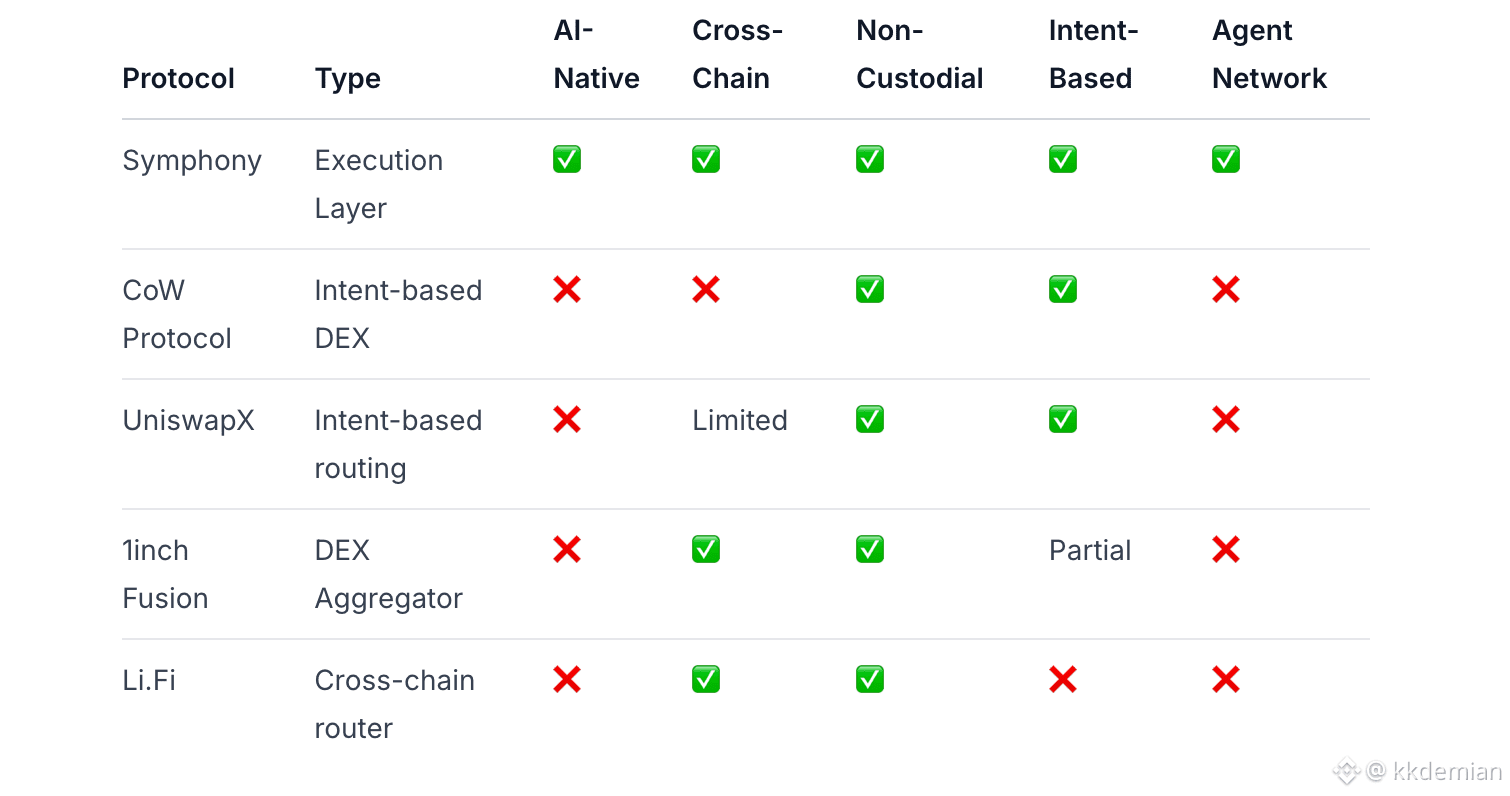
B. Risk Decomposition: AI-Driven Execution Under Market Stress
High-Stress Scenarios:
Flash Crash Events: Agent coordination may break down under extreme volatility
Cross-Chain Congestion: Atomic execution guarantees may fail during network stress
Agent Manipulation: Coordinated malicious behavior could exploit intent mechanisms
Oracle Failures: Price feed disruptions could cause execution errors
Risk Mitigation Requirements:
Circuit breakers for extreme market conditions
Redundant cross-chain execution paths
Agent reputation systems with slashing mechanisms
Multiple oracle sources with fallback mechanisms
This report represents analysis based on publicly available information as of January 26, 2026. Investment decisions should incorporate additional due diligence and risk assessment.


