

In technology’s early moments, it’s natural to measure progress with the tools at hand. When the first cars were built, speed tests decided reputations. Later, the narrative shifted to reliability, comfort, and utility. In the world of blockchain, we’re in a similar transitional moment — but the shift is happening faster and is far more consequential than most people realize.
For years, transaction throughput, finality times, and network fees were the primary metrics for comparing Layer-1 blockchains. They told a simple story: how fast can a system move data? How cheap is it to interact? These questions made sense when blockchains were primarily casts for financial primitives — simple ledgers tallied by miners and validators.
Then intelligent systems entered the frame.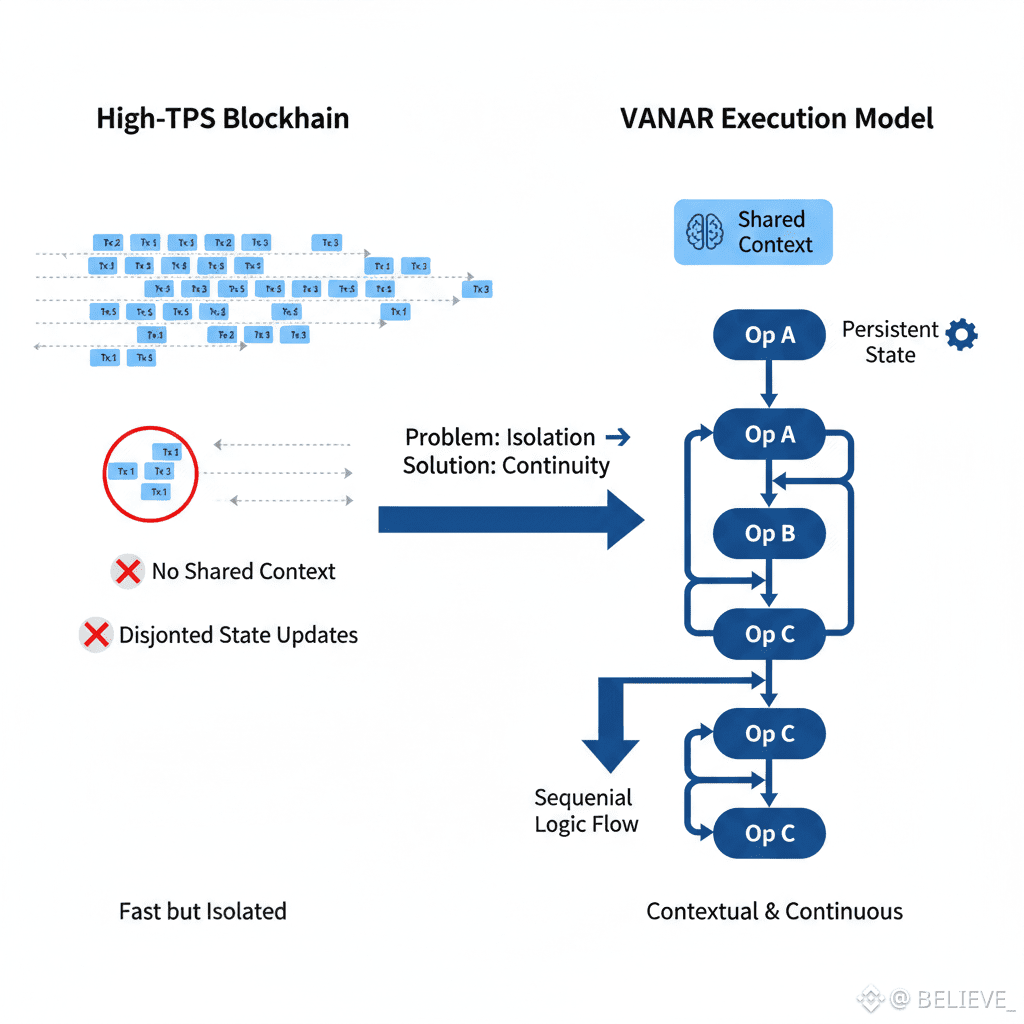
Intelligence changes what we’re optimizing for. A fast system that can’t sustain coherent execution across complex logical operations is less useful than a slower system that can. In an environment where agents and autonomous systems need persistence, coordination, and predictable behavior, raw throughput becomes an incomplete measure at best — and misleading at worst.
This is why Vanar Chain doesn’t treat TPS as prima facie “readiness” for the AI era. Vanar approaches readiness as a set of capabilities that go beyond how many transactions can fit into a block. It treats continuity, context, and predictability as first-order requirements — not nice-to-haves.
To understand why, imagine two systems. The first can handle thousands of isolated transactions per second but loses contextual data between them. The second processes far fewer operations in controlled bursts but retains semantic links, preserves state across interactions, and supports logic that persists over time. In the real world, the second system is far more valuable because real usage isn’t a sequence of independent clicks — it’s a flow of behavior.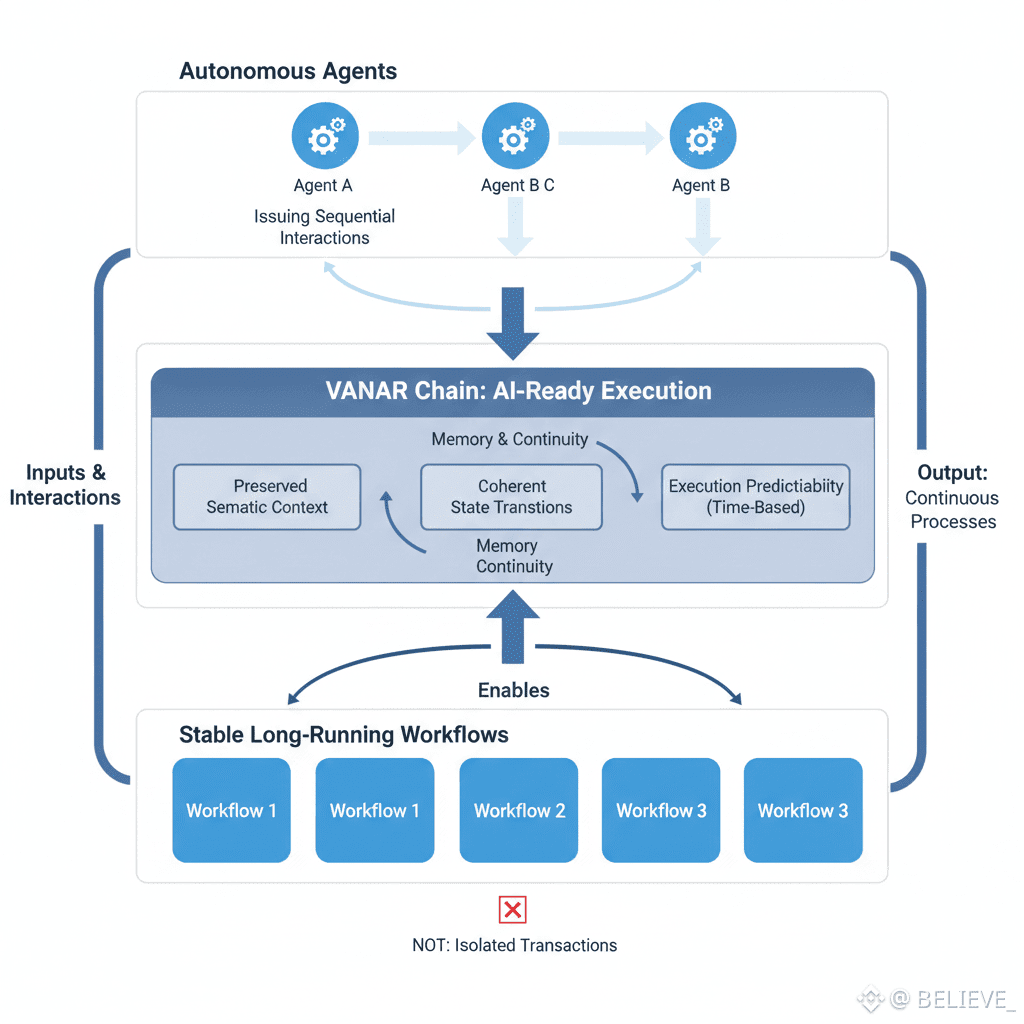
Vanar’s design reflects this understanding. Instead of emphasizing speed benchmarks that have little bearing on persistent logic, the network prioritizes features that matter to intelligent execution at scale. Persistent semantics, data continuity, and coherent state transitions become the silent infrastructure that intelligent systems depend on when they run unattended.
This isn’t a philosophical preference. It’s rooted in how systems behave when complexity and autonomy scale. An autonomous agent doesn’t issue one transaction and stop. It issues sequences of interactions, adjusts behavior based on context, and expects the infrastructure to treat its sequence as a story rather than a series of unrelated events.
Traditional blockchain metrics simply don’t capture this.
Latency and throughput measure capacity — how much a network can do under ideal conditions. But readiness for autonomous systems is about how well a network can manage sequences of logic under unpredictable conditions without losing coherence. That’s a far higher standard.
A meaningful comparison is between a database that supports atomic transactions and one that honors complex workflows with dependencies. One can move numbers fast. The other understands operations. Vanar’s approach leans toward the latter — not because it’s trendy, but because it aligns with what modern systems truly demand.
This focus also redefines what adoption looks like. Networks built around old metrics attract developers who prioritize isolated interactions — simple tokens, static state, predictable user input. Vanar attracts developers who need systems that behave intelligently — environments where logic must remain consistent even as interactions stack unpredictably.
That difference shapes the kinds of applications that choose Vanar. Not just simple smart contracts, but interactive systems with memory, reasoning, and automated behaviors. These are the kinds of systems that cannot be evaluated on a dashboard of speed numbers. They are evaluated by how they behave over time.
Users feel this intuitively. That’s why applications that prioritize human experience — such as immersive environments, continuous interaction platforms, and persistent economies — often demand reliability over raw speed. A lagging but coherent interaction feels smoother than a fast but disjointed one.
Vanar’s orientation toward metrics that matter also shifts developer expectations. Instead of aspiring to beat benchmark leaders with superficial numbers, developers build for internal consistency, long-running interactions, and systemic reliability. This affects the kinds of tools they create, the protocols they trust, and the workflow assumptions they embed in their code.
In effect, Vanar reframes readiness around behavioral metrics — not performance ones. It asks: Does the system preserve context? Does it handle sequences coherently? Does it support models that learn, adapt, and coordinate across time?
These questions don’t reduce to TPS. They resolve into a richer, more nuanced understanding of what infrastructure must do when intelligent agents replace manual initiators.
It’s why, to developers who think in terms of workflows rather than clicks, Vanar feels fundamentally different.
Not faster by headline.
Not cheaper by tabulation.
But capable in the ways that matter when behavior becomes continuous, not transactional.
This shift is easy to miss if you’re still looking at blockchains through a legacy lens. But as systems evolve, the criteria for judgment must evolve with them.
Vanar’s readiness model anticipates that evolution — and positions the chain not for yesterday’s metrics, but for tomorrow’s demands.