

For years, blockchain development has treated performance as the primary measure of progress. Faster block times, higher transactions per second, lower fees. These metrics became shorthand for innovation and chains competed loudly to claim leadership in each category. Yet outside technical circles, this race often failed to translate into real adoption. Applications launched, incentives attracted users briefly, and then activity faded. The problem was not speed. It was usability.
@Vanarchain enters this landscape with a different premise. It does not assume that users are waiting for more performance. It assumes they are waiting for fewer reasons to feel uncomfortable. In that sense, Vanar’s design is less about winning benchmarks and more about removing friction from everyday interaction. Performance still matters, but only insofar as it supports practical use rather than overshadowing it.
This distinction sounds subtle, but it changes everything about how a network is built.
High performance without usability tends to push complexity outward. The chain may be fast, but the burden of understanding it falls on users and developers. Wallet setup becomes fragile. Fees fluctuate unpredictably. Transaction behavior feels inconsistent across apps. In theory, the system works. In practice, users hesitate. Vanar’s architecture reflects a recognition that performance must be internalized by the network so that users experience stability, not speed as a concept.
One of the clearest examples of this balance is how Vanar treats transaction finality and cost. Instead of exposing users to volatile fee markets or making them constantly adjust behavior based on network congestion, Vanar aims for predictability. When users know roughly how long a transaction will take and how much it will cost, they stop thinking about the chain itself. The action becomes routine. That is when usage compounds.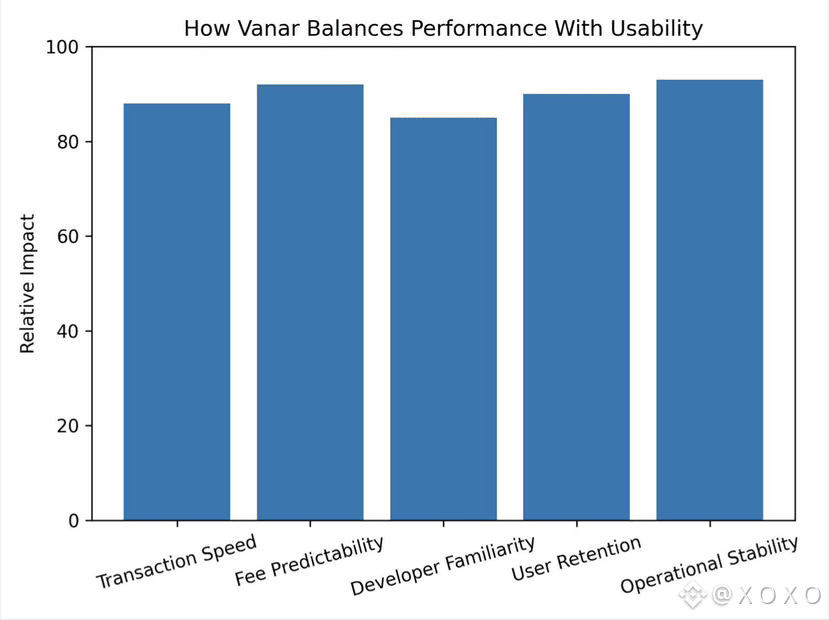
Performance is still there, but it disappears into the background.
This approach matters most for consumer-facing applications. Gaming, social platforms, digital goods, and real-time marketplaces do not succeed because they are technically impressive. They succeed because users can interact without pausing to understand the infrastructure underneath. A player does not want to reason about gas. A creator does not want to explain wallets to their audience. A studio does not want to rebuild flows every time the network changes. Vanar’s usability-first performance model acknowledges this reality.
Another dimension where Vanar balances performance with practicality is developer experience. High-performance chains often introduce novel execution models or specialized tooling that require developers to relearn fundamentals. While this can unlock efficiency, it also slows iteration and increases the cost of mistakes. Vanar leans toward familiarity. By maintaining compatibility with existing development environments and patterns, it allows teams to focus on product design rather than infrastructure translation.
This is not a lack of ambition. It is an understanding of where ambition should be directed. Most developers are not trying to invent new virtual machines. They are trying to ship reliable products. When performance gains come at the cost of cognitive overhead, those gains rarely survive beyond early experimentation. Vanar’s choice to integrate performance improvements without forcing developers into unfamiliar mental models is a deliberate usability decision.
Performance also intersects with usability through consistency. A network that behaves differently under load introduces uncertainty. Users notice failed transactions, delayed confirmations, and inconsistent app behavior. Even if average performance is high, variance erodes trust. Vanar’s emphasis on stable execution and predictable ordering reflects an understanding that consistency is a form of usability. Users forgive slowness more easily than they forgive randomness.
This philosophy extends to how Vanar positions itself within the broader ecosystem. Rather than presenting itself as a replacement for everything, Vanar focuses on being reliable where it matters. It does not promise to serve every possible use case. It concentrates on scenarios where performance must support interaction at scale without overwhelming users. This restraint is part of its usability strategy. When a system knows what it is for, it becomes easier to use.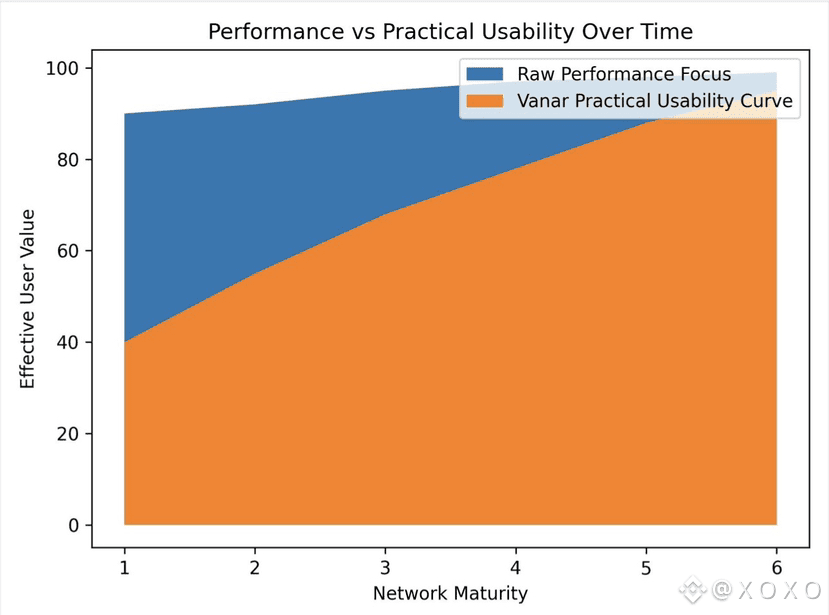
The balance between performance and usability also shows up in how Vanar approaches onboarding. Many chains treat onboarding as an external problem, something wallets or applications should solve. Vanar treats it as a network-level concern. If the first interaction feels confusing or risky, performance metrics become irrelevant. By prioritizing smoother entry points and reducing the number of decisions users must make early on, Vanar lowers the threshold for participation.
Importantly, this balance does not sacrifice long-term capability. Vanar is not slow by design. It simply refuses to treat speed as the user experience itself. Performance is harnessed to support familiar patterns rather than replace them. This makes the system more adaptable over time. As applications evolve, they do not need to re-educate users or rebuild trust from scratch.
From an ecosystem perspective, this approach changes how growth unfolds. Instead of sharp spikes driven by incentives, usage tends to grow more steadily. Retention improves because users feel comfortable returning. Developers invest more deeply because their products age gracefully rather than breaking under shifting assumptions. Performance becomes a quiet enabler instead of a constant headline.
There is also a psychological element to this balance. Users interpret stability as reliability. When something works the same way every time, it earns trust. Vanar’s design acknowledges that trust is not built through speed alone. It is built through repeated, uneventful success. This is why the most widely adopted digital systems often feel boring on the surface. They remove drama from interaction. Blockchain systems rarely embrace this lesson. Vanar does.
In practical terms, balancing performance with usability means accepting trade-offs. It means resisting the urge to expose every optimization directly to users. It means designing for the median user, not the most technical one. Vanar’s architecture reflects those choices. It aims to serve the majority quietly rather than impress the minority loudly.
Over time, this balance may prove more valuable than raw performance leadership. As blockchain technology moves from experimentation toward integration with everyday products, usability becomes the constraint that defines scale. Networks that ignore it risk remaining niche regardless of how advanced they become. Networks that respect it gain the chance to disappear into the background, where real adoption happens.
My take is that Vanar’s strength lies precisely in this restraint. It does not chase performance as a spectacle. It treats performance as a responsibility. The goal is not to make users aware of how fast the system is, but to make them forget there is a system at all. If Vanar succeeds, it will not be because users praise its architecture. It will be because they stop noticing it.
And in infrastructure, that is often the clearest sign of success.