
There is a moment that many people in crypto experience sooner or later. You start out excited about decentralization, freedom, and ownership, and then you slowly realize that much of the digital world still runs on the same old foundations. Your assets might be on-chain, but your data lives on centralized servers. Your applications might call themselves decentralized, but a single company can still pull the plug. Walrus enters the story right at that moment of realization, not with noise or hype, but with a quiet, almost stubborn belief that things can be built better.
Walrus is not just a protocol you glance at and forget. It feels more like infrastructure you grow into understanding. At its core, it is designed to protect something deeply human in the digital age: the right to control your own data. Every photo, file, record, and interaction we create has value, and Walrus treats that value with respect. Built on the Sui blockchain, the protocol combines speed, scalability, and modern design with a strong focus on privacy and resilience. It does not try to fight the future; it prepares for it.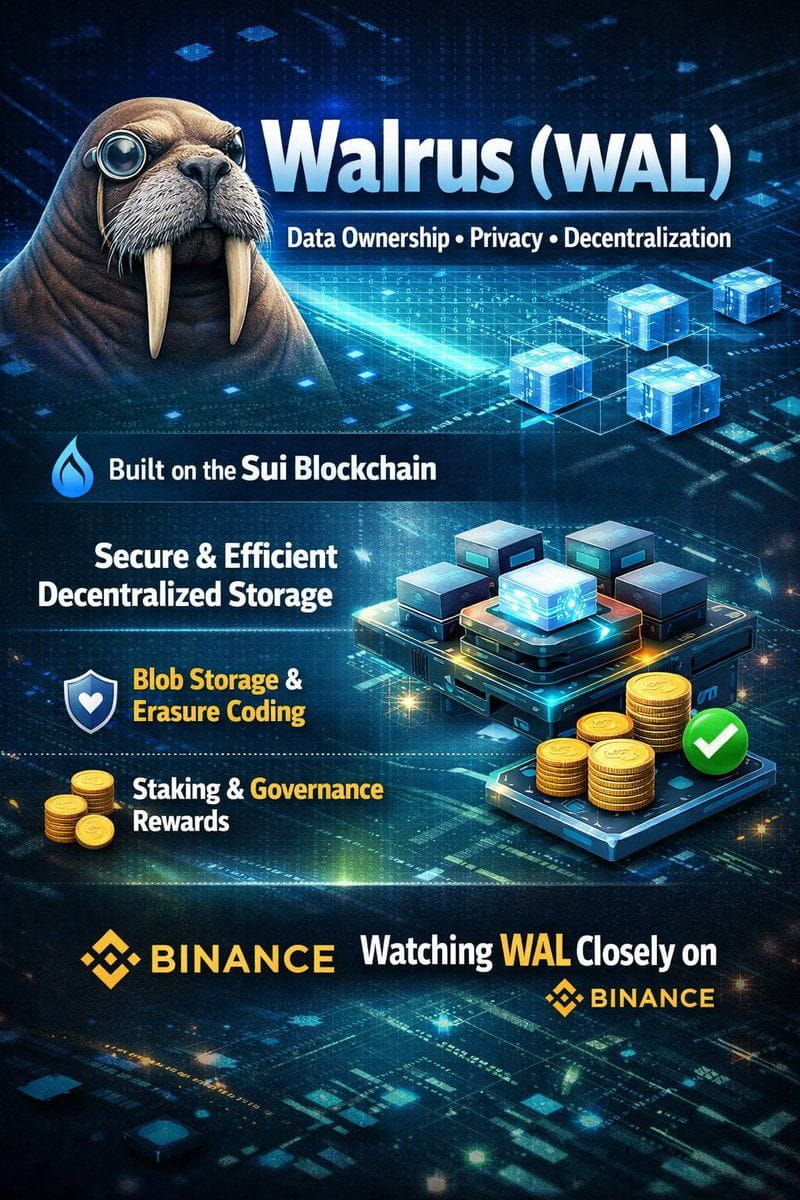
The WAL token sits at the center of this ecosystem like a quiet engine. It does not scream for attention, yet nothing works without it. WAL powers storage, transactions, staking, governance, and incentives. When users store data, they use WAL. When node operators provide resources, they earn WAL. When the community makes decisions about upgrades and direction, WAL becomes the voice. This creates an economy that feels alive, where value flows through real use rather than empty promises.
What truly gives Walrus its identity is the way it handles data. Instead of relying on single servers or even full replicas spread across nodes, Walrus breaks data into fragments using erasure coding and stores those fragments as blobs across a decentralized network. No single participant holds the full file. This design makes censorship extremely difficult and failures far less damaging. Even if parts of the network go offline, the data remains recoverable. It is a system built with the assumption that things will go wrong, and that resilience matters more than perfection.
Privacy is not an afterthought here. In many blockchain systems, privacy is something you add later, often with complexity and compromise. Walrus takes the opposite approach. It recognizes that individuals, businesses, and institutions need different levels of transparency. Some data should be public. Some should be private. Some should be shared only with specific parties. Walrus gives users that control without forcing them to abandon decentralization. This balance is rare, and it opens doors to use cases that go far beyond typical DeFi experiments.
As the protocol evolves, staking and governance will deepen the relationship between the network and its community. Staking WAL is not just about earning rewards; it is about signaling trust and commitment. Governance, in turn, gives that commitment meaning. Decisions about fees, upgrades, and new features can be shaped by the people who actually use and support the network. Over time, this can turn Walrus into a self-sustaining organism rather than a top-down product.
The future roadmap of Walrus feels grounded in reality. In the early phases, the focus remains on strengthening the core technology, improving efficiency, reducing storage costs, and refining privacy mechanisms. Developer experience is likely to become a major priority, because builders are the bridge between infrastructure and real users. When it becomes easy to integrate Walrus into applications, adoption stops being a marketing problem and starts becoming a natural outcome.
As adoption grows, Walrus has the potential to fade into the background in the best possible way. It can become the unseen layer that powers decentralized social platforms, NFT ecosystems, financial tools, and enterprise systems. Users might not talk about Walrus every day, but they will rely on it. Their files will load. Their data will stay safe. Their applications will keep running even when centralized alternatives fail. This kind of quiet reliability is often what separates long-lived infrastructure from short-lived trends.
In a longer horizon, Walrus can step beyond crypto-native audiences. Enterprises are increasingly aware that centralized cloud storage comes with hidden risks, from data breaches to regulatory pressure and service outages. A decentralized, privacy-preserving, cost-efficient storage layer offers a compelling alternative. Walrus does not need to replace everything at once. It only needs to be good enough, reliable enough, and simple enough to earn trust step by step.
What makes Walrus feel premium is not flashy branding or exaggerated promises. It is the sense of intention behind every design choice. The protocol assumes that users care about their data, that developers want tools that work, and that communities value systems they can shape. It treats decentralization not as a slogan, but as a responsibility.
In the end, Walrus is a reminder that the future of blockchain is not only about faster trades or higher yields. It is about building digital spaces that respect people, protect information, and endure. If Walrus continues on its current path, it may not always be the loudest project in the room, but it has the potential to be one of the most important. And often, the most important things are the ones quietly holding everything else together.
@Walrus 🦭/acc #walrus #Walrus $WAL

