

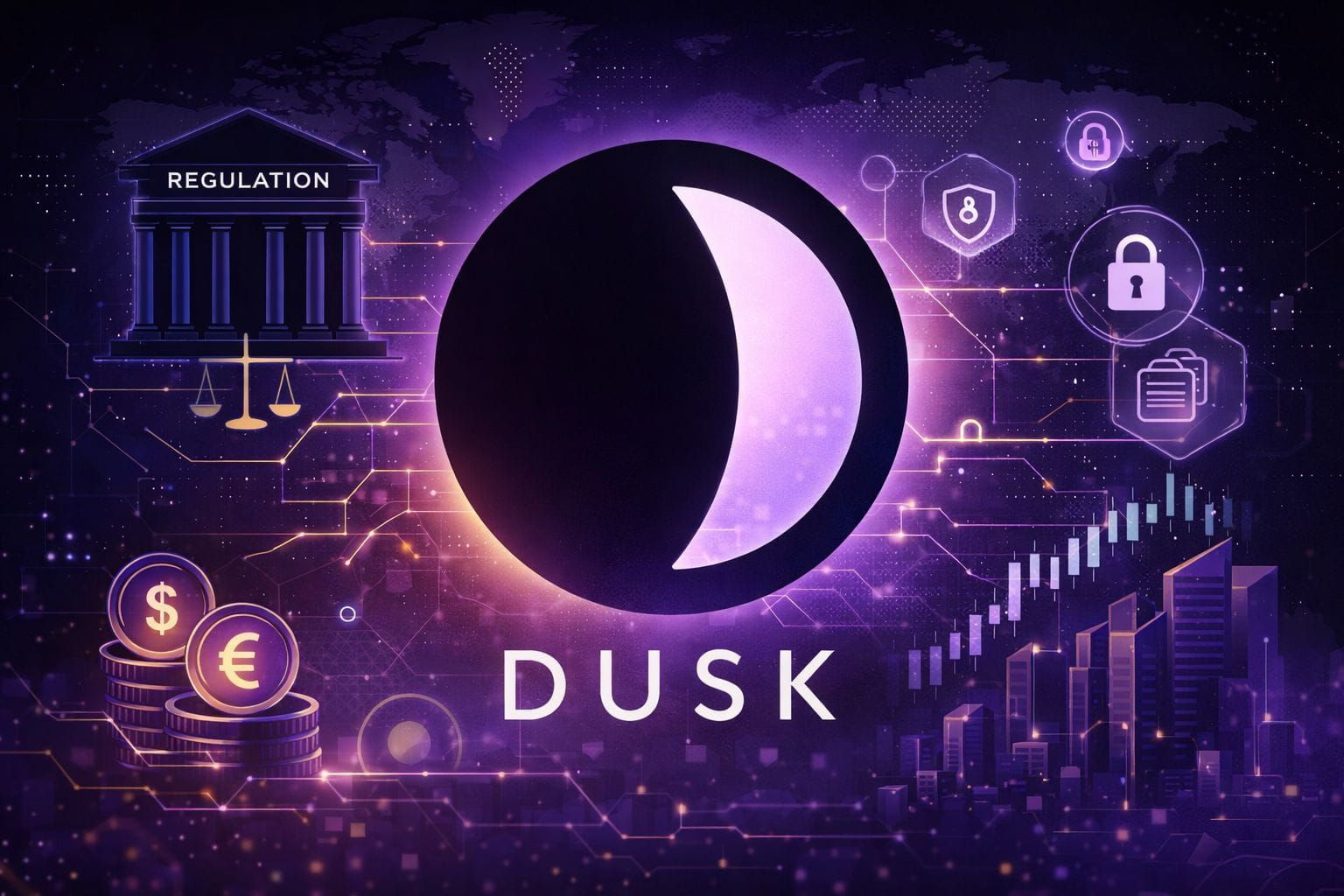
 For a long time, crypto treated privacy and compliance as opposites. You either protected users by hiding everything, or you opened the books completely to satisfy regulators. There seemed to be no middle ground. That false choice slowed adoption and left a massive gap in Web3 infrastructure. Dusk stepped into that gap with a different mindset and a more mature understanding of how real financial systems operate.
One of the biggest misconceptions in crypto is equating privacy with secrecy. Early privacy-focused chains built solid walls around transactions, blocking all visibility. That approach works for individuals, but it fails the moment institutions get involved. Regulated entities need to prove what happened inside a transaction. Compliance teams need auditability. Risk officers need verifiable records. Dusk recognized this early and redefined the problem. Instead of treating privacy as hiding, Dusk treats it as controlled disclosure. Sensitive information stays protected, while correctness and rule-following remain provable.
This balance is achieved through zero-knowledge technology. Each transaction carries cryptographic proof that it followed the rules, without revealing private details. Think of it as a sealed receipt: it proves validity without exposing contents. The network can enforce compliance, regulators can gain confidence, and users don’t have to surrender their confidentiality. This approach flips the old narrative. Transparency no longer requires exposure, and privacy no longer blocks accountability.
This design is critical for real-world adoption. As financial institutions move toward tokenized assets, regulated markets, and on-chain settlement, they need systems that mirror the structure of traditional finance. Securities, funds, and institutional products cannot live on chains that either reveal everything or hide everything. Dusk fills that missing middle layer. It allows private business logic while still proving that every action complies with the rules governing the market.
Traditional finance is built on layers: identity checks, settlement finality, verification, audits, reporting, and risk controls. Dusk understands this architecture and brings it on-chain in a form that works. That’s why it feels fundamentally different from chains designed mainly for experimentation or speculation. Dusk is engineered to support serious financial activity while respecting user-level privacy where it matters.
The introduction of DuskEVM strengthens this vision even further. Developers can now build using familiar EVM tools while gaining access to Dusk’s privacy-aware and compliance-ready framework. This lowers the barrier for teams that previously avoided blockchain due to legal or regulatory uncertainty. With DuskEVM, builders can create compliant markets, private liquidity pools, confidential auctions, regulated asset platforms, and settlement systems that require selective transparency. It’s a bridge between what developers know and what institutions demand.
What truly sets Dusk apart is how it refuses to pick a side. Users are not forced to expose their entire financial history. Businesses can protect sensitive operations. At the same time, institutions can verify their activity when required, and regulators can perform oversight without peering into private data. Auditors can confirm rule compliance without accessing confidential details. This creates trust not through blind faith, but through verifiable design.
As governments continue to shape digital asset regulation, the demand for clarity will only grow. Regulators want systems that can be audited and monitored without creating blind spots. Users and businesses want protection from unnecessary exposure. Dusk aligns these interests instead of forcing trade-offs. It respects regulation without sacrificing the core values of decentralization and privacy.
The deeper you look at Dusk, the clearer its discipline becomes. It avoids extremes. It doesn’t default to full transparency or full opacity. Privacy exists where it’s justified. Visibility exists where it’s required. This mirrors how established financial markets operate, and that realism is what makes Dusk so forward-looking.
Another reason Dusk’s relevance is growing is the global push toward real-world assets on-chain. Banks, brokers, and enterprises want to issue securities, manage settlements, and run compliant financial infrastructure using blockchain technology. These use cases demand privacy for competitive and operational reasons, while still requiring strict rule enforcement. Few networks can support this without compromise. Dusk can.
The strength of Dusk lies in its focus. It doesn’t chase trends or short-term attention. It builds infrastructure meant to survive regulation, audits, and long-term institutional use. That level of seriousness is rare in crypto, and it’s exactly what regulated markets require before committing capital and trust.
Web3 is entering a new phase. The idea that privacy and compliance must conflict is fading. People now recognize that both can coexist when systems are designed correctly. Dusk is one of the clearest examples of this evolution. It shows that confidentiality and accountability are not enemies, but complementary forces.
The future of blockchain belongs to networks that can respect rules without erasing individual rights. Dusk embodies that balance. It offers protection for users, confidence for institutions, and assurance for regulators. More than just another chain, Dusk is laying the groundwork for regulated digital finance. In a world moving steadily toward compliant Web3, Dusk’s timing and design feel exactly right.