If you’ve spent any time in the crypto trenches of late, you’ve felt the tremor. It’s not coming from another memecoin frenzy or the latest Layer-1 throughput war. The ground is shifting beneath our feet, and the battle is for something far more fundamental: the bone structure of the internet itself persistent data storage. For years, we’ve treated storage as a commodity, a solved problem, a boring backend footnote in the flashy narratives of DeFi yields and NFT PFP manias. That was our first, and perhaps most costly, collective mistake. The assumption that a decentralized future could be built atop the same centralized, custodial data silos of Web2 is a architectural flaw of existential proportions. We’ve been busy painting a beautiful new facade on a crumbling house.
Enter the Walrus protocol on Sui. On the surface, it’s another entrant in the decentralized storage arena, a space with established names. But to dismiss it as such is to miss the entire point. Walrus isn’t just competing for a piece of the storage pie; it is subtly, ingeniously, redefining the very economics and security premises of how value attaches to data in a trustless world. It represents a paradigm shift from replication-based security to mathematically-encoded permanence, and in doing so, it exposes the latent tension between the crypto ethos of ownership and the inconvenient, expensive physics of preserving data forever. This is not a feature upgrade. It’s a philosophical and economic realignment.
The Original Sin of Replication and the Illusion of Permanence
To understand why Walrus matters, you must first confront the quiet failure baked into the "solutions" we’ve celebrated. The dominant model, championed by protocols like Filecoin and Arweave, is built on replication. The logic seems sound: to ensure data survives, copy it across dozens, even hundreds, of independent nodes. More copies equals more redundancy equals more security. It’s a brute-force approach, a digital version of storing duplicate manuscripts in monasteries across a continent.
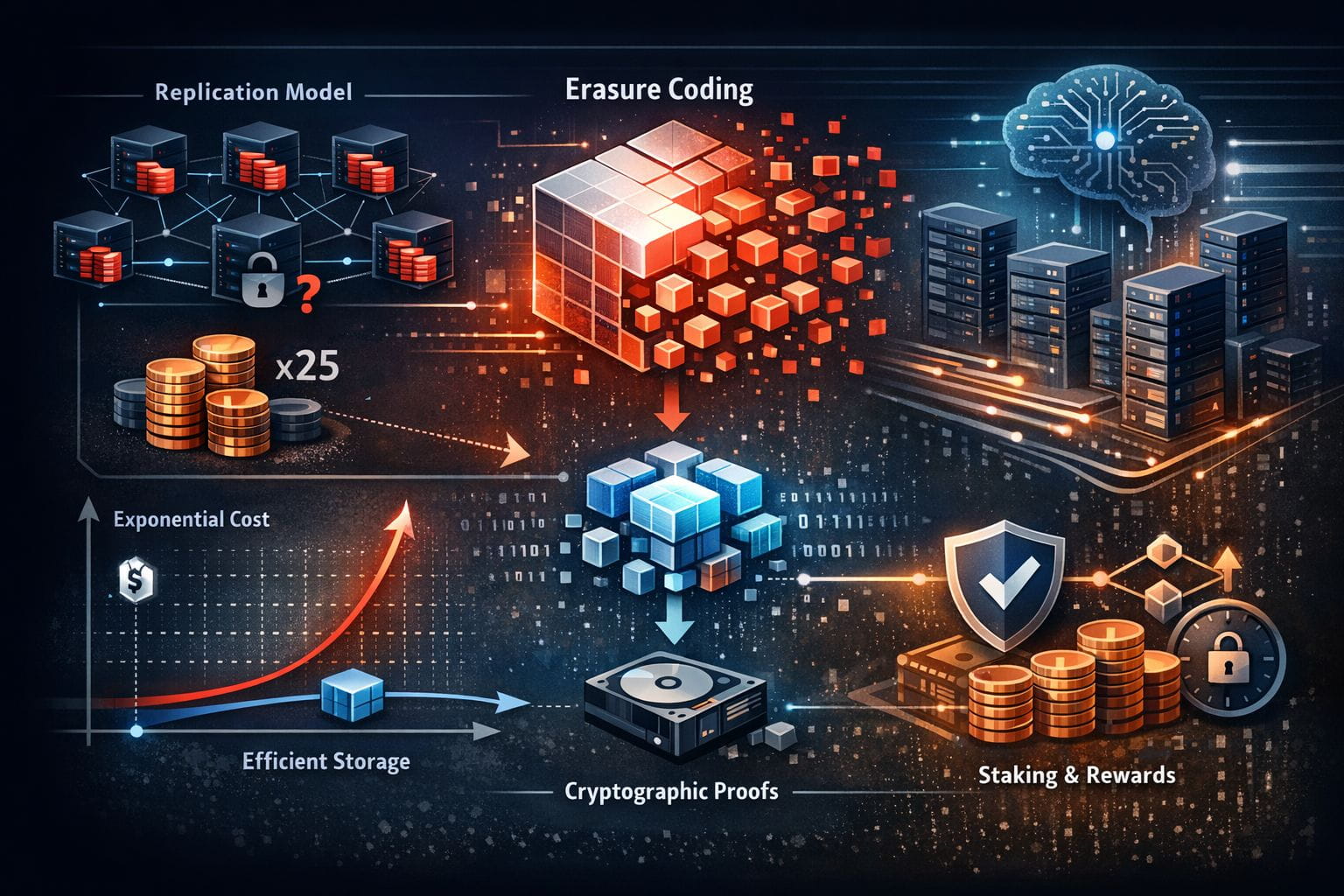
The economic and technical cracks in this model are now undeniable. The security of replication is probabilistic and, crucially, exponentially expensive. To achieve meaningful resilience against collusion or catastrophic node failure, you need a replication factor (RF) that soars into the double digits 25x is not uncommon. This means storing 1 terabyte of meaningful data requires 25 terabytes of raw, duplicated storage across the network. The cost isn’t linear; it’s a cliff. Every additional unit of real data stored imposes a crushing, multiplicative burden on the network's total resource consumption. The tokenomics of these systems become a perpetual game of subsidizing this inefficiency, inflating rewards to node operators to compensate for the staggering underlying waste. It’s a Ponzi scheme of hard drives, where long-term sustainability is perpetually mortgaged against new user adoption and token speculation.
Worse, replication creates a perverse security paradox. A node operator can claim to be storing a vast amount of data, receive rewards for it, and only actually store a tiny fraction, challenging the network to constantly "prove" the data is there. The classic answer is the storage proof, a cryptographic challenge sent at random intervals. But here’s the dirty secret most whitepapers gloss over: if a node knows the challenge is coming, it can fetch the data just in time from another source, perform the proof, and discard it again. This "challenge-response" game becomes a cat-and-mouse of timing, not a guarantee of persistent custody. The data isn’t stored; it’s stage-managed. This is the illusion of permanence. It’s security theater for the most critical layer of the Web3 stack.
Red Stuff: The Cryptography of Economic Reality
This is where Walrus stops playing the game and changes the rules entirely. Its core innovation isn’t a marketing gimmick; it’s a mathematical lens called Red Stuff Encoding. Forget replication. Walrus uses a form of erasure coding, a technique borrowed from deep-space communications where bandwidth is precious and retries are impossible. Your data blob is transformed encoded into a set of fragments with a powerful property: you only need a subset of those fragments to perfectly reconstruct the original whole. Lose some fragments? It doesn’t matter. As long as you have the minimum threshold, the data is perfectly recoverable.
The magic is in the numbers. Where replication might need a 25x overhead for robust security, Walrus’s erasure coding achieves comparable often superior fault tolerance with an effective replication factor of just 4.5x. Let that sink in. For the same economic cost, you can secure over five times more real, unique data. The capital efficiency is not a marginal improvement; it’s a different universe. This flips the entire economic model from one of wasteful redundancy to one of elegant, mathematical necessity.
But Walrus’s real masterstroke is in its asynchronous proof system. Remember the timing game that plagues replication protocols? Walrus makes it irrelevant. Its proof challenges are not periodic requests that can be anticipated and gamed. The system is designed so that a node cannot feasibly retrieve and compute the proof after receiving the challenge; the proof must be derived from data already locally stored. This isn’t a stronger lock; it’s the removal of the concept of "picking the lock" altogether. It transforms data storage from a verifiable service into a provable state. The data is there, not because a node says it is, but because the cryptographic proof is inextricably bound to its continuous, physical presence on the disk. This is the shift from "trust, but verify" to "verify, therefore trust."
WAL Tokenomics: Skin in the Game as a Protocol Parameter
Token models in crypto are often elaborate fictions, abstract point systems tenuously linked to utility. The WAL token, however, is engineered as the literal stress-bearing beam of the Walrus architecture. Its utility is not an afterthought; it is the mechanism that aligns all participants toward a single goal: network security and data integrity.
Payment for storage is the obvious, surface-level use. But the profound design is in the staking mechanics. Staking WAL is how one becomes a node operator, and the size of your stake directly influences the amount of storage load you are assigned. This creates a capital-at-risk model. Misbehave by failing proofs, going offline, or attempting to game the system and your stake is slashed. Your financial skin in the game is your credibility. But Walrus adds a critical, often-overlooked lever: the lock-up multiplier.
In most staking systems, locking your tokens longer might get you a slightly higher annual percentage yield (APY). In Walrus, the lock-up duration directly multiplies your effective stake for the purpose of reward allocation. This is a stroke of behavioral genius. It doesn’t just reward long-term thinking; it incentivizes it at a structural level. A node operator committing tokens for a year is making a different statement about their belief in the network’s future than one committing for a month. The protocol recognizes this and rewards that conviction by giving them a larger share of the storage work and, consequently, the fees. This creates a flywheel: long-term stakers get more work, earning more fees, which makes staking more attractive, which draws in more long-term capital, which further secures the network. It turns token holding from a passive speculative activity into an active, time-bound declaration of network faith.
This model also subtly defends against a silent killer of decentralized networks: mercenary capital. In other systems, liquidity can flood in during high-yield periods and vanish overnight when a better opportunity arises, destabilizing the network’s operational security. Walrus’s lock-up mechanics naturally dampen this volatility. The most secure, reliable nodes will be those with the deepest, longest-term commitments, creating a stable core for the network regardless of speculative winds. The token, therefore, becomes a clock regulating the protocol’s heartbeat.
The Sui Synergy: Not Just a Host, But an Accelerant
Choosing to build on Sui is a technical decision with massive strategic implications. Sui’s object-centric model and Move programming language are not just a different virtual machine; they represent a rethinking of on-chain state. In Sui, every asset is a distinct, owned object with defined rules for transfer and mutation. This is a perfect conceptual match for Walrus, where every data blob is a unique, immutable object that needs to be owned, permissioned, and tracked.
The synergy is operational. Sui’s parallel transaction execution means that the thousands of micro-verifications and proof submissions that the Walrus network needs to process don’t bottleneck on a single, sequential chain. They can flow through simultaneously. This allows Walrus to operate at a scale and speed that would be choked on a traditional EVM chain. Furthermore, Move’s inherent focus on safety and preventing reentrancy bugs is critical for a protocol managing slashing conditions and valuable staked assets. It’s not just about being on a chain; it’s about being of the chain, leveraging its deepest architectural principles to enable something that couldn’t exist elsewhere.
This is why the Mysten Labs connection is more than a pedigree. It’s a co-evolution. Walrus is the designed storage primitive for the Sui ecosystem’s data-heavy future, from dynamic NFTs whose metadata can evolve, to complex DeFi positions that need verifiable, on-chain audit trails, to the entire promised world of on-chain AI. It is the persistent memory for Sui’s powerful processor.
The AI Data Furnace and the New Scarcity
This brings us to the present moment and the single greatest demand driver on the horizon: Artificial Intelligence. The AI revolution is, at its core, a data crisis. High-quality, verifiable, and permissionlessly available training data is becoming the most valuable commodity on earth. Current AI models are built on mountains of scraped data of dubious provenance and licensing, a legal and ethical time bomb.
Walrus, and protocols like it, create the substrate for a new data economy. Imagine a future where a researcher can upload a curated, labeled dataset to Walrus, tokenize access to it, and allow AI models to train on it for a fee, with every access and provenance step immutably recorded on Sui. The data isn’t just stored; it becomes a productive, revenue-generating asset. The storage layer becomes the foundation for data markets. This transforms the Walrus protocol from a cost center (pay to store) into a value-enabling platform (store to earn).
In this context, Walrus’s efficiency isn’t just a nice-to-have; it’s the bottleneck breaker. The datasets required for modern AI are measured in petabytes. A replication-based system would make storing this economically insane. Walrus’s 4.5x overhead makes it merely expensive, and more importantly, viable. The tokenomics align here too: those staking WAL to secure the network aren’t just securing cat pictures and website HTML; they’re securing the feedstock of the 21st century’s defining technology. The yield they earn is, in a very real sense, a dividend on the AI economy. This is the high-impact, long-term narrative that separates a utility token from a fundamental infrastructure bet.
The Inevitable Friction: Centralization Pressures and the Oracle Problem
No analysis is complete without confronting the hard truths. Walrus’s model, for all its elegance, creates its own novel pressures. The efficiency of erasure coding comes with a computational cost at the encoding and decoding stages. This isn’t a problem for a user storing a file once and retrieving it occasionally. But for a high-frequency application constantly reading and writing, that overhead adds up. Will this push developers toward centralized caching layers on top of Walrus, recreating the very intermediaries we sought to remove? It’s a risk that must be actively architectured against, perhaps by incentivizing decentralized caching networks with their own micro-tokenomics.
Furthermore, while Walrus proves the data exists and is stored correctly, it does not, by itself, prove what that data means or that it’s the correct data. This is the oracle problem in a new guise. If a DeFi protocol stores its critical interest rate curve on Walrus, how does it know the blob it just retrieved contains the authorized, updated curve and not a maliciously uploaded, incorrect one? The integrity of the pointer (the on-chain hash) is guaranteed, but the connection between that hash and real-world meaning still requires a trusted publishing step. Walrus solves the persistence problem but nudges the trust problem one layer up the stack. This is not a flaw, but a clarification of responsibility. It tells us that perfect storage is necessary but not sufficient for a trusted system.
The Market Signal Hidden in Plain Sight
As of today, with WAL trading at a fraction of its all-time high, the market sentiment is arguably one of indifference or ignorance toward the storage sector. This is the opportunity. The capital flows are currently chasing the next gamified Ponzi or the shiniest new Layer-1. The narrative cycle hasn’t yet swung back to fundamentals and infrastructure. But the demand signals are undeniable. Look at the exponential growth in data produced by blockchain applications themselves from rollup states to NFT media to perpetual swap histories. This data has to live somewhere, and the bill for the current model is coming due.
When the cycle turns, it won’t be the loudest protocol that wins, but the most efficient, secure, and economically sustainable. Walrus, with its cryptographic rigor, its capital-efficient model, and its deep integration into a high-performance ecosystem like Sui, is positioned not as a speculative toy, but as a strategic utility. Its price action in the coming year will be a leading indicator of whether the market is maturing enough to value engineering over hype, and whether investors are starting to understand that the most profound bets aren’t on what happens on the chain, but on what enables the chain to remember anything at all.
The silent war for Web3’s spine is underway. We’ve been distracted by the flickering screens of price charts, while beneath the surface, the protocols that will determine whether any of this has a lasting legacy are being built. Walrus is a declaration in that war. It posits that the future belongs not to those who store the most copies, but to those who store the most truth with the least waste. In a world drowning in data and starving for trust, that is not just a technical specification. It is a manifesto.