
For a long time, Web3 has been living in a beautiful, albeit slightly delusional, bubble. We’ve built incredibly fast blockchains that can process thousands of transactions per second, yet we’ve ignored the elephant—or rather, the Walrus—in the room. Blockchains are excellent at "thinking" (execution) and "agreeing" (consensus), but they are historically terrible at "remembering" (storage). As we move into 2026, the industry is hitting a wall where 4K videos, massive AI training sets, and complex 3D gaming assets simply cannot fit on a traditional chain. This is the "Data Reality" that the Walrus Protocol was built to solve.
A blockchain is a ledger, not a hard drive.
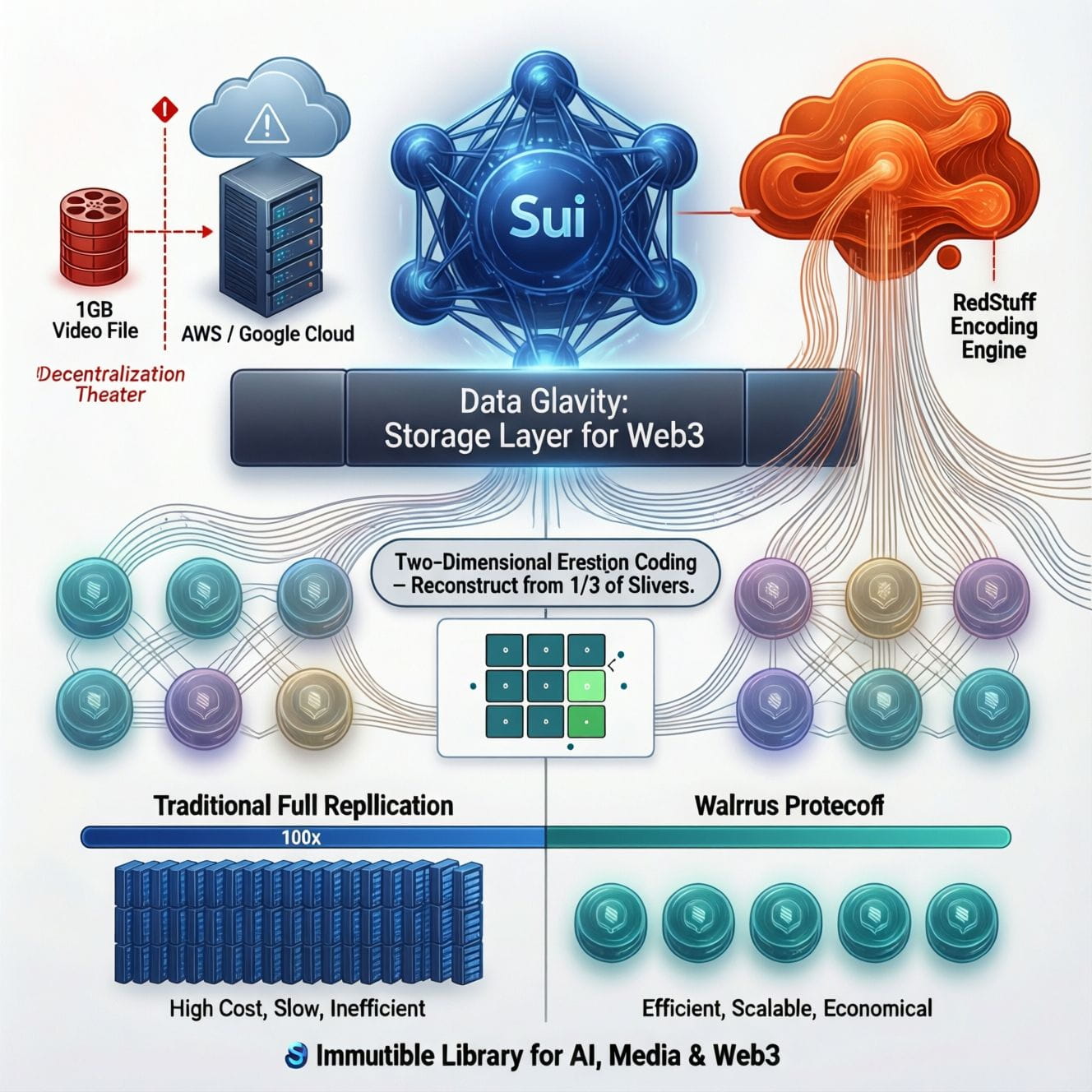
The crisis is simple: if you try to store a 1GB video file directly on a standard blockchain, the cost would be astronomical, and the network would grind to a halt. To get around this, most "decentralized" apps today cheat. They store the heavy data on centralized servers like AWS or Google Cloud while keeping a tiny link on the blockchain. This creates a "decentralization theater" where your NFT or your AI model can be deleted at any moment by a single company’s billing department. Walrus changes this by providing a way to store "blobs"—large chunks of raw data—in a way that is actually decentralized, cheap, and permanent.
The Math of Resilience: RedStuff and Slivers
At the heart of Walrus is a technical breakthrough called RedStuff encoding. Instead of following the old-school method of making ten complete copies of a file (which is slow and expensive), Walrus uses two-dimensional erasure coding. It breaks your data into tiny fragments called "slivers" and scatters them across a global network. Because of the way the math is structured, you only need about one-third of those slivers to reconstruct the entire file. Even if two-thirds of the storage nodes go dark or vanish, your data remains perfectly intact.
Efficiency is the only way to achieve true scale.
This approach allows Walrus to achieve a replication factor of only 4x or 5x, compared to the 100x or more required by traditional full-replication blockchains. This isn't just a technical flex; it’s an economic one. By slashing the overhead, Walrus can offer storage prices that finally compete with centralized cloud giants while maintaining the "can’t be censored, can’t be deleted" spirit of Web3. It’s the first time we’ve seen a storage layer that can handle the "heavy lifting" of the internet without breaking the bank.
Fueling the AI and Media Explosion
The timing couldn't be more critical. In 2026, the explosion of AI agents and high-fidelity media has created an insatiable demand for "Proof of Availability." If an AI model makes a decision, we need to be able to see the data it was trained on to ensure it wasn't biased or tampered with. If a creator launches a decentralized film, they need to know the video won't disappear if a hosting provider changes its terms. Walrus provides the "immutable library" for these new digital economies, anchored directly to the high-speed Sui blockchain for coordination.
Data is the new oil, but only if you have a safe place to keep it.
Because Walrus is integrated with Sui’s object-centric model, storage becomes "programmable." A developer can write a smart contract that automatically deletes a temporary log file after a month or extends the life of a precious digital artwork for a century. This turns storage from a static bucket into a dynamic tool. It allows Web3 to finally grow up and move past simple token swaps and into the world of rich, data-heavy applications that real people actually use every day.
The End of Decentralization Theater
The "Data Reality" is that we can no longer afford to pretend that a blockchain link is the same thing as decentralized ownership. Walrus Protocol provides the missing infrastructure layer that allows us to build an internet that is truly owned by its users—from the code that runs to the very last byte of data.
The future of Web3 isn't just about moving fast; it's about staying put.