


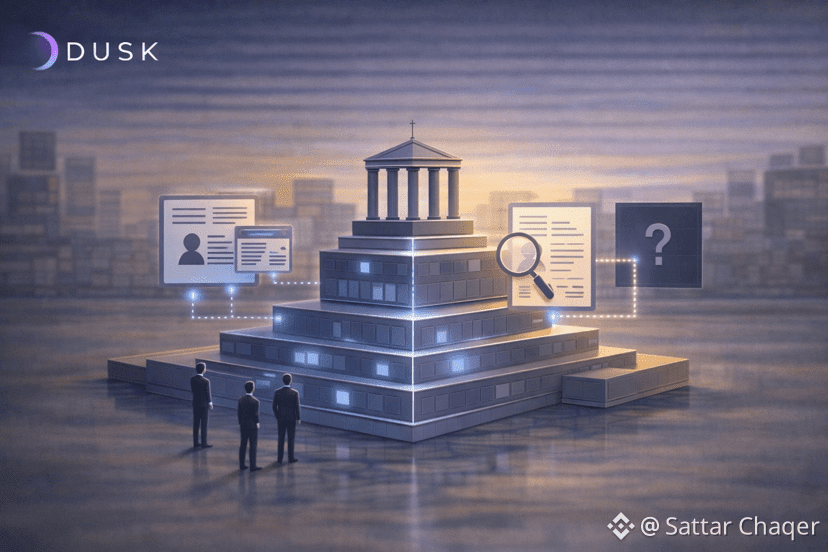
In most blockchain systems, disclosure is treated as a user-level preference. You choose what to reveal, when to reveal it, and to whom. Privacy becomes a feature that individuals toggle, negotiate, or work around.
That framing works for consumer applications. It fails in markets.
Dusk starts from a different assumption: disclosure is not a personal decision. It is a system decision.
In regulated finance, disclosure is governed by rules, roles, and timing. Market participants do not decide arbitrarily what to reveal. Disclosure is structured. Auditors see one view. Regulators see another. Counterparties see what is necessary to transact. The public sees very little. This is not a cultural choice; it is how markets remain functional.
Dusk reflects this structure at the protocol level.
Rather than asking users to manage privacy themselves, Dusk encodes disclosure rules into the network. Information is private by default, but not inaccessible. Proofs replace raw data. Obligations can be verified without broadcasting sensitive details. Oversight exists without continuous exposure.
This distinction is subtle, but it changes how the system behaves under pressure.
Most public blockchains treat transparency as a default condition. Every transaction is visible. Every balance is traceable. Compliance, when required, is layered on top through contracts, permissions, or off-chain processes. As long as activity remains experimental, this approach can work.
Problems emerge when assets carry legal responsibility.
Securities, funds, and regulated instruments cannot operate in environments where disclosure is uncontrolled. Strategy leaks distort markets. Visibility enables front-running. Public audit trails expose positions that were never meant to be public. In these conditions, participants either withdraw or avoid on-chain infrastructure entirely.
Dusk assumes this outcome in advance.
By treating disclosure as a system property rather than a user option, Dusk avoids forcing market participants to choose between privacy and compliance. The network itself defines what can be proven, to whom, and under which conditions. This reduces reliance on trust, interpretation, and manual enforcement.
It also reduces fragility.
When disclosure logic lives at the application layer, it must be maintained indefinitely. As protocols evolve, integrations change, and regulatory expectations shift, those controls become brittle. Small misconfigurations can have large consequences. Regulators understand this risk, and institutions feel it immediately.
Dusk embeds disclosure rules directly into its design. This makes the system less permissive, but more predictable. Predictability is essential when transactions create obligations that extend beyond the network.
This approach also explains why Dusk often feels different from retail-oriented blockchains.
Retail systems optimize for flexibility. Users are free to experiment, compose, and iterate rapidly. Regulated systems optimize for consistency. Behavior today should match behavior tomorrow. Changes require justification. Outcomes must be explainable after the fact.
Dusk aligns with the second environment.
Privacy, in this context, is not about concealment. It is about controlled revelation. Information exists, but it is not broadcast. Proofs exist, but they are contextual. Oversight is possible without turning markets into open ledgers of strategy and exposure.
This is why Dusk does not frame privacy as a political stance. It frames it as infrastructure.
Infrastructure does not ask users to decide how the system should behave under scrutiny. It defines that behavior in advance. When questions arise, the system already has answers.
Many blockchain projects assume that markets will adapt to new transparency norms. Dusk assumes the opposite. Markets have spent decades refining how information is disclosed, when it is disclosed, and to whom. Technology that ignores this history does not replace it; it collides with it.
Dusk avoids that collision by designing around it.
This choice limits certain forms of experimentation. It slows some forms of development. It reduces narrative appeal during speculative phases. But it increases the likelihood that the system remains usable when assets, institutions, and regulators are involved.
Disclosure is where most on-chain finance breaks down. Not because information cannot be hidden, but because it cannot be revealed correctly.
Dusk treats that problem as foundational.
By making disclosure a system decision rather than a user preference, Dusk positions itself as infrastructure that can support markets as they actually function, not as they are imagined in whitepapers.
If regulated finance continues moving on-chain, the systems that last will be the ones that understood this early.
Dusk was built with that understanding in place.
