

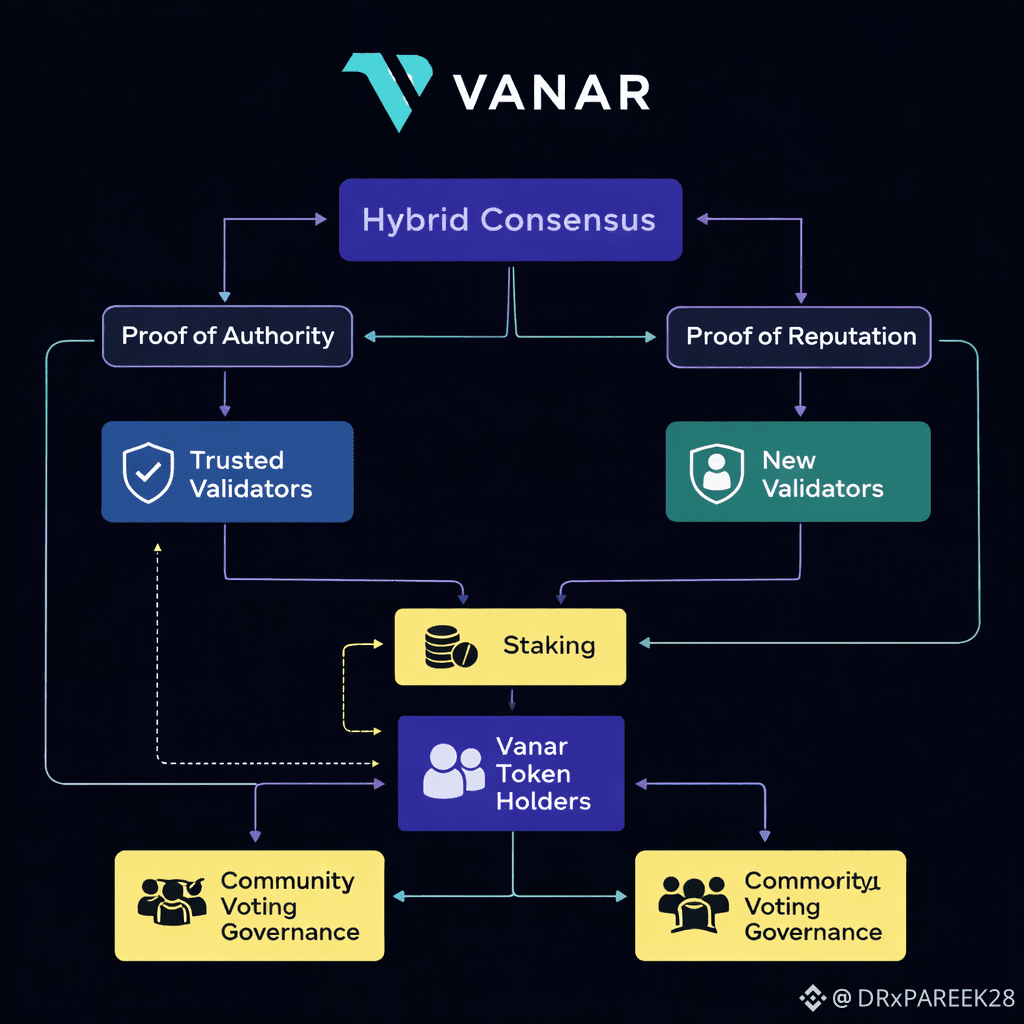
Vanar is positioning itself as a next-generation blockchain that blends performance, governance, and community participation into a single cohesive ecosystem. At the heart of its design is a hybrid consensus architecture that doesn’t rely on just one philosophy of trust, but instead combines structured authority with community-driven reputation. This layered approach reflects a broader vision: building a network that is both secure in its early stages and progressively decentralized as the ecosystem matures.
The foundation of the network’s security begins with a Proof of Authority model. In this structure, a known and trusted set of validators is responsible for producing blocks and maintaining network integrity. This allows the chain to achieve high throughput, predictable performance, and low latency — critical features for applications that demand real-time responsiveness such as gaming, digital identity, AI integrations, and immersive metaverse experiences. By ensuring that validators are accountable entities, the network can reduce the risks often associated with anonymous validator sets in early-stage chains.
However, Vanar does not stop at authority. It extends its consensus with a Proof of Reputation layer that introduces a powerful social and community dimension. Instead of limiting validation power to a closed group indefinitely, the network creates a pathway for new participants to earn their role. Reputation is not bought instantly; it is built through consistent, meaningful contributions to the ecosystem. This can include technical involvement, governance participation, ecosystem support, and alignment with the long-term goals of the network. Over time, this reputation becomes a measurable signal of trustworthiness.
This reputation-based mechanism transforms validator selection into a more democratic process. Community participation plays a direct role in deciding who gets to help secure the network. Rather than relying purely on capital or hardware, Vanar adds a social trust layer that reflects real engagement. This approach encourages long-term commitment instead of short-term speculation. Validators are not just infrastructure providers; they are recognized community stakeholders whose standing is tied to their behavior and contributions.
Governance is where this design truly shines. The integration of community voting into validator onboarding and network decisions strengthens decentralization in a practical way. Token holders are not passive observers; they actively shape the validator set and, by extension, the future direction of the chain. This governance structure creates a feedback loop where responsible behavior is rewarded with influence, and influence comes with responsibility. It aligns incentives between the network’s technical backbone and its user base.
Staking plays a central role in this ecosystem. Participants stake the network’s native token into dedicated contracts to gain voting rights and other benefits. This staking process is more than a financial mechanism; it represents a commitment to the health and longevity of the network. By locking value into the system, community members signal their belief in the project’s future while gaining the power to influence governance outcomes. This dynamic deepens engagement and helps create a resilient economic layer around the protocol.
The combination of authority, reputation, and staking forms a multi-dimensional trust model. Authority ensures operational efficiency and stability. Reputation introduces merit and community accountability. Staking adds economic alignment. Together, these elements produce a network that is not only technically robust but also socially sustainable. It reduces the risk of centralization over time while avoiding the instability that can come from premature full decentralization.
From an ecosystem perspective, this structure is particularly attractive for builders and enterprises. Developers gain a high-performance environment backed by predictable infrastructure, while also benefiting from a governance system that evolves toward broader decentralization. Brands and large-scale applications can build with confidence knowing that network security is professionally maintained, yet community voices still matter.
In the long term, Vanar’s approach represents a bridge between traditional trust models and fully decentralized networks. It acknowledges that strong foundations are necessary in the early stages, but it also embeds mechanisms that gradually distribute influence outward. By combining structured validation with reputation-driven participation and token-based governance, Vanar is crafting a blockchain ecosystem designed for durability, fairness, and meaningful community ownership.
